

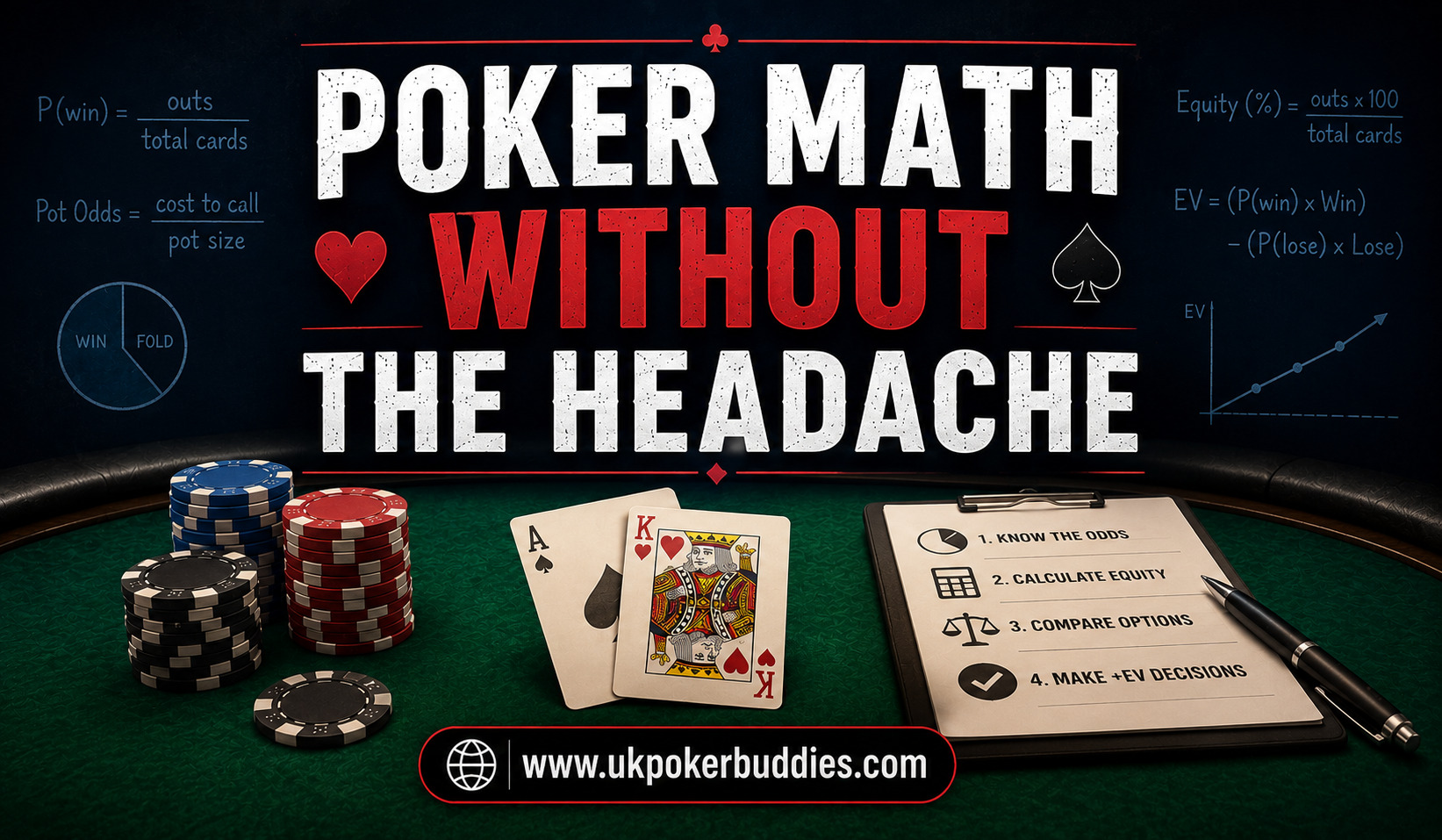
A Beginner-Friendly Guide to the Numbers Behind the Game
Poker is often described as a game of psychology, strategy and reading opponents, but mathematics quietly influences almost every decision at the table. From calculating the chance of completing a draw to deciding whether a call is worth the price, players regularly make mathematical judgments, even when they are not consciously working through complicated equations.
For beginners, the word “math” can make poker seem more difficult than it really is. In reality, players do not need advanced mathematics to understand the fundamentals. A handful of simple concepts—including outs, pot odds, equity and expected value—can make poker decisions much easier to understand.
The goal is not to turn every poker hand into a classroom exercise. Instead, basic poker math provides a framework for making more informed decisions when the outcome is uncertain.
Why Mathematics Matters in Poker
Every poker decision involves uncertainty. A player rarely knows exactly what an opponent is holding, which card will arrive next or how the hand will eventually finish. Mathematics helps players estimate these unknowns.
Imagine holding four cards toward a flush after the flop. You know there are still cards left in the deck that could complete your draw. The question is not simply whether you might hit the flush. The more useful question is how likely you are to hit it and whether the amount you must pay to continue is justified.
This distinction separates mathematical thinking from guesswork.
Poker math also helps explain why a player can make a good decision and still lose a hand. A favorable probability does not guarantee a favorable result every time. Instead, it improves the chances of making money over many similar situations.
Understanding Outs
One of the easiest mathematical concepts for a poker beginner is the idea of an “out.” An out is a card that is expected to improve a player’s hand to a potentially winning combination.
For example, suppose a player has four cards toward a flush after the flop. There are typically nine remaining cards of that suit that could complete the flush, assuming none of those cards are already visible elsewhere.
Those nine cards are the player’s potential outs.
The challenge is that not every appearance is necessarily clean. A card that improves your hand may also improve an opponent’s hand even more. Therefore, experienced players distinguish between obvious outs and cards that are genuinely likely to produce the winning hand.
Common drawing situations include:
- Flush draw: Often has nine potential suit-completing cards after the flop.
- Open-ended straight draw: Usually has eight cards that can complete the straight.
- Gutshot straight draw: Usually has four cards that complete the straight.
- Pair improvement: Additional cards may improve a pair to trips or two pair.
Knowing the approximate number of outs gives players a starting point for estimating their chances.
The Rule of 2 and 4
Players at live tables do not always have time to perform detailed calculations. One popular shortcut is the Rule of 2 and 4.
The basic idea is simple. When you have a drawing hand and expect to see one more card, multiply your outs by approximately two to estimate the percentage chance of hitting on the next card.
When you expect to see two more cards, such as from the flop through the river, multiply the number of outs by approximately four.
For example, with nine outs after the flop, multiplying nine by four gives roughly 36%. This is an approximation rather than an exact calculation, but it can be useful for quick decisions.
The shortcut becomes less accurate in certain situations, particularly when an opponent’s cards or future betting decisions affect the situation. Still, it provides beginners with an intuitive way to think about probability without requiring a calculator.
Pot Odds Explained Simply
Pot odds sound more complicated than they are. Essentially, they compare the amount you need to call with the amount you could potentially win.
Suppose the pot contains ₹1,000 and your opponent bets ₹500. You need to call ₹500 to continue. If you win, the total pot after your call would be ₹2,000.
Your call costs ₹500 for a chance to compete for ₹2,000, meaning you need approximately 25% equity for the call to break even in a simplified situation.
| Situation | Amount |
| Pot before opponent’s bet | ₹1,000 |
| Opponent’s bet | ₹500 |
| Your call | ₹500 |
| Final pot if you call | ₹2,000 |
| Approximate break-even equity | 25% |
The important point is that pot odds give a player a minimum winning probability needed to justify a call based purely on the immediate numbers.
In real poker, the calculation can become more complicated because future betting, implied odds and the possibility of losing additional chips can affect the decision.
Equity: Your Share of the Pot
Equity refers to your estimated chance of winning the pot at a particular point in the hand.
If you have 60% equity against an opponent’s possible range, you can think of yourself as having approximately a 60% share of the pot’s value over the long run.
Equity is different from certainty. Having 60% equity does not mean you will win 60% of the individual hands. You could lose several hands in succession despite having the mathematical advantage.
This is one of the most important ideas for new poker players to understand. Short-term results can be heavily influenced by luck, while mathematical advantages become more meaningful across a large number of hands.
Expected Value and Better Decisions
Expected value, commonly shortened to EV, is another central concept in poker mathematics. It estimates how profitable a decision is over the long term.
A positive-EV decision is expected to make money over repeated situations. A negative-EV decision is expected to lose money over time.
This does not mean every positive-EV decision produces an immediate profit. Poker results are influenced by variance, meaning short-term outcomes can move dramatically away from the mathematical expectation.
Consider a simplified example. If you have a 60% chance of winning a ₹1,000 pot and the cost of continuing is small enough to justify that probability, the decision may have positive expected value. You could still lose the particular hand, but the decision can remain mathematically sound.
Players often use poker math to evaluate:
- Whether calling a bet is profitable.
- Whether a drawing hand has enough equity.
- Whether a bluff has a reasonable chance of succeeding.
- Whether the potential reward justifies the risk.
This approach shifts attention away from individual results and toward decision quality.
Bluffing Has Mathematics Too
Bluffing may appear to be purely psychological, but mathematics plays an important role here as well.
Suppose a player makes a large river bet representing a strong hand. The opponent must decide whether to call or fold. The profitability of the bluff depends partly on how often the opponent folds.
A simplified example can illustrate the idea. If a player bets ₹1,000 into a ₹2,000 pot, the bluff risks ₹1,000 to win the existing ₹2,000. Ignoring other considerations, the bluff needs to succeed often enough to compensate for the times it gets called.
This is known as the required fold frequency.
The exact calculation depends on the pot and bet size, but the underlying principle is straightforward: the bigger the potential reward compared with the cost of the bluff, the less frequently the bluff needs to work to become profitable.
Why Position Changes the Math
Poker mathematics does not exist separately from strategy. Position can change the value of a hand because players acting later have more information.
A player on the button can observe what several opponents do before making a decision. A player in an early position has less information and may face action from many players afterward.
This affects the practical value of starting hands, drawing hands and bluffs.
For example, a marginal hand might be playable in a late position when several opponents have already folded but less attractive from an early position. The cards themselves have not changed, but the surrounding mathematical and strategic circumstances have.
Implied Odds: Looking Beyond the Current Pot
Pot odds consider the money available right now. Implied odds take potential future winnings into account.
Imagine a player has a drawing hand and receives attractive immediate pot odds. If the draw succeeds, there may also be an opportunity to win additional chips on later betting streets.
That potential future profit can make a call more attractive than the immediate pot odds alone suggest.
However, implied odds should not be treated as guaranteed money. The opponent may fold when the draw completes, or the completed hand may still lose to a stronger combination.
Important poker math concepts to learn first
- Outs: Cards that can improve your hand.
- Equity: Your estimated share of the pot.
- Pot odds: The price of calling compared with the potential pot.
- Expected value: The long-term profitability of a decision.
Learning these four concepts provides a strong foundation without overwhelming a beginner with advanced formulas.
Variance: Why Good Decisions Can Still Lose
One of the biggest misunderstandings about poker mathematics involves variance. A mathematically correct decision does not guarantee an immediate positive result.
Suppose a player has a 70% chance of winning a particular situation. There is still a 30% chance of losing. Over one hand, that losing outcome can happen. Over hundreds or thousands of similar situations, the results should move closer to the expected probability, although they will never become perfectly predictable.
Understanding variance can help players avoid changing a good strategy simply because a few hands went badly.
Poker mathematics is therefore about managing uncertainty rather than eliminating it.
Conclusion
Poker mathematics does not have to be intimidating. The most useful concepts are surprisingly practical: count your outs, understand your approximate equity, compare pot odds with your chances of winning, and think about whether decisions have positive expected value.
The numbers will never predict exactly what happens on the next card. Instead, they provide a way to make better decisions when the outcome is uncertain. That is the real purpose of poker math.
For beginners, learning these fundamentals gradually can transform poker from a game of guesses into a game where probability, strategy and judgment work together. You do not need to become a mathematician to understand poker—you simply need to become comfortable with the numbers that appear naturally in the game.
Frequently Asked Questions
Do I need advanced mathematics to play poker?
No. Basic arithmetic, percentages and probability concepts are enough to understand the most useful poker mathematics.
What is an out in poker?
An out is a card that can improve your hand to a combination that is likely to win. Players should remember that some apparent outs may not be completely reliable.
What are pot odds?
Pot odds compare the cost of calling with the size of the pot you could potentially win. They help players determine whether a call has enough potential value.
Is the Rule of 2 and 4 exact?
No. It is a quick approximation used to estimate drawing probabilities. Exact probabilities require more detailed calculations.
What does EV mean in poker?
EV stands for expected value. It estimates how profitable a particular decision should be over many similar situations.