

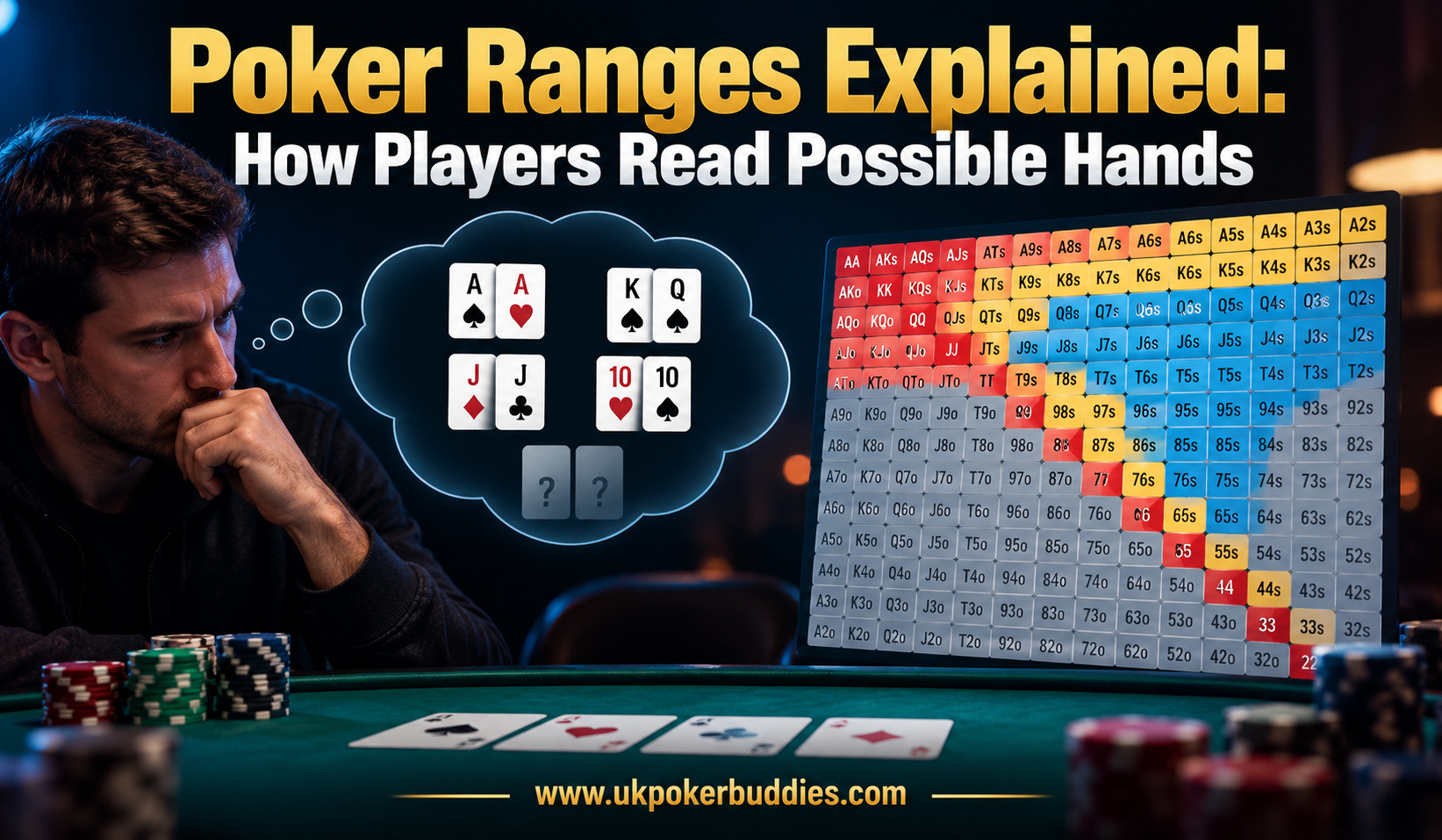
Poker is often described as a game of cards, but experienced players know that it is really a game of decisions and probabilities. You rarely know exactly what cards an opponent holds. Instead, you try to determine which hands they could reasonably have based on their actions, position, and betting patterns. This is where poker ranges become important.
A poker range is a collection of hands a player could have in a particular situation. Rather than trying to guess one exact hand, players use ranges to evaluate multiple possibilities and make better decisions.
Understanding ranges can make poker strategy easier to understand because it changes the way you think about opponents. Instead of asking, “Does my opponent have a strong hand?” you begin asking, “Which hands are realistically possible given everything that has happened?”
What Is a Poker Range?
A poker range is simply the group of possible hands a player might hold.
For example, imagine an opponent raises before the flop. You cannot see their cards, but you can make an educated estimate of the hands they might raise with. Their range could include strong pocket pairs, medium pairs, suited combinations, and certain high-card hands.
The exact range depends on the player and the situation.
A cautious player may raise with a relatively narrow range, while an aggressive player may raise with many more combinations. Position also matters. A player opening from early position may generally use a tighter range than someone opening from the button.
This is why ranges are not fixed lists. They change according to circumstances.
Why Poker Players Use Ranges
Trying to put an opponent on one exact hand can lead to poor decisions.
Suppose an opponent makes a large bet on the river. You might immediately think they have a very strong hand. But several hands could produce the same betting action. Some may be strong value hands, while others could be bluffs.
Thinking in ranges allows you to consider the entire group of possible hands.
This approach is particularly useful because poker decisions are based on incomplete information. You are making decisions using probabilities rather than certainty.
Instead of saying, “My opponent definitely has a flush,” you might think, “A flush is one part of the hands they could have, but their range may also contain sets, two pair, missed draws, or bluffs.”
That mindset leads to more balanced decisions.
How Starting-Hand Ranges Work
Starting-hand ranges describe the hands a player is likely to play before the flop.
These ranges are often represented using a poker hand matrix, sometimes called a range chart. The chart contains all possible combinations of two starting cards and helps players visualize which hands belong in a particular range.
A tight opening range might contain premium pairs, strong aces, and selected high-value combinations.
A wider range could include smaller pairs, suited connectors, suited aces, and more playable combinations.
The important point is that a range represents possibilities rather than guarantees. If a player has a particular range, it does not mean they will have every hand in that range equally often.
Position Changes a Player’s Range
Position is one of the biggest factors affecting poker ranges.
A player acting from early position has several opponents behind them who can still call or raise. Because of this, opening with weak hands can create difficult situations.
A player on the button faces fewer players after them and will usually have a positional advantage after the flop. This can allow them to open with a much wider range.
For example, a hand that may be folded from early position could become a reasonable opening candidate on the button.
Therefore, when analyzing an opponent’s range, always consider where they are sitting.
A raise from early position and a raise from the button should not automatically be interpreted as representing the same range.
How Betting Actions Narrow Ranges
One of the most useful aspects of range analysis is that ranges can change as the hand develops.
Imagine a player raises before the flop and you call. The flop then appears, and your opponent checks.
That check provides information, although it does not reveal their exact cards. Some strong hands may still be present, while other hands may become less likely depending on the player’s tendencies and the board.
If the opponent then calls a bet, their range changes again.
The same process continues on the turn and river.
This is known as range narrowing. With every action, you can eliminate some hands that become less likely and give greater weight to hands that still make sense.
Reading Ranges From Player Behavior
Range analysis is not only about mathematics. It also involves observing how opponents play.
Some players are naturally aggressive and open many hands. Others are conservative and enter pots only with stronger holdings.
If an opponent frequently raises before the flop, their range may be wider than that of a player who rarely raises.
Similarly, if a normally cautious player suddenly makes a large river bet, that action may carry more weight because it does not match their usual behavior.
However, you should avoid making decisions based on a single observation. Reliable range analysis comes from identifying repeated patterns.
Board Texture and Poker Ranges
The community cards also influence how you evaluate a range.
Consider a flop containing three cards of the same suit. Certain flush possibilities immediately become relevant. On a connected board, straight draws and two-pair combinations may become more important.
The board can therefore make some hands more plausible while making others less likely.
Good players compare the board with the opponent’s pre-flop range and then ask which hands from that range interact naturally with the cards on the table.
This is more effective than simply looking at your own two cards.
Value Hands and Bluffing Ranges
When analyzing an opponent’s range, players generally divide possible hands into broad categories such as value hands and bluffs.
Value hands are strong enough to bet because they expect to be ahead when called.
Bluffs are weaker hands that are being used to try to make the opponent fold.
A player’s betting range can contain both.
For example, if an opponent makes a large river bet, you can consider which strong hands they might value-bet and which missed draws or weaker hands they could potentially turn into bluffs.
The relationship between value hands and bluffs is important when deciding whether calling is profitable.
What Does a Polarized Range Mean?
A polarized range contains very strong hands and bluffs, with fewer medium-strength hands.
This situation often appears on later streets when a player makes a large bet.
For example, an opponent might represent a strong made hand while also including missed draws as bluffs. The medium-strength hands may choose to check instead because they do not want to risk a large amount of chips.
Recognizing polarized ranges can help you understand why certain large bets are made and how your own hand performs against the opponent’s likely holdings.
Common Mistakes When Using Poker Ranges
One of the biggest mistakes beginners make is assuming an opponent’s range is too narrow.
A player might think, “They raised, so they must have a premium pair.” In reality, the player’s position and style may indicate a much wider range.
Another mistake is failing to update a range as the hand develops. A range estimated before the flop should not remain unchanged after several betting actions.
Players also sometimes focus too much on what they believe an opponent should do instead of what that opponent actually does.
Good range analysis combines theoretical knowledge with real observations.
How to Practice Range Analysis
The best way to improve your understanding of poker ranges is to practice thinking in possibilities rather than exact hands.
After each significant action, ask yourself:
What hands would make sense here?
Which hands have become less likely?
Which strong hands could still be present?
What possible bluffs does the opponent have?
How does the board affect their range?
You can also review hands after playing and reconstruct the range you believed your opponent had at different points. Then compare your assumptions with the showdown result.
The goal is not to guess the exact cards every time. The goal is to make better decisions against a realistic group of possible hands.
Final Thoughts
Poker ranges provide a framework for understanding what opponents could realistically hold. Instead of trying to guess one exact hand, players evaluate groups of possibilities based on position, betting actions, player tendencies, and the community cards.
Range analysis becomes more powerful as a hand progresses because each action provides additional information. A pre-flop raise creates an initial range, while calls, bets, checks, and raises can gradually narrow or reshape it.
Learning to think in ranges can make your poker decisions more logical and less dependent on guesswork. You may not always know what your opponent holds, but you can estimate what they are likely to have—and that is often enough to make a smarter decision.