

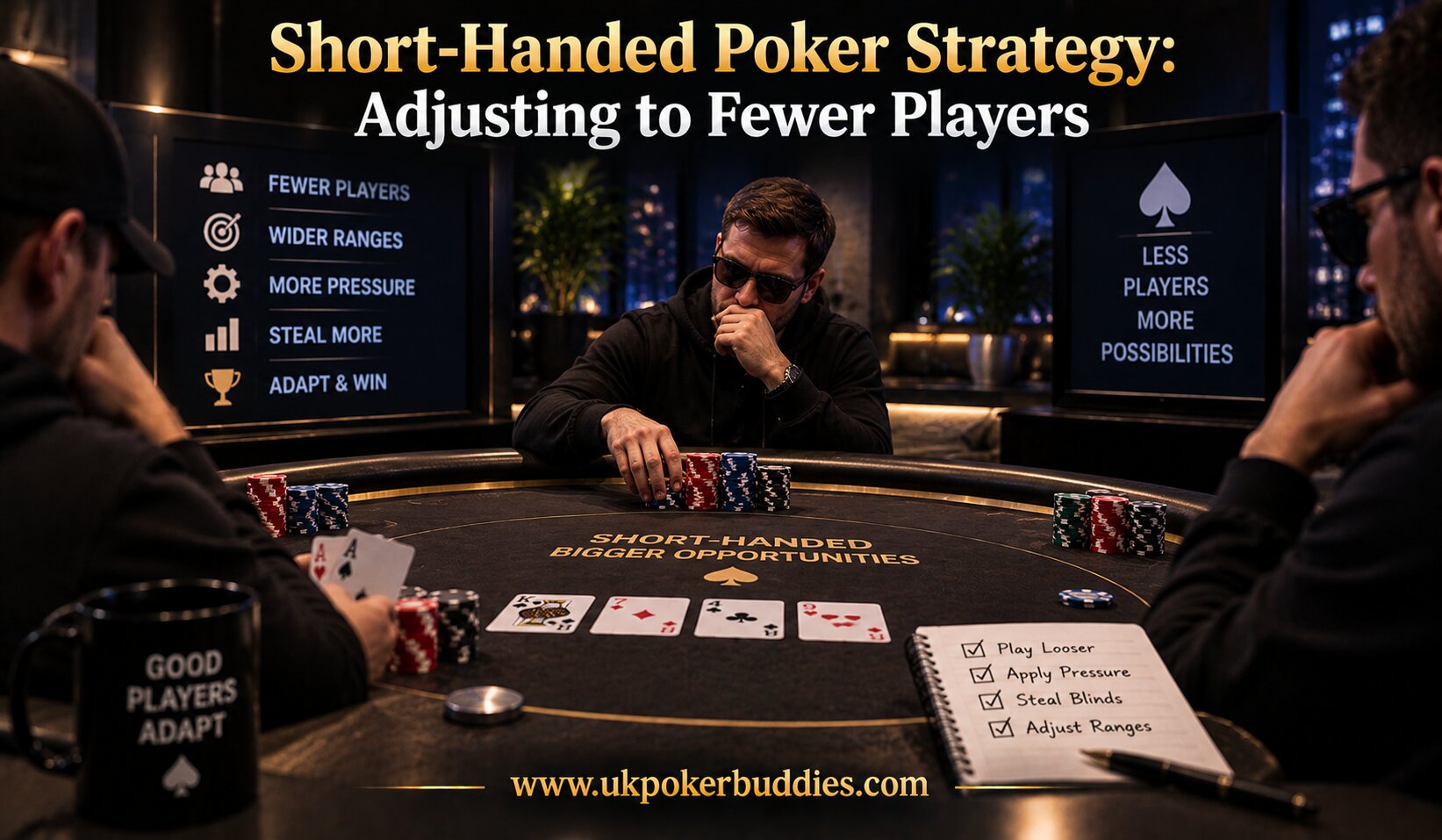
Poker strategy changes significantly when fewer players are sitting at the table. A hand that may be considered marginal at a full table can become a strong opening hand when only four, five, or six players remain.
This is the basic idea behind short-handed poker strategy. With fewer opponents, players have to participate in more pots, open wider ranges, and place greater importance on position and aggression.
Short-handed poker is common in tournaments, cash games, and situations where players have been eliminated or left the table. Learning how to adjust can help you avoid one of the biggest mistakes players make: using full-ring strategy when the table has become much shorter.
What Is Short-Handed Poker?
Short-handed poker generally refers to a table with fewer players than a full-ring game.
A six-handed table is one of the most common short-handed formats. Games with four or five players can be even more aggressive because each player has to act more frequently.
The fewer players there are, the more often you will receive playable hands and be involved in the action.
This changes the value of position, starting hands, blinds, and aggression.
Why Short-Handed Poker Is Different
At a full table, several players act before you. There is a greater chance that someone has a strong starting hand.
At a short-handed table, there are fewer players who can hold premium cards.
As a result, the average strength of the hands being played tends to decrease.
This means players can usually open more hands than they would at a full-ring table.
However, wider ranges do not mean playing every hand.
Short-handed poker still requires discipline and careful decision-making.
Starting-Hand Ranges Become Wider
One of the most important adjustments is opening more hands.
Imagine you are playing a nine-handed game. A hand such as K-9 suited may be difficult to open from an early position because several players remain behind you.
At a six-handed table, there are fewer players left to act.
The same hand can become a more reasonable opening candidate depending on position and opponent tendencies.
This does not mean every weak hand suddenly becomes profitable. Instead, the reduced number of opponents changes the probability that someone has a very strong hand.
Position Becomes Even More Important
Position is always important in poker, but it can become particularly valuable in short-handed games.
With fewer players, you will frequently find yourself in late position or the blinds.
Acting later allows you to see what opponents do before making your own decision.
If everyone folds to you on the button, for example, you can often consider raising a wider range than you would from an early position at a full table.
The fewer opponents remaining behind you, the more attractive stealing opportunities can become.
Aggression Is More Valuable
Short-handed poker generally rewards active play.
Because there are fewer players, simply waiting for premium hands can cause you to surrender too many blinds and opportunities.
Aggressive players can take advantage of this by raising when opponents show weakness.
This does not mean raising randomly.
Effective aggression still depends on position, hand strength, stack sizes, board texture, and opponent tendencies.
The goal is to put pressure on opponents while maintaining a range that can withstand resistance.
Blind Stealing Becomes Important
When you are playing short-handed, you reach the button and other late positions more frequently.
That creates more opportunities to attack the blinds.
Suppose you are on the button and both players before you fold.
You only need to deal with the small blind and big blind.
A well-timed raise can therefore win the blinds without seeing a flop.
These small pots can become important over time, particularly when blinds are large relative to the stacks.
Defending the Blinds
The same principle works in reverse.
If you are sitting in the big blind, opponents may attempt to raise more frequently because they know your range is being forced to defend a wide area of hands.
You therefore need to avoid automatically folding to every late-position raise.
Some hands can be defended through calling or raising, depending on the situation.
The correct response depends on the raise size, your opponent’s tendencies, your stack size, and your position after the flop.
Post-Flop Play Changes
Short-handed poker also changes how players approach the flop.
Because ranges are generally wider, opponents can arrive at the flop with more combinations of weaker hands.
This can increase the value of continuation betting and well-timed bluffs.
At the same time, wider ranges also mean players can connect with a greater variety of board textures.
You should therefore avoid assuming that an opponent has only premium hands.
Reading the board together with the opponent’s pre-flop actions becomes especially important.
Top Pair Can Become More Valuable
Relative hand strength matters enormously in short-handed poker.
At a full table, top pair with a weak kicker can sometimes be vulnerable against multiple opponents.
In a heads-up or short-handed pot, however, top pair may be much stronger relative to the opponent’s likely range.
This can create opportunities for value betting.
Still, top pair is not automatically a hand that should be played for stacks.
Board texture, kicker strength, betting action, and opponent tendencies all matter.
Bluffing in Short-Handed Games
Bluffing can become more effective because there are fewer opponents to convince.
In a heads-up pot, you only need one player to fold.
In a multiway pot, convincing several players to fold is much more difficult.
Short-handed games therefore create more natural opportunities for aggression.
However, successful bluffs should still tell a believable story.
Consider whether the board favors your range, whether your opponent has shown weakness, and whether your bet size creates enough pressure.
Random bluffing simply because the table is short can become expensive.
Bet Sizing Matters
Short-handed poker does not require completely different bet sizes, but your sizing should reflect the situation.
Pre-flop raises may become more frequent, while post-flop bets can be adjusted according to board texture and range advantage.
Large bets can create pressure but also expose you to greater risk.
Smaller bets may allow you to bet frequently while risking fewer chips.
The right size depends on the specific hand and strategy rather than simply the number of players at the table.
Short-Handed Poker and Stack Sizes
Stack depth becomes extremely important.
A player with 50 big blinds has considerably more room for post-flop decisions than someone with 10 big blinds.
Short-handed games can become particularly aggressive when stacks are shallow.
Players may use more all-in strategies because calling or raising can commit a significant percentage of their stack.
Before entering a pot, consider not only your cards but also how many big blinds you and your opponents have behind.
Heads-Up Is a Different Level
Short-handed poker should not be confused with heads-up poker.
A six-handed game and a two-player game require different strategies.
As the number of opponents decreases, starting ranges generally become wider.
In heads-up play, players may be involved in a very large percentage of hands because there are only two possible players.
This makes hand reading, position, aggression, and adaptation extremely important.
Adjusting to Opponents
Not every short-handed table should be played in exactly the same way.
If your opponents are extremely aggressive, constantly trying to out-aggress them may not be the best approach.
You may instead allow them to make mistakes and look for opportunities to trap or call with stronger ranges.
Against players who fold too often, increasing your stealing and bluffing frequency can be effective.
The best short-handed strategy is therefore based on both the table structure and the people sitting at it.
Common Short-Handed Poker Mistakes
One common mistake is playing too tightly.
A player accustomed to full-ring poker may continue folding hands that are perfectly playable in a six-handed game.
Another mistake is becoming excessively aggressive.
Short-handed poker encourages wider ranges, but that does not mean every hand should be raised.
Players can also forget how quickly the blinds accumulate.
Because you receive the blinds more frequently, passive play can become costly.
How to Improve Your Short-Handed Strategy
Start by paying attention to how often you are entering pots.
Compare your decisions at a six-handed table with the decisions you would make at a full-ring table.
Then consider whether your opening ranges are too tight or too loose.
Pay particular attention to the button and blinds.
These positions create many of the most important decisions in short-handed poker.
It is also useful to review hands after playing. Look for situations where you folded automatically simply because a hand felt weak, even though the table structure made it more playable.
Final Thoughts
Short-handed poker strategy is built around adaptation.
With fewer players at the table, starting-hand ranges generally become wider, blinds become more important, position gains value, and aggression can create more opportunities.
However, playing short-handed does not mean abandoning discipline. Every decision still depends on factors such as position, stack size, board texture, opponent tendencies, and betting patterns.
The biggest adjustment is understanding that the strength of a poker hand is relative to the situation. A hand that looks weak at a full table may become profitable when fewer opponents remain.
Once you learn to adjust your ranges and aggression according to the number of players, short-handed poker becomes less about waiting for premium cards and more about recognizing opportunities.