

Rules, Gameplay, Hand Rankings and Beginner Guide
Caribbean Stud Poker is a casino card game that combines traditional poker hand rankings with a straightforward player-versus-dealer format. Unlike Texas Hold’em or Omaha, where players compete against one another, Caribbean Stud is played directly against the dealer. This makes the game easier to follow for beginners while still offering several important decisions during a hand.
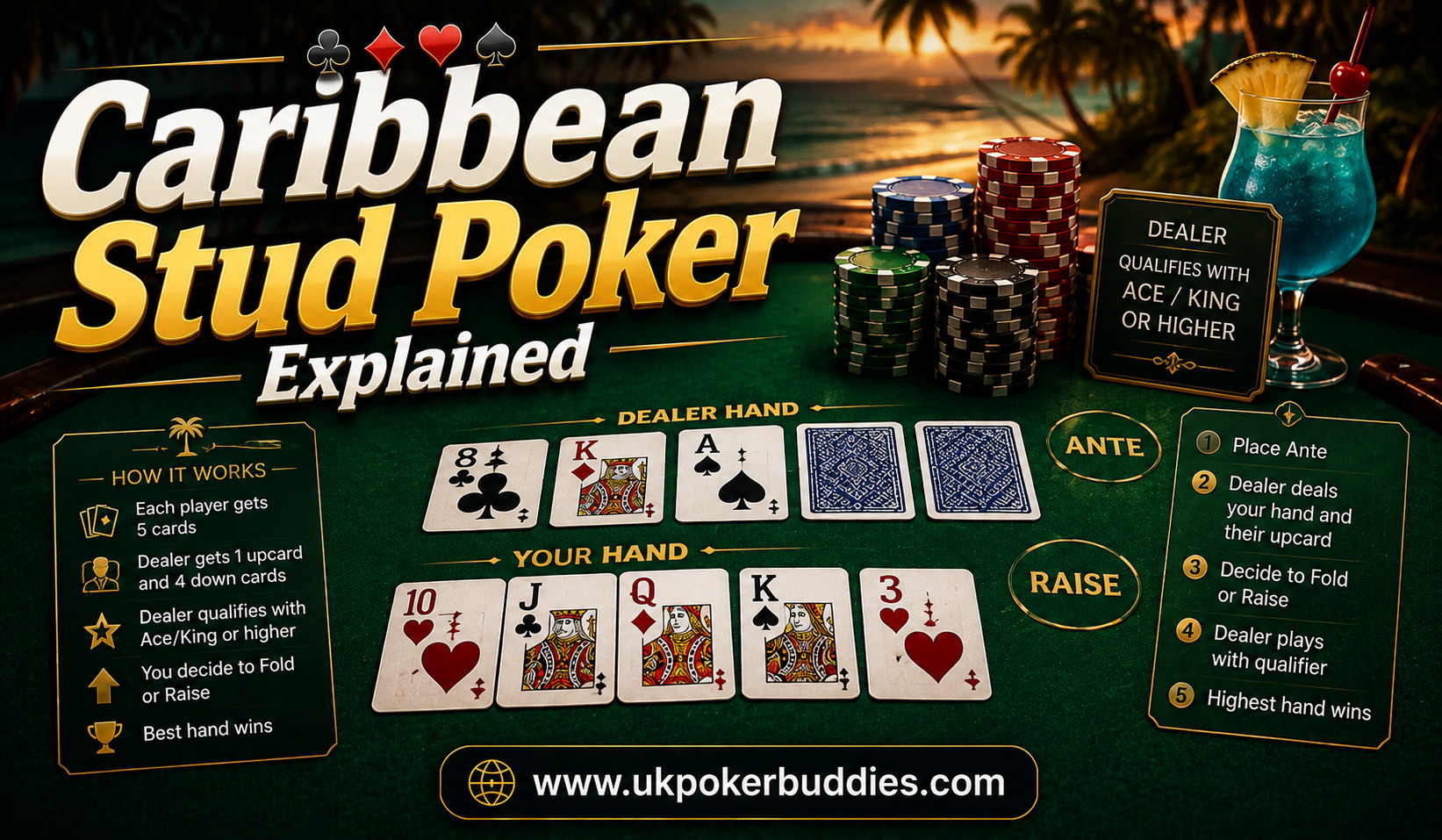
The game uses a standard 52-card deck and gives players five cards each. The dealer also receives five cards, although one of the dealer’s cards is initially exposed. After seeing their hand and the dealer’s visible card, players decide whether to fold or continue by placing a second wager.
Caribbean Stud has remained a recognizable poker-style casino game because of its simple structure, quick rounds and progressive jackpot options available at some tables. Understanding the rules, hand rankings, dealer qualification and betting process is important before playing.
What Is Caribbean Stud Poker?
Caribbean Stud Poker is a casino version of five-card stud poker. It is designed as a house-banked game, meaning the player competes against the casino dealer rather than other players.
Each player normally places an initial Ante wager before receiving five cards. The dealer also receives five cards, but one card is dealt face up so players have limited information about the dealer’s potential hand.
After looking at their cards, players make one of two choices. They can fold and end the hand, or they can continue by placing a Raise wager, which is commonly twice the original Ante.
The dealer then reveals the remaining cards, and the player’s hand is compared with the dealer’s qualifying hand.
How a Caribbean Stud Poker Round Works
A standard round begins with the player placing an Ante. Optional progressive jackpot wagers may also be available depending on the casino.
Five cards are then dealt to the player, while the dealer receives five cards. One of the dealer’s cards remains face up.
The player now has enough information to make the central decision of the game. If the hand appears weak, the player can fold. If the player believes the hand is worth continuing, they place the required Raise wager.
After all players have made their decisions, the dealer reveals the remaining cards and checks whether the hand qualifies under the game’s rules.
If the dealer does not qualify, the player’s Ante is generally paid according to the game’s rules while the Raise is returned. If the dealer qualifies, the dealer’s hand is compared with the player’s hand.
The exact settlement rules can vary, so players should read the posted table rules before placing a wager.
The Dealer Qualification Rule
The dealer qualification rule is one of the defining features of Caribbean Stud Poker.
In the standard version, the dealer must have at least an ace-king combination or a qualifying pair or better to participate in the normal hand comparison.
This means the dealer does not always qualify. A dealer holding a hand such as king-jack-9-7-3 would normally fail to qualify because it does not contain an ace-king combination or a pair or stronger hand.
If the dealer fails to qualify, the player’s Ante is typically paid at even money while the Raise is returned. When the dealer qualifies, the two hands are compared.
Because rules can differ between casinos and game providers, players should confirm the exact qualification and payout conditions at the table.
Caribbean Stud Poker Hand Rankings
Caribbean Stud uses conventional five-card poker rankings. Unlike some shorter poker variations, the standard hierarchy applies.
| Rank | Poker Hand | Example |
| 1 | Royal Flush | A-K-Q-J-10 of the same suit |
| 2 | Straight Flush | 9-8-7-6-5 of the same suit |
| 3 | Four of a Kind | Four queens |
| 4 | Full House | Three kings and two 8s |
| 5 | Flush | Five cards of the same suit |
| 6 | Straight | 8-7-6-5-4 |
| 7 | Three of a Kind | Three jacks |
| 8 | Two Pair | Two aces and two 7s |
| 9 | One Pair | Two tens |
| 10 | High Card | Highest card when no combination is formed |
The strength of a hand is determined by the highest applicable category. If both the player and dealer have the same category, the individual card values determine which hand is stronger.
What Happens If the Player Folds?
Folding is one of the two main decisions available after the cards are dealt.
When a player folds, the hand ends immediately. The player generally loses the Ante wager, while any optional side wager is settled separately according to its own rules.
There is no additional betting decision after folding. This makes the choice particularly important because the player must decide whether the original wager is worth risking another bet.
What Happens When the Dealer Qualifies?
If the dealer has a qualifying hand, the dealer’s cards are compared directly with the player’s hand.
If the dealer’s hand is stronger, the player generally loses the Ante and Raise wagers.
If the player’s hand is stronger, the Ante normally pays according to the table’s rules, while the Raise can receive a payout based on the strength of the winning hand.
For example, a pair may receive a different payout from a straight, while a royal flush can qualify for a much larger payout.
The exact payout schedule should always be checked because casinos can offer different versions of the game.
Understanding the Progressive Jackpot
Many Caribbean Stud tables offer an optional progressive jackpot wager. This is separate from the main Ante and Raise betting system.
The jackpot is generally based on the player receiving a sufficiently strong poker hand. The exact qualifying hand and payout depend on the particular progressive system.
Some versions may award smaller fixed prizes for strong hands while reserving the largest jackpot for a royal flush.
Because progressive jackpot wagers have their own mathematical structure, players should not assume that they provide the same value as the main game.
Before playing, check these table details:
- Minimum and maximum Ante limits.
- Dealer qualification requirements.
- Raise and Ante payout rules.
- Progressive jackpot conditions and payout schedule.
Caribbean Stud Poker vs Traditional Poker
Although Caribbean Stud uses poker hand rankings, its gameplay is very different from competitive poker.
In Texas Hold’em, players compete against one another and can use betting pressure, position and bluffing to influence opponents.
Caribbean Stud removes most of those elements. Players do not generally need to predict whether another participant is bluffing because the dealer is the only opponent in the main game.
| Feature | Caribbean Stud | Texas Hold’em |
| Main opponent | Dealer | Other players |
| Cards per player | 5 | 2 private cards + community cards |
| Community cards | None | 5 |
| Main decision | Fold or Raise | Multiple betting decisions |
| Bluffing | Not central | Major strategic element |
| Progressive jackpot | Often available | Not part of standard play |
This makes Caribbean Stud closer to a casino table game than a traditional poker competition.
Basic Strategy for Beginners
The main strategic decision in Caribbean Stud comes after the player receives five cards and sees one of the dealer’s cards.
Players should consider both the strength of their own hand and the information provided by the dealer’s exposed card.
A very strong poker hand will generally justify continuing. With weaker holdings, the decision becomes more complicated because the dealer’s visible card provides limited information about the remaining four hidden cards.
A commonly discussed strategy is to raise with strong made hands and fold many weaker combinations, but the exact optimal approach depends on the rules and mathematical assumptions of the specific game.
Players should understand that strategy cannot eliminate the casino’s house advantage.
Why Caribbean Stud Remains Popular
The game’s simplicity is one of its biggest strengths. Players receive five cards, see one dealer card and make a single major decision about whether to continue.
The format also offers the familiarity of poker hands without requiring players to compete against a table full of opponents.
The possibility of progressive jackpot prizes adds another layer of interest. A rare hand such as a royal flush can produce a substantial payout when the appropriate jackpot wager and table conditions apply.
Its relatively quick pace also makes it suitable for players who prefer shorter casino games.
Understanding the House Edge
Caribbean Stud is a casino game with a mathematical advantage for the house. The player can make strategic decisions, but those decisions do not guarantee a long-term profit.
The dealer qualification rule and payout structure are important factors in determining the game’s mathematical characteristics.
Optional progressive wagers can have a substantially different house edge from the main game. Players should therefore evaluate them separately rather than assuming that a large jackpot automatically makes a wager favorable.
Understanding these concepts helps set realistic expectations.
Conclusion
Caribbean Stud Poker offers a straightforward way to experience poker-style gameplay in a casino setting. The player receives five cards, sees one dealer card and decides whether to fold or continue with a Raise. The dealer then reveals the complete hand, qualifies according to the game’s rules and competes directly against the player.
The most important concepts for beginners are the dealer qualification rule, traditional poker hand rankings, the Ante and Raise wagers and the optional progressive jackpot.
While the game includes strategic decisions, it remains a casino game with a mathematical house advantage. Learning the rules, checking the specific payout structure and setting sensible limits can help players approach Caribbean Stud with realistic expectations and a better understanding of how each round works.
Frequently Asked Questions
How many cards are dealt in Caribbean Stud Poker?
The player and dealer each receive five cards. One of the dealer’s cards is normally exposed while the others remain hidden until the final comparison.
Does Caribbean Stud use standard poker rankings?
Yes. The game generally uses the traditional five-card poker ranking system, from royal flush down to high card.
What is the dealer qualification rule?
In the standard version, the dealer generally needs an ace-king combination or a pair or better to qualify. Specific rules may vary by casino.
What happens if the dealer does not qualify?
The exact settlement depends on the table rules. In the common format, the player’s Ante is paid while the Raise is returned.
What is the Raise wager?
The Raise is the second wager placed when a player chooses to continue after seeing their cards and the dealer’s exposed card. It is commonly twice the Ante.