

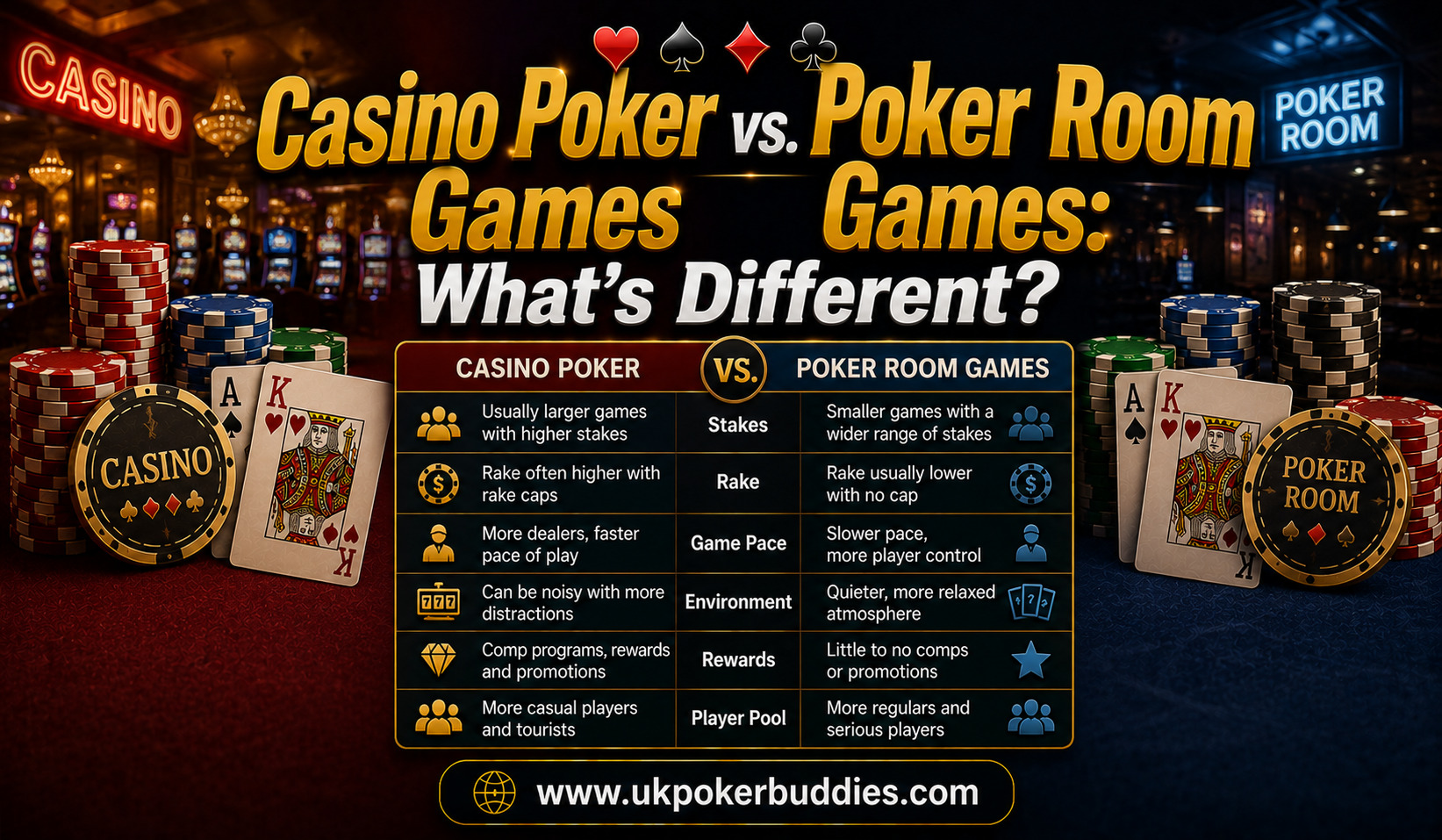
Poker is often treated as a single category of gaming, but the experience can change considerably depending on where and how the game is played. A player sitting at a casino table may be participating in a house-banked poker variation, while another player in the same casino could be seated in a dedicated poker room competing directly against other players.
The difference may sound minor, but it affects almost everything from the opponent and betting structure to the role of the casino and the strategies players use. Casino poker games are usually designed around a fixed set of rules in which players compete against the house. Poker room games, meanwhile, are generally player-versus-player contests where the casino provides the table, dealers, and facilities while taking a fee for hosting the game.
As poker continues to attract both recreational and experienced players, understanding these two environments can help newcomers choose a format that suits their interests. Although both may involve familiar poker hands, the actual experience can be very different.
What Does “Casino Poker” Mean?
Casino poker usually refers to poker-based table games in which players compete against the casino rather than against one another. Popular examples include Three Card Poker, Caribbean Stud Poker, and other casino-designed poker variations.
The casino acts as the banker in these games. Players place wagers according to the rules of the specific game, receive cards, and attempt to achieve a winning result against the dealer.
This setup creates a relatively straightforward structure. The casino’s role is clearly defined, and the game operates according to a fixed mathematical advantage known as the house edge.
The player is not trying to outplay another customer at the table. Instead, the objective is to make the best decision possible within the game’s rules and wager structure.
What Happens in a Poker Room?
A dedicated poker room works differently. In games such as Texas Hold’em and Omaha, players compete against each other for a shared pot.
The casino or card room generally provides the dealer, table, chips, and operating environment. Rather than playing against the house, players are competing against the other people seated at the table.
The casino typically earns revenue through a rake or another table fee. The exact system depends on the venue and the game.
This creates an important distinction: the casino is facilitating the poker game rather than determining the winning hand.
House-Banked Poker vs. Player-Versus-Player Poker
The clearest difference between the two formats is the identity of the opponent.
In casino poker, the dealer represents the house. The dealer follows predetermined rules and does not make strategic decisions based on the player’s behavior.
In a poker room, every opponent is another player capable of changing their strategy. They can bluff, fold, raise, slow-play strong hands, or adjust their decisions based on what they believe others are holding.
This makes poker room games much more dynamic from a strategic perspective.
A player in a poker room must therefore consider factors such as opponent tendencies, table position, betting patterns, and stack sizes. Those considerations are generally much less important in house-banked poker.
The Role of the Dealer Is Different
The dealer performs different functions depending on the game.
In casino poker, the dealer represents the house and follows the predetermined rules of the game. Their actions are usually automated by the rules. For example, a dealer may need to qualify with a specific hand before certain wagers are settled.
In a poker room, the dealer is generally neutral. They deal the cards, manage the betting sequence, protect the integrity of the game, and distribute the pot to the winner.
The dealer does not compete with the players.
This distinction is particularly important for newcomers because the presence of a dealer can make two games look similar even when their underlying structures are completely different.
Betting Structures Can Be Very Different
Betting is another major area where casino poker and poker room games differ.
Casino poker games often have clearly defined wagers. Players may place an Ante, Play, Pair Plus, or another optional bet depending on the game.
Poker room games can offer much more flexible betting structures. Texas Hold’em may be played as No-Limit, Pot-Limit, or Fixed-Limit, while tournaments can introduce additional changes to blinds and betting dynamics.
| Feature | Casino Poker | Poker Room Games |
| Main opponent | Casino/dealer | Other players |
| Casino role | Banker | Host/operator |
| Common formats | Three Card Poker, Caribbean Stud | Texas Hold’em, Omaha, Stud |
| Revenue model | House edge | Rake or fees |
| Bluffing | Limited against dealer | Major strategic element |
| Betting | Usually predetermined | Often more flexible |
| Strategy | Hand strength and probabilities | Position, ranges, betting and psychology |
The difference in betting structure can make poker room games feel considerably more complex.
Bluffing Matters More in Poker Rooms
Bluffing is one of the defining elements of player-versus-player poker.
A poker room player can bet aggressively with a weak hand to convince opponents that they have a strong combination. Another player may attempt to identify that bluff and make a difficult call.
This creates a psychological layer that is largely absent from house-banked casino poker.
In casino poker, the dealer is not making a strategic judgment about whether a player’s bet represents strength. The dealer follows the rules. As a result, bluffing has limited or no role in many casino poker formats.
Players who enjoy reading opponents and creating deceptive betting lines may therefore prefer poker room games.
Strategy and Skill Take Different Forms
Both formats require players to understand the rules and make informed decisions, but the type of skill involved is different.
Casino poker rewards players who understand the mathematical structure of the game. Knowing when a wager is favorable, understanding hand rankings, and managing a bankroll are important.
Poker room games demand a broader range of skills. Players must understand probability while also analyzing opponents, adjusting to table dynamics, choosing bet sizes, and recognizing situations where aggression or caution may be appropriate.
This does not mean casino poker has no strategy. Instead, the strategic environment is more limited because the dealer’s decisions are determined by the rules.
The Social Experience
Poker rooms can provide a strong social atmosphere. Players sit together for extended sessions, interact between hands, and experience the changing dynamics of a table.
A casino poker table can also be social, but hands are often completed more quickly. Players may arrive, place wagers, and leave after relatively short sessions.
Poker rooms tend to attract people specifically interested in poker, while casino poker variations may appeal to a broader casino audience.
The atmosphere can therefore differ depending on the venue, game, and time of day.
Cash Games and Tournaments
Poker rooms also offer different formats that are not usually associated with casino poker.
Cash games allow players to buy chips and play with values that correspond to real money. Players can generally leave the table when they choose, subject to the room’s rules.
Tournaments operate differently. Players typically pay an entry fee, receive tournament chips, and compete until they are eliminated or reach the final stages. Blinds generally increase over time, creating additional pressure as the tournament progresses.
Casino poker variations usually do not follow this player-versus-player tournament structure because the house remains the opponent.
Risk and the House Edge
The financial structure of the two formats deserves attention.
In casino poker, the house has a mathematical advantage built into the rules. Even when a player makes good decisions, the game is designed to provide the casino with a long-term edge.
In poker room games, the casino does not normally play against the customer. Instead, it earns revenue through a rake or other fees. This means a player’s long-term result depends heavily on how well they perform relative to the other players after accounting for those costs.
This difference is fundamental to understanding the economics of the two formats.
Why Players Choose Casino Poker
Casino poker can be attractive to people who want a simple and fast experience. Players do not need to study opponent ranges or spend hours developing advanced betting strategies.
Some of its key attractions include:
- Straightforward rules and betting decisions.
- Faster individual hands.
- Direct competition against a dealer.
- Multiple game options with different poker-style mechanics.
For casual players, these features can make casino poker easier to approach.
Why Poker Rooms Attract Serious Players
Poker rooms often appeal to players who enjoy competition, long-term strategy, and the psychological side of the game.
A player’s result can depend on their ability to identify weaker opponents, adapt to aggressive players, control their emotions, and make profitable decisions over a large number of hands.
The environment also supports more advanced learning. Players can study tournament strategy, cash-game theory, position, ranges, pot odds, and other concepts that are central to competitive poker.
This depth is one reason dedicated poker rooms continue to have a strong following.
Choosing Between the Two
The right format depends on what a player wants from the experience.
Someone looking for a quick poker-themed casino game may prefer Three Card Poker or another house-banked variation. Someone interested in competing directly against other players may prefer a poker room.
Before choosing, it is useful to consider:
- Whether the player prefers competition against people or the house.
- How much strategic complexity they want.
- Whether they prefer short sessions or extended games.
- Which betting structure they understand and enjoy.
There is no universal answer because the two formats are designed around different experiences.
The Growth of Online Poker and Hybrid Experiences
The digital era has added another dimension to the comparison. Online casinos offer many house-banked poker variations, while online poker rooms provide player-versus-player games across different stakes and formats.
Digital platforms can also make it easier for players to explore multiple variants before deciding which style suits them.
However, online and live environments have their own differences. Live poker rooms provide physical interaction and table dynamics, while online games generally offer faster action and greater accessibility.
The underlying distinction between house-banked poker and player-versus-player poker remains the same.
Final Thoughts
Casino poker and poker room games may share the same basic vocabulary of cards, hands, bets, and dealers, but they operate on fundamentally different principles.
Casino poker is usually a house-banked experience in which players compete against the dealer under predetermined rules. Poker room games place players against one another, creating a much deeper strategic environment involving bluffing, position, opponent analysis, and long-term decision-making.
For casual players, casino poker can provide a quick and accessible way to enjoy poker-style gameplay. For those who want a competitive challenge, poker rooms offer a much broader strategic experience.
Understanding the difference allows players to make more informed choices and appreciate why these two forms of poker continue to exist side by side.
Frequently Asked Questions
What is the main difference between casino poker and poker room games?
Casino poker usually involves playing against the house, while poker room games involve players competing against one another for a shared pot.
Does the casino play against players in a poker room?
Generally, no. The casino provides the table, dealer, and services but does not normally compete for the pot in standard poker room games.
Is bluffing possible in casino poker?
Traditional bluffing has little role in most casino poker games because the dealer follows fixed rules rather than making strategic decisions like a human opponent.
What games are commonly found in poker rooms?
Texas Hold’em and Omaha are among the most common poker room games, with Stud and other variants also available at some venues.
What is a rake in poker?
A rake is a fee taken by the poker room from eligible cash-game pots or through another approved fee structure. The exact amount and method vary by venue.