

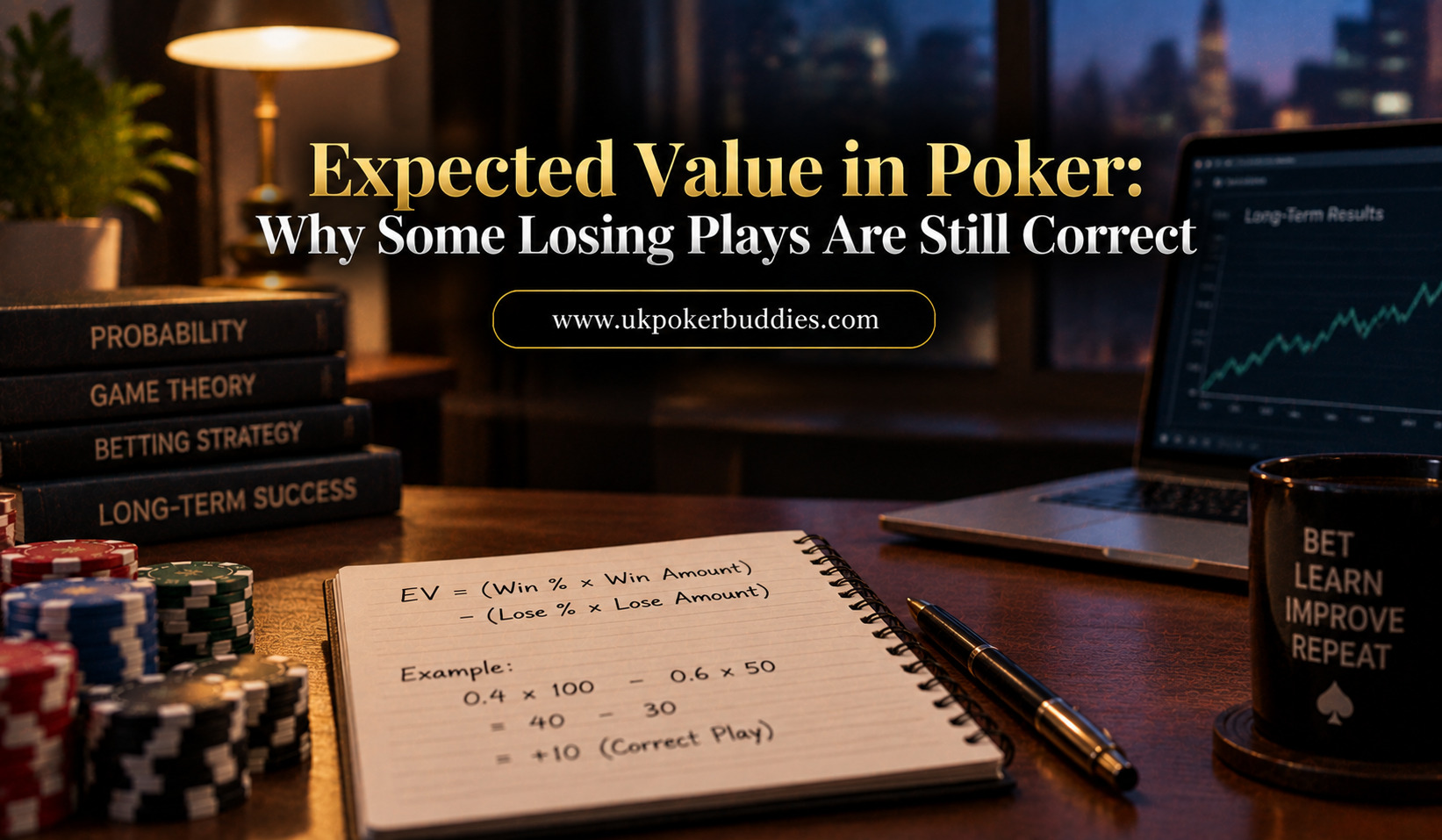
Poker can be confusing because a correct decision does not always produce a winning result. You can make a mathematically sound call, choose the right bet size, or move all-in with a strong advantage and still lose the hand.
This is where expected value in poker, commonly called EV, becomes important.
Expected value helps players evaluate decisions based on their potential long-term results rather than what happens in one particular hand. A play can lose today and still be profitable over hundreds or thousands of similar situations.
Understanding EV is one of the most useful steps toward thinking about poker strategically.
What Is Expected Value in Poker?
Expected value is an estimate of how much a decision is expected to win or lose on average over the long run.
It does not predict the result of the next hand.
Instead, EV considers the possible outcomes of a decision and the probability of each outcome.
For example, imagine a decision where you have a 60% chance of winning ₹100 and a 40% chance of losing ₹50.
The calculation would consider both outcomes and their probabilities.
The important point is that you will not necessarily win ₹40 on the next hand. You might win ₹100, lose ₹50, or experience another result depending on the situation.
EV is about the average result if the same decision could be repeated many times.
Why EV Matters in Poker
Poker contains too much uncertainty for players to judge decisions solely by their immediate results.
Suppose you make a call that is profitable according to the available information. You call, your opponent shows a weaker hand, but the final community card gives them a winning hand.
You lose.
If you judge the decision only by the result, you might conclude that calling was a mistake.
EV provides a different perspective.
The question becomes:
Was the call profitable when I made it, given the pot size, my chances of winning, and my opponent’s likely range?
If the answer is yes, losing the individual hand does not necessarily mean the decision was wrong.
A Losing Play Can Be Correct
This is one of the most important ideas behind poker EV.
Imagine you have a 70% chance of winning when the chips go into the pot.
You lose this particular hand.
Was the decision incorrect?
Not necessarily.
You were still making a decision with a favorable expectation.
The outcome simply landed on the losing side of the probability distribution.
Over many similar situations, the player who repeatedly makes the 70% decision should win more often than lose. But individual results will naturally vary.
This is where variance and expected value work together.
EV measures the quality of the decision, while variance explains why actual results can temporarily move away from that expectation.
Positive EV vs Negative EV
Poker decisions are commonly described as positive EV (+EV) or negative EV (-EV).
A positive-EV decision is expected to make money over the long run.
A negative-EV decision is expected to lose money over the long run.
For example, imagine you have a drawing hand and the price offered by the pot is favorable enough to justify continuing.
You may miss your draw and lose the hand.
That particular result is negative.
But if the call was profitable when considering all possible outcomes, the decision itself can still be +EV.
The opposite is also true.
You can make a negative-EV call and happen to win.
Winning does not automatically make the decision profitable.
EV and Poker Equity
Poker equity and expected value are closely related, but they are not identical.
Equity represents your estimated share of the pot based on your chances of winning.
EV considers what that equity is worth financially after accounting for factors such as the amount you must invest and the potential return.
For example, having 40% equity in a large pot may be attractive if you are receiving the correct price to continue.
But if you must invest too much compared with the amount you can potentially win, the same 40% equity may not make the decision profitable.
This is why players need to consider both probability and pot economics.
EV and Pot Odds
Pot odds are another important part of evaluating expected value.
Suppose there is ₹1,000 in the pot and your opponent bets ₹500.
You have to decide whether calling ₹500 is worthwhile.
The decision depends partly on how often you expect to win compared with the price you are receiving.
If your estimated chance of winning is high enough, calling may have positive expected value.
If your chance of winning is too low, calling may be negative EV.
The exact decision also depends on factors such as future betting, opponent ranges, and whether you can realize your equity.
EV Is Not About Predicting the Next Card
A common misunderstanding is that EV tells you what will happen next.
It does not.
If a particular decision has a positive expected value, that does not mean you are guaranteed to profit from it immediately.
For example, a coin flip can have an equal chance of landing on either side. If you repeat the experiment many times, the results tend to become more representative of those probabilities.
Poker works similarly.
The more often comparable situations occur, the more useful EV becomes for evaluating your overall strategy.
EV and Bluffing
Expected value is also important when deciding whether to bluff.
A bluff can be profitable even when you have almost no chance of winning at showdown.
Why?
Because your opponent may fold.
Suppose you bet ₹500 into a pot of ₹1,000.
If your opponent folds often enough, the successful bluffs can compensate for the times they call and you lose.
This is an example of fold equity contributing to EV.
The goal is not to make every bluff work.
The goal is to choose situations where the overall expectation of the bluff is favorable.
EV and Value Betting
EV also helps explain why value betting is important.
Suppose you have a strong hand and believe your opponent will call with several weaker hands.
Betting can be profitable because you expect to win additional money from those weaker holdings.
However, betting too large may cause weaker hands to fold while stronger hands continue.
That can reduce the value of the bet.
A good value bet therefore considers how your opponent’s range responds to different bet sizes.
The best size is often the one that maximizes your expected return from the hands that can realistically call.
EV and Position
Position can influence expected value because acting later provides more information.
When you are in position, you often get to see what your opponent does before making your decision.
This additional information can help you make more accurate decisions on later streets.
As a result, the same starting hand can have different EV depending on where you are sitting at the table.
This is one reason poker strategy cannot be separated from position.
EV and Opponent Ranges
You cannot calculate meaningful EV without making reasonable assumptions about your opponent’s possible hands.
For example, a call might be profitable against a wide range but unprofitable against a very strong range.
This is why range analysis is so important.
Instead of asking, “What exact hand does my opponent have?” think about the collection of hands they could realistically hold.
Your estimate of their range helps determine your equity, potential outcomes, and ultimately the expected value of your decision.
Common EV Mistakes
One of the biggest mistakes players make is judging EV by the result.
A player calls and wins, then assumes the call was +EV.
Another player calls and loses, then assumes the call was -EV.
Neither conclusion is necessarily correct.
Another common mistake is ignoring future actions.
A decision that looks profitable on the current street may become less attractive if you expect difficult decisions on later streets.
Players also sometimes use unrealistic assumptions about their opponent’s range, which can make their EV calculations inaccurate.
How to Improve Your EV Thinking
You do not need to calculate exact EV numbers for every hand you play.
Instead, develop the habit of asking a few questions:
How often am I likely to win?
How much do I need to invest?
How much can I potentially win?
What hands can my opponent realistically have?
Will future cards or betting change the situation?
These questions encourage you to think beyond the immediate result.
Over time, this type of thinking can make your decisions more consistent.
EV vs Short-Term Results
One of the biggest benefits of understanding expected value is that it changes how you view losing sessions.
If you consistently make positive-EV decisions, you can still experience losing days or weeks because of variance.
That does not automatically mean your strategy has stopped working.
Similarly, a winning session does not prove that every decision was correct.
Strong poker players evaluate the process behind their decisions, not simply the money won or lost in one session.
Final Thoughts
Expected value in poker provides a framework for understanding why some losing plays can still be correct.
A decision should not be judged only by its immediate outcome. Instead, players should consider the probabilities, pot size, opponent’s range, potential future actions, and possible rewards and losses.
A positive-EV decision can lose in the short term. A negative-EV decision can win.
That is simply how probability and variance work.
The goal of strong poker strategy is not to win every hand. It is to consistently make decisions that have favorable long-term expectations.
Once you start thinking in terms of EV, losing a hand becomes less important than understanding whether you made the best decision with the information available at the time. That shift can make your poker analysis more objective and your long-term strategy much stronger.