

Rules, Gameplay and What Beginners Should Know
Omaha poker has become a popular variation of community-card poker, offering a more action-packed style of play than Texas Hold’em. At first glance, the two games appear similar because both use community cards and multiple betting rounds. However, one major rule makes Omaha fundamentally different: players receive four private cards, but they must use exactly two of them when creating their final five-card poker hand.
That single requirement changes the mathematics, strategy and overall gameplay. With four hole cards available, players can form a much wider range of potential combinations. This often leads to stronger hands, more draws and bigger pots.
For beginners, learning Omaha is not difficult once the basic structure is clear. The challenge is understanding how the four-card starting hand interacts with the community cards and why some hands that look powerful at first may not be as useful as they appear.
What Is Omaha Poker?
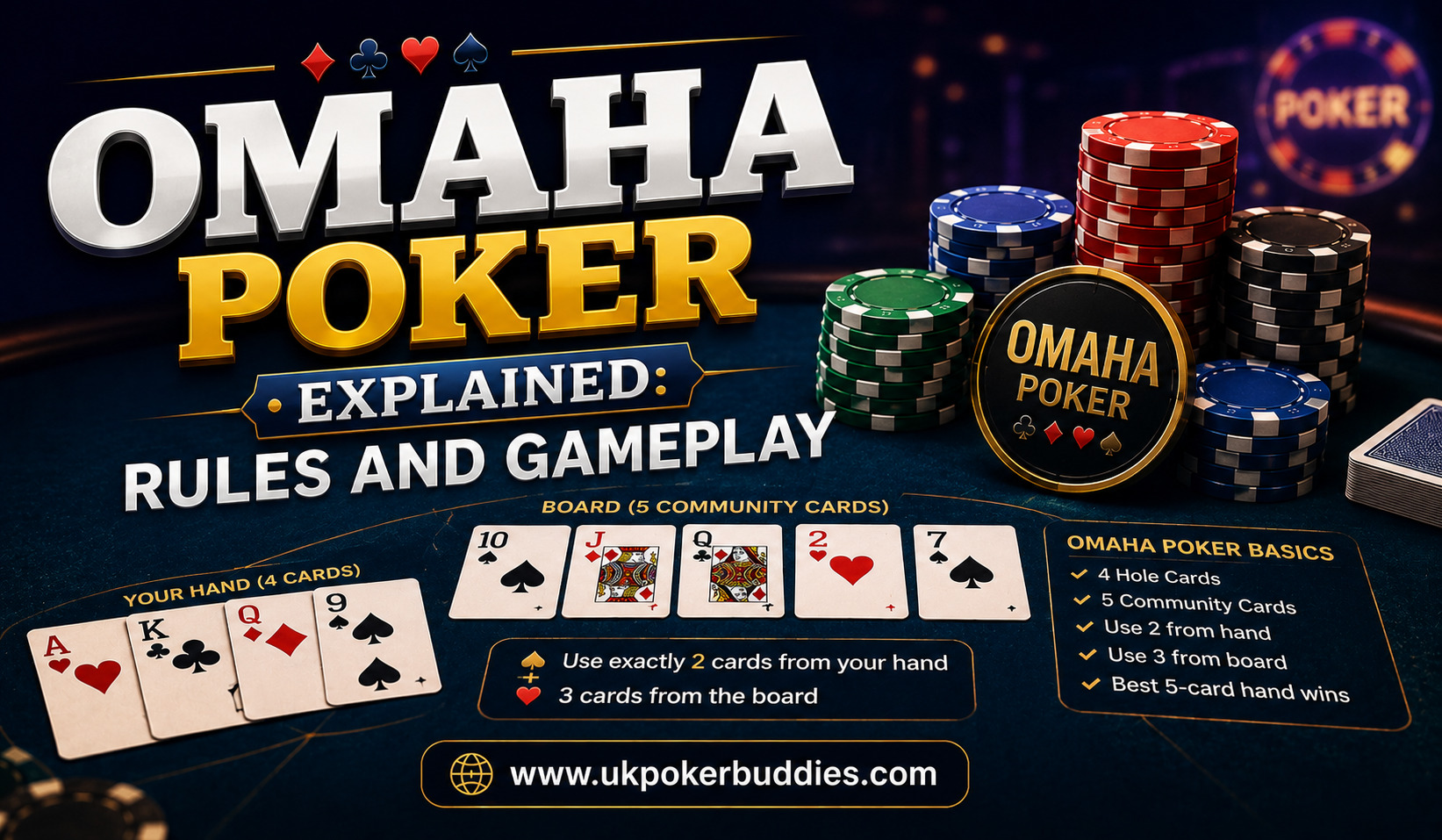
Omaha is a community-card poker game normally played with a standard 52-card deck. Each player receives four private cards, which remain hidden from opponents.The objective is to make the strongest possible five-card poker hand. However, Omaha has a strict construction rule: players must use exactly two cards from their four-card hand and exactly three cards from the five community cards.
This is the key difference between Omaha and Texas Hold’em. In Hold’em, a player can use any combination of their hole cards and community cards. In Omaha, the two-card requirement must always be followed.
For example, if a player holds four cards and the board contains several cards of the same suit, they cannot simply use three cards from their hand to create a flush. Exactly two hole cards must be used.
How an Omaha Hand Begins
A typical Omaha hand starts with a dealer button and forced blinds. The player immediately to the left of the dealer generally posts the small blind, while the next player posts the big blind.
Once the blinds are posted, every active player receives four hole cards face down. Players examine their cards and decide whether to continue with the hand.
The first betting round is known as the pre-flop. Depending on the betting structure and the action before them, players can fold, call or raise.
The hand then progresses through the flop, turn and river, with additional betting rounds between each stage.
The Four Main Stages of Omaha Gameplay
The basic flow of Omaha is similar to other community-card poker formats, but the four-hole-card rule remains important throughout the entire hand.
Pre-Flop
Four private cards are dealt to every player. This gives each player considerably more possible combinations than in Texas Hold’em.
However, having four cards does not mean every starting hand is strong. The cards need to work together. A hand containing connected cards, matching suits and strong pairs can provide multiple ways to improve.
Beginners often make the mistake of looking at the highest individual card and assuming the hand is automatically playable. In Omaha, the relationship between all four cards is usually more important.
The Flop
Three community cards are dealt after the first betting round. Players now have more information about possible completed hands and draws.
The flop can create several opportunities at once. A player might have a straight draw, flush draw or combination of different potential improvements.
Because Omaha creates many possible combinations, the flop can produce significant betting action.
The Turn
The fourth community card is dealt after the flop betting round. This card can complete a draw, improve a made hand or change the potential combinations available to other players.
At this stage, players should reassess their hands rather than assuming that a strong flop automatically remains strong.
The River
The fifth and final community card is called the river. It completes the board and leads to the final betting round.
If more than one player remains after the betting is completed, the players reveal their cards. The best legal five-card combination wins the pot.
The Most Important Omaha Rule
The exact-two rule deserves special attention because it is responsible for many beginner mistakes.
Suppose a player has four hole cards and three hearts among those cards. If the board contains two hearts, a beginner might think a flush is possible by combining three hearts from their hand with two from the board.
That is not allowed.
The player must use exactly two hole cards. Therefore, the final hand must contain exactly two cards from the player’s private hand and exactly three community cards.
This rule applies to every hand category, not just flushes. Understanding it before playing Omaha is essential.
Omaha Poker Hand Rankings
The hand rankings in Omaha are generally the same as standard poker rankings. The difference is how the final five-card hand must be constructed.
| Rank | Hand | Example |
| 1 | Royal Flush | A-K-Q-J-10 of the same suit |
| 2 | Straight Flush | 9-8-7-6-5 of the same suit |
| 3 | Four of a Kind | Four queens |
| 4 | Full House | Three kings and two 8s |
| 5 | Flush | Five cards of the same suit |
| 6 | Straight | Five consecutive cards |
| 7 | Three of a Kind | Three jacks |
| 8 | Two Pair | Two aces and two 7s |
| 9 | One Pair | Two tens |
| 10 | High Card | Highest card when no combination is made |
While the ranking system is familiar, Omaha frequently produces stronger combinations because players begin with four private cards.
Why Omaha Can Produce Bigger Hands
The additional hole cards dramatically increase the number of possible combinations available to each player. A player can have several potential straight or flush draws at the same time.
This is one reason Omaha can feel more volatile than Texas Hold’em. A player may have what appears to be a strong hand but still face an opponent with a stronger combination or a better draw.
For beginners, this means a hand should not be judged only by what it looks like at the current moment. The possible hands opponents can make should also be considered.
Starting Hands in Omaha
Starting-hand selection is particularly important because four cards can create complicated combinations.
Strong Omaha starting hands often have cards that work together rather than simply containing one premium card. Connected ranks, suited combinations and coordinated pairs can create multiple paths toward strong final hands.
For example, a hand containing connected high cards with useful suit relationships can have more potential than four disconnected cards.
New players should therefore avoid the temptation to play every hand simply because they receive four cards.
Important qualities to examine in a starting hand
- Whether the cards are connected and can form straights.
- Whether suited cards provide realistic flush possibilities.
- Whether pairs are supported by other useful cards.
- Whether the four cards work together rather than functioning as separate combinations.
Pot-Limit Omaha: The Most Common Format
One of the most widely recognized versions of Omaha is Pot-Limit Omaha, commonly abbreviated as PLO.
In Pot-Limit Omaha, the maximum bet or raise is restricted by the current size of the pot and the amount required to call. This creates a different betting environment from fixed-limit formats.
PLO is known for large pots and strong drawing hands. Because players can hold four private cards, the number of possible combinations can become substantial, particularly when the board contains connected or suited cards.
Players unfamiliar with pot-limit betting should learn how the maximum raise is calculated before playing for real money.
Omaha vs Texas Hold’em
Although both games use community cards, their strategies are noticeably different.
| Feature | Omaha | Texas Hold’em |
| Private cards | 4 | 2 |
| Community cards | 5 | 5 |
| Hole-card requirement | Exactly 2 must be used | Any combination |
| Typical action | Often more drawing possibilities | Generally fewer combinations |
| Popular format | Pot-Limit Omaha | No-Limit Hold’em |
The four-card structure makes Omaha more combination-heavy. A starting hand that looks attractive in Hold’em terms may not necessarily be strong in Omaha.
How Beginners Can Approach Omaha
Learning Omaha is easier when players focus first on the rules rather than trying to memorize complicated strategies.
Start by practicing the exact-two-card requirement until it becomes automatic. Then learn to identify connected cards, suited combinations and potential draws. Over time, players can develop a better understanding of position, pot odds and opponent ranges.
It is also useful to review completed hands. Looking back at decisions can reveal whether a hand was strong because it had multiple possibilities or weak because the cards were disconnected.
The most important lesson is that four cards do not automatically mean four times the strength. Omaha rewards combinations that work together.
Conclusion
Omaha poker offers a distinctive combination of familiar poker rules and additional strategic complexity. The four-hole-card format creates more possible combinations, stronger draws and frequently larger pots than beginners may expect.
The most important rule to remember is simple: use exactly two hole cards and exactly three community cards. Once that rule becomes familiar, players can begin focusing on starting-hand quality, position, drawing possibilities and the strength of their final combinations.
For newcomers, the best way to understand Omaha is to learn the basic structure first and then gradually explore more advanced concepts. With patience, practice and responsible play, Omaha can be an engaging poker format for players who enjoy a more dynamic and combination-heavy style of the game.
Frequently Asked Questions
How many cards does each player get in Omaha?
Each player normally receives four private hole cards.
How many cards must I use from my hand?
Exactly two hole cards must be used to create the final five-card hand.
How many community cards are dealt?
Five community cards are dealt: three on the flop, one on the turn and one on the river.
Is Omaha harder than Texas Hold’em?
The basic rules are similar, but Omaha can be more complex because players receive four hole cards and must evaluate many more possible combinations.
What is Pot-Limit Omaha?
Pot-Limit Omaha is a format where the maximum bet or raise is determined by the size of the pot and the current betting situation.