

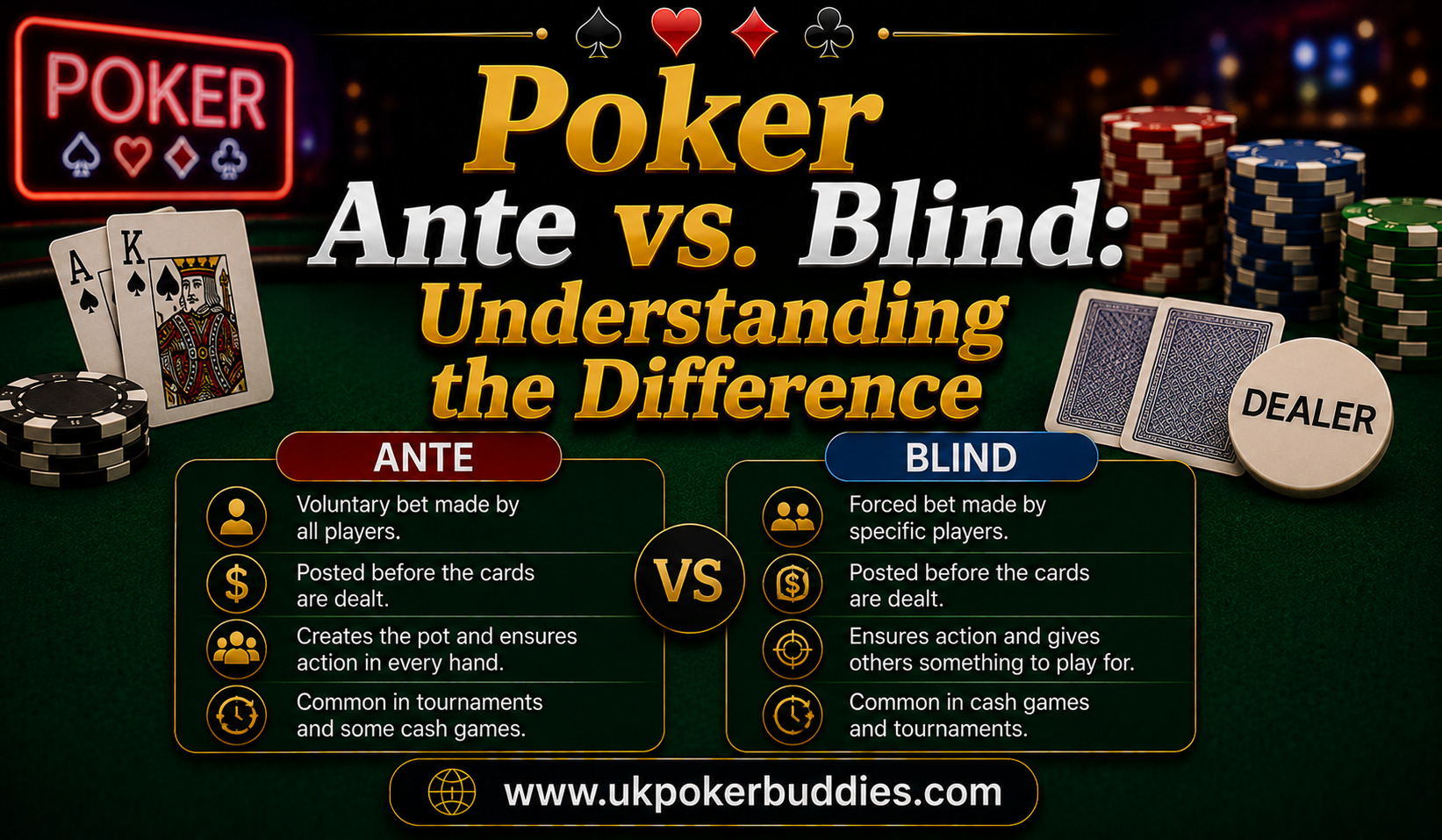
Poker has many rules that can appear simple at first but become important once a game gets underway. Among the most commonly misunderstood elements are antes and blinds. Both require players to put chips into the pot before the main betting action begins, but they serve different purposes and operate in different ways.
Understanding the difference between an ante and a blind is essential for anyone learning poker. The distinction becomes particularly important when moving between different poker formats, such as cash games and tournaments. A player who understands when money enters the pot before the cards are dealt can make better decisions about starting hands, stack sizes and betting strategies.
While blinds are strongly associated with games such as Texas Hold’em and Omaha, antes are used in several poker formats and tournament structures. Modern poker has also introduced variations in which one player posts an ante for the entire table, making the subject even more relevant for new players.
What Is a Poker Ante?
An ante is a mandatory contribution that players make to the pot before a hand begins. Unlike a blind, an ante is generally paid by every player at the table rather than only by specific positions.
For example, if a poker game has a 10-chip ante, each player contributes 10 chips before receiving cards. With nine players at the table, the pot begins with 90 chips before the first betting round starts.
The purpose of an ante is to create an initial pot and encourage action. Because players have already invested chips in every hand, there is an incentive to compete rather than simply wait for premium cards.
Antes are especially common in tournaments and certain poker variants. They can also be used alongside blinds, creating a structure in which players contribute to the pot through both mechanisms.
What Is a Poker Blind?
A blind is another mandatory pre-flop contribution, but it differs from an ante because only designated players are required to post it on each hand.
In Texas Hold’em, for example, the player immediately to the left of the dealer button usually posts the small blind, while the next player posts the big blind. The amount of each blind is determined by the game’s limits.
If a game is described as a 1/2 Hold’em game, the small blind is generally $1 and the big blind is $2. These positions rotate around the table as the dealer button moves.
The term “blind” comes from the fact that players must contribute before seeing their hole cards. This creates immediate action and ensures that there is something to play for on every hand.
Ante vs. Blind: The Core Difference
The easiest way to understand the distinction is to focus on who pays and how the contribution is calculated.
An ante is normally paid by all players, while blinds are normally posted by specific players based on their positions at the table. Blinds also establish the basic betting structure in many poker games.
| Feature | Ante | Blind |
| Who pays? | Usually every player | Usually one or two designated players |
| Timing | Before the hand begins | Before the hand begins |
| Main purpose | Build the starting pot | Create forced action and establish betting stakes |
| Position-based? | Traditionally no | Yes |
| Common in tournaments? | Yes | Yes |
| Common in Texas Hold’em? | Sometimes, depending on format | Standard feature |
| Amount | Usually fixed for the table or level | Defined by the blind structure |
This difference may look minor, but it can have a significant effect on poker strategy.
Why Do Poker Games Use Antes and Blinds?
Poker is designed around decision-making, risk and competition. Without forced contributions, players could theoretically fold almost every hand without losing chips.
Antes and blinds prevent that from happening.
Forced bets create an initial pot and give players a reason to participate. They also increase the cost of waiting indefinitely for strong cards. As a result, players must make decisions about when to enter pots, when to defend their positions and when to apply pressure to opponents.
Blinds are particularly important because they move around the table. Every player eventually has to pay the small blind and big blind, creating a relatively balanced system over time.
Antes work differently because they are typically paid by everyone. This means the entire table contributes to the pot, regardless of position.
How Blinds Affect Poker Strategy
Blinds are closely connected to position, which makes them a major part of poker strategy. A player sitting in the big blind has already invested chips and may receive favorable pot odds when facing a raise.
However, having money invested does not automatically mean a player should continue with a weak hand. The strength of the cards, opponent’s betting range, position and size of the raise still matter.
The small blind presents another strategic challenge. A player in this position has already contributed chips but will generally be out of position for much of the hand. This can make post-flop decisions more difficult.
Players also need to remember that blinds rotate. A player who folds every hand will eventually be forced to contribute a blind, gradually reducing their stack in tournament play.
How Antes Change the Pot
Antes can make the starting pot noticeably larger. When every player contributes before the action begins, there is more money available to win before anyone makes a post-flop decision.
This can encourage players to compete for pots more frequently. A raise that might not make sense in a game with no ante can become more attractive when there are additional chips already in the middle.
In tournament poker, antes become particularly important as blind levels rise. They increase the cost of simply waiting and can accelerate the pace of the game.
Players therefore need to consider not just the blind amount but the total amount of chips entering the pot before the betting begins.
Traditional Antes and Modern Big Blind Antes
Poker terminology can become confusing because there are different ways to implement antes.
In a traditional ante structure, every player posts the same ante before each hand. For instance, at a nine-player table, all nine players might contribute one ante.
A big blind ante changes this arrangement. Instead of every player contributing separately, the player in the big blind position posts an ante on behalf of the entire table.
This system has become popular in many modern tournaments because it simplifies the process. Dealers no longer have to collect small ante contributions from every player before each hand.
For players, the strategic effect can be significant because the big blind position may have a larger amount committed before the cards are played.
How Antes and Blinds Work Together
Antes and blinds do not necessarily compete with each other. In many poker games, they operate together.
Imagine a tournament level with a 500/1,000 blind structure and a 1,000-chip big blind ante. The small blind posts 500 chips, the big blind posts 1,000 chips as the blind and an additional 1,000 chips as the ante.
That means there are already 2,500 chips in the pot before other players take action, assuming no other antes or contributions apply.
This larger starting pot can make pre-flop aggression more attractive. Players have more chips to win, but they also face greater pressure because tournament stacks are gradually being consumed by the forced payments.
Antes and Blinds in Cash Games
The use of antes varies depending on the cash-game format. Traditional No-Limit Texas Hold’em cash games commonly use blinds without an ante, although some modern cash games introduce an ante or big blind ante.
Cash games are generally more flexible than tournaments, so poker rooms can offer different structures. Players should always understand the posted stakes and forced-bet rules before joining a table.
For example, a game may advertise a blind structure but also include an additional ante. That changes the effective cost of entering each hand and can influence optimal strategy.
Antes and Blinds in Tournaments
Tournament poker places even greater emphasis on forced bets because blinds and antes usually increase at scheduled intervals.
Early in a tournament, players may have stacks that are large compared with the blinds. As the tournament progresses, the same number of chips can become much less valuable in terms of how many rounds a player can survive.
The increasing blinds and antes create pressure to accumulate chips. Players cannot simply sit back indefinitely because their stack may gradually shrink even without losing a major pot.
This is one reason tournament poker often becomes more aggressive as it moves toward later stages.
Key Points to Remember
- Antes are generally paid by every player, while blinds are usually paid by designated positions.
- Blinds rotate around the table, meaning every player eventually posts them.
- Antes increase the starting pot and encourage players to compete for more chips.
- Big blind antes simplify tournament procedures by allowing the big blind player to post the ante for the table.
Why Understanding the Difference Matters
Knowing the difference between antes and blinds is more than a matter of memorizing poker terminology. These forced bets influence the value of starting hands, the size of pots and the amount of pressure placed on players.
A tournament player who ignores the ante can underestimate how quickly their stack is being reduced. A cash-game player who misunderstands the blind structure can miscalculate the cost of entering a pot.
The forced-bet structure also affects table dynamics. When the pot becomes larger before the betting begins, players have greater incentives to compete for it. This can create more aggressive pre-flop action and make position even more important.
Final Thoughts
Antes and blinds perform similar broad functions in poker: they put chips into the pot before players make voluntary betting decisions. However, the way they work is different.
Blinds are generally connected to specific table positions and rotate from player to player. Antes, by contrast, are traditionally paid by everyone at the table. Modern formats can also use a big blind ante, where one player contributes the ante on behalf of the table.
Understanding these differences helps players read tournament structures, calculate pot sizes and make more informed strategic decisions. Whether playing Texas Hold’em, Omaha or another poker variant, knowing the forced-bet structure should be one of the first things a player checks before the cards are dealt.
Frequently Asked Questions
1. What is the main difference between an ante and a blind?
An ante is generally a mandatory contribution made by every player, while a blind is normally posted by specific players according to their position at the table.
2. Does everyone pay the blind in poker?
No. In a standard Texas Hold’em game, the small blind and big blind positions post the blinds. The positions rotate after each hand.
3. Does everyone pay an ante?
In a traditional ante structure, yes. Every player normally contributes the required ante before the hand begins. However, big blind ante systems allow the big blind player to post the ante for the table.
4. Why are antes used in poker?
Antes create a starting pot and encourage players to participate. They also increase the cost of waiting for premium hands, particularly in tournament play.
5. What is a big blind ante?
A big blind ante is a structure in which the player in the big blind position posts an ante on behalf of the entire table. It is widely used in modern poker tournaments.