

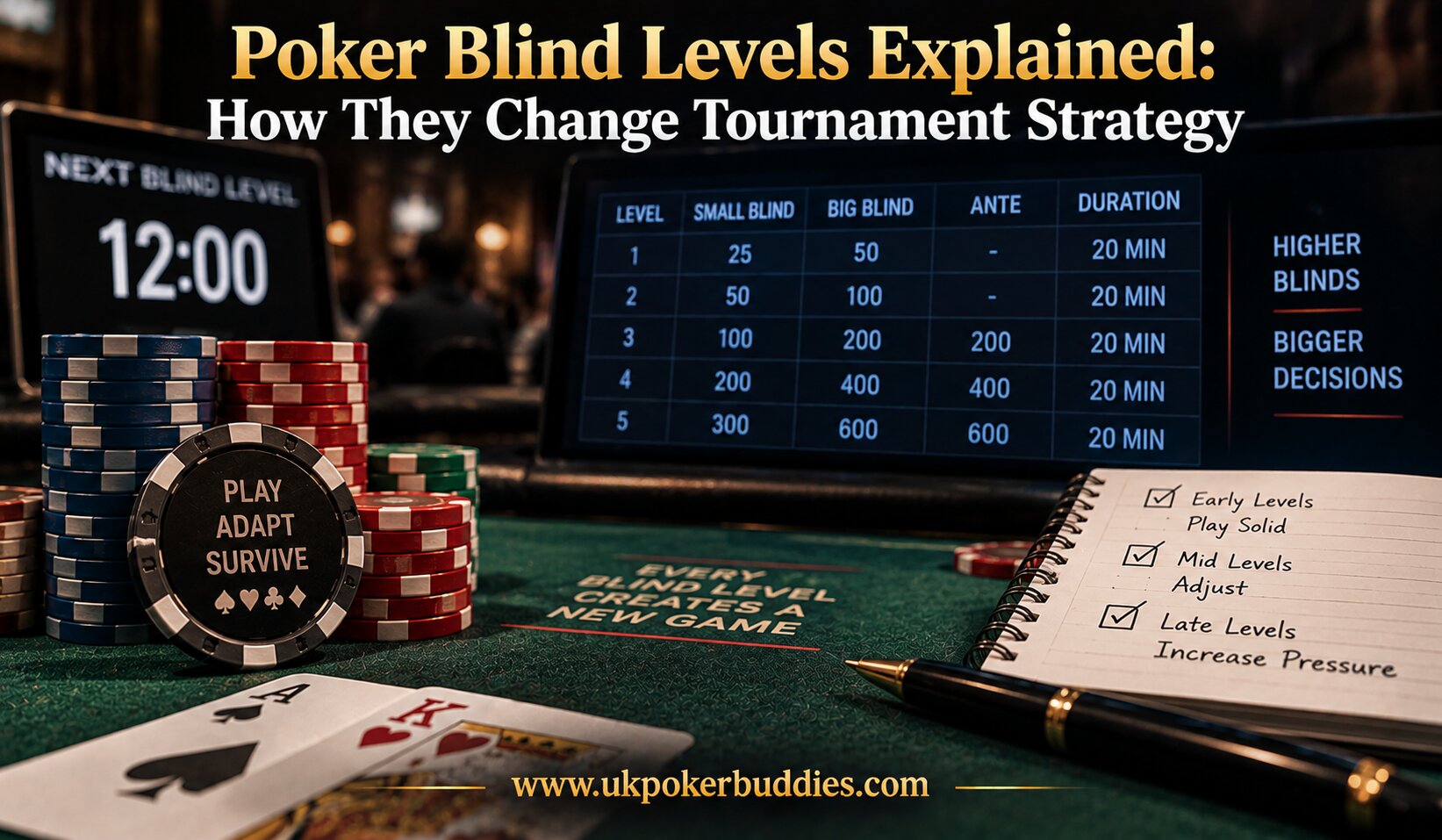
Tournament poker is not played at the same pace from beginning to end. As the tournament progresses, the blinds increase, creating more pressure on players and forcing them to adjust their strategies.
These changing levels are one of the biggest differences between tournament poker and cash games.
At the beginning of a tournament, blinds are usually small compared with the starting stacks. Players can therefore afford to wait for favorable opportunities and play more hands after the flop. Later, the blinds become larger relative to the remaining stacks, making every decision more important.
Understanding poker blind levels can help players recognize when to be patient, when to become more aggressive, and when waiting too long can put their tournament life at risk.
What Are Blind Levels in Poker?
In Texas Hold’em tournaments, the small blind and big blind are forced bets that rotate around the table.
A blind level refers to the period during which a particular blind amount remains in place.
For example, a tournament might begin with blinds of 100/200. After a certain amount of time, the blinds could increase to 200/400, then 300/600, and continue increasing throughout the event.
The exact blind schedule varies between tournaments.
The purpose of increasing blinds is to prevent players from simply waiting indefinitely. As the tournament progresses, the cost of staying in the game increases.
Why Do Tournament Blinds Increase?
Increasing blinds create tournament pressure.
If the blinds remained unchanged, players with large stacks could potentially wait for premium hands without losing much of their stack.
Increasing blinds force players to make decisions.
A player who begins with 20,000 chips may feel comfortable when the big blind is only 100. But if the big blind eventually rises to 2,000, that same 20,000-chip stack represents only 10 big blinds.
The number of chips has not changed, but their value in terms of big blinds has changed dramatically.
This is why tournament players often measure their stack in big blinds rather than simply counting chips.
Understanding Your Stack in Big Blinds
One of the easiest ways to understand blind-level pressure is to calculate how many big blinds you have.
Suppose you have 30,000 chips.
If the blinds are 500/1,000, your stack is worth:
30,000 ÷ 1,000 = 30 big blinds
Now imagine the blinds increase to 2,000/4,000.
Your 30,000 chips are now worth only:
30,000 ÷ 4,000 = 7.5 big blinds
You still have 30,000 chips, but your strategic options have changed significantly.
You now have far less room to maneuver.
Early Blind Levels
Early tournament levels generally provide the deepest stacks relative to the blinds.
This can create more opportunities for post-flop play.
Players can afford to call reasonable bets without committing a large percentage of their stacks, and speculative hands can sometimes have more room to develop.
However, this does not mean every hand should be played.
Strong starting-hand selection and position remain important.
The main advantage of deep early levels is that losing a small pot usually does not threaten your tournament life.
Middle Blind Levels
As blind levels increase, tournament dynamics begin to change.
Players who have lost chips early may find their stacks becoming uncomfortable.
Meanwhile, players who accumulated chips can begin applying more pressure.
The middle stages often require greater awareness of stack depth.
A hand that was easy to call at 50 big blinds may become much more difficult at 20 big blinds.
Players also need to pay attention to upcoming blind increases.
If another level is about to begin, your stack could become significantly shorter in big-blind terms within minutes.
Late Blind Levels
Late in a tournament, blinds and antes can represent a large portion of many players’ stacks.
This creates a much more aggressive environment.
Players with short stacks cannot always wait for premium hands because the blinds continue consuming their chips.
Stealing blinds and antes can become increasingly valuable.
At the same time, larger stacks may use their chip advantage to put pressure on opponents who are trying to survive.
Late-stage poker therefore requires more awareness of stack sizes, position, payout structure, and tournament pressure.
The Importance of Antes
Many tournament structures also include antes.
An ante is a forced contribution that comes from players before the hand begins.
Antes increase the amount of dead money available in each pot.
This means winning the blinds and antes can become increasingly important as levels rise.
For example, stealing a pot containing only blinds may not seem significant early in a tournament. Later, the combination of blinds and antes can represent a meaningful percentage of a short stack.
This creates additional motivation to enter pots aggressively in the right situations.
Blind Levels and Starting-Hand Selection
As blinds increase, starting-hand selection may need to change.
With a deep stack, you have more room to play hands that can potentially make strong combinations after the flop.
With a short stack, speculative hands become more difficult to play because you may not have enough chips to navigate multiple betting rounds.
Short stacks often need to focus more on hands that can profitably move all-in or continue against aggression.
The correct range depends on position, stack sizes, opponent tendencies, and the tournament situation.
Blind Levels and Aggression
Increasing blinds naturally create more opportunities for aggression.
Suppose everyone folds to you in late position.
If the blinds are small compared with your stack, stealing them may not dramatically change your tournament position.
But later in the tournament, the same blinds may represent a significant portion of your stack.
This can make blind stealing more valuable.
However, aggression should be based on the situation rather than simply the blind level.
If players behind you are likely to defend frequently or move all-in, repeatedly attempting steals can become costly.
Short-Stack Strategy
Short-stack play becomes increasingly important as blind levels rise.
A player with 8 or 10 big blinds cannot approach the game in the same way as a player with 60 big blinds.
There is less room for calling raises and then making complicated post-flop decisions.
The threat of an all-in becomes more significant.
Short-stack players should therefore understand concepts such as position, fold equity, push-and-fold situations, and the strength of their opponents’ ranges.
Waiting too long can be dangerous because the next blind increase may reduce their stack even further.
Big-Stack Strategy
Big stacks can use increasing blinds to their advantage.
When several opponents have relatively short stacks, a large stack may be able to apply pressure by raising frequently in favorable positions.
Shorter stacks may be reluctant to defend marginal hands because losing could put them in serious trouble.
However, big-stack players should still avoid unnecessary confrontations.
A large stack provides an advantage, but that advantage can disappear quickly after a major loss.
Good big-stack strategy combines aggression with selective risk-taking.
Blind Levels and Tournament Bubbles
Blind increases become particularly important near the tournament bubble.
Suppose only a few players remain before reaching the money, but several short stacks are losing chips rapidly to the blinds.
The pressure can become intense.
Short stacks may need to act before another blind increase leaves them with too few chips to maneuver.
Meanwhile, larger stacks can sometimes take advantage of players who are reluctant to risk elimination.
This is where blind levels, stack sizes, and ICM can interact.
Blind Levels and Pay Jumps
Later tournament levels can also coincide with significant payout increases.
A player may be approaching a final table or moving closer to a major prize jump.
At this stage, simply knowing the blind level is not enough.
Players should consider how many big blinds they have, how quickly the blinds will increase, where the other stacks are, and what the payout structure looks like.
A decision that is reasonable in a low-pressure situation may be inappropriate when a major payout jump is approaching.
Common Blind-Level Mistakes
One common mistake is looking only at the number of chips you have.
A 50,000-chip stack might be enormous at one stage and extremely short at another.
Another mistake is waiting too long to become active.
Players sometimes keep folding because they are hoping for a premium hand, only to discover that their stack has fallen from 20 big blinds to 8 big blinds.
Some players also ignore the next blind increase.
If the blinds are scheduled to rise soon, your current stack may look healthier than it will shortly afterward.
How to Adjust to Blind Increases
A good tournament player regularly reassesses their stack in big blinds.
Before each new level, consider:
- Your current stack in big blinds
- The stacks of your opponents
- Your position at the table
- The size of the blinds and antes
- How quickly the next level will arrive
- The tournament’s current stage
This helps you avoid making decisions based only on the absolute number of chips.
Your strategy should evolve as the tournament evolves.
Final Thoughts
Poker blind levels are one of the key forces that shape tournament strategy.
As the blinds increase, stacks become smaller in big-blind terms, the cost of waiting rises, and aggressive decisions can become more valuable. Early levels generally offer more room for post-flop play, while later levels often require greater attention to position, stack depth, stealing opportunities, and tournament pressure.
The most important habit is to stop thinking about your stack only as a number of chips. Instead, ask how many big blinds you have and how that number will change when the next level begins.
Once you understand how blind levels affect stack depth, you can adjust your strategy before the pressure becomes overwhelming. In tournament poker, staying ahead of the blind structure can be just as important as having good cards.