

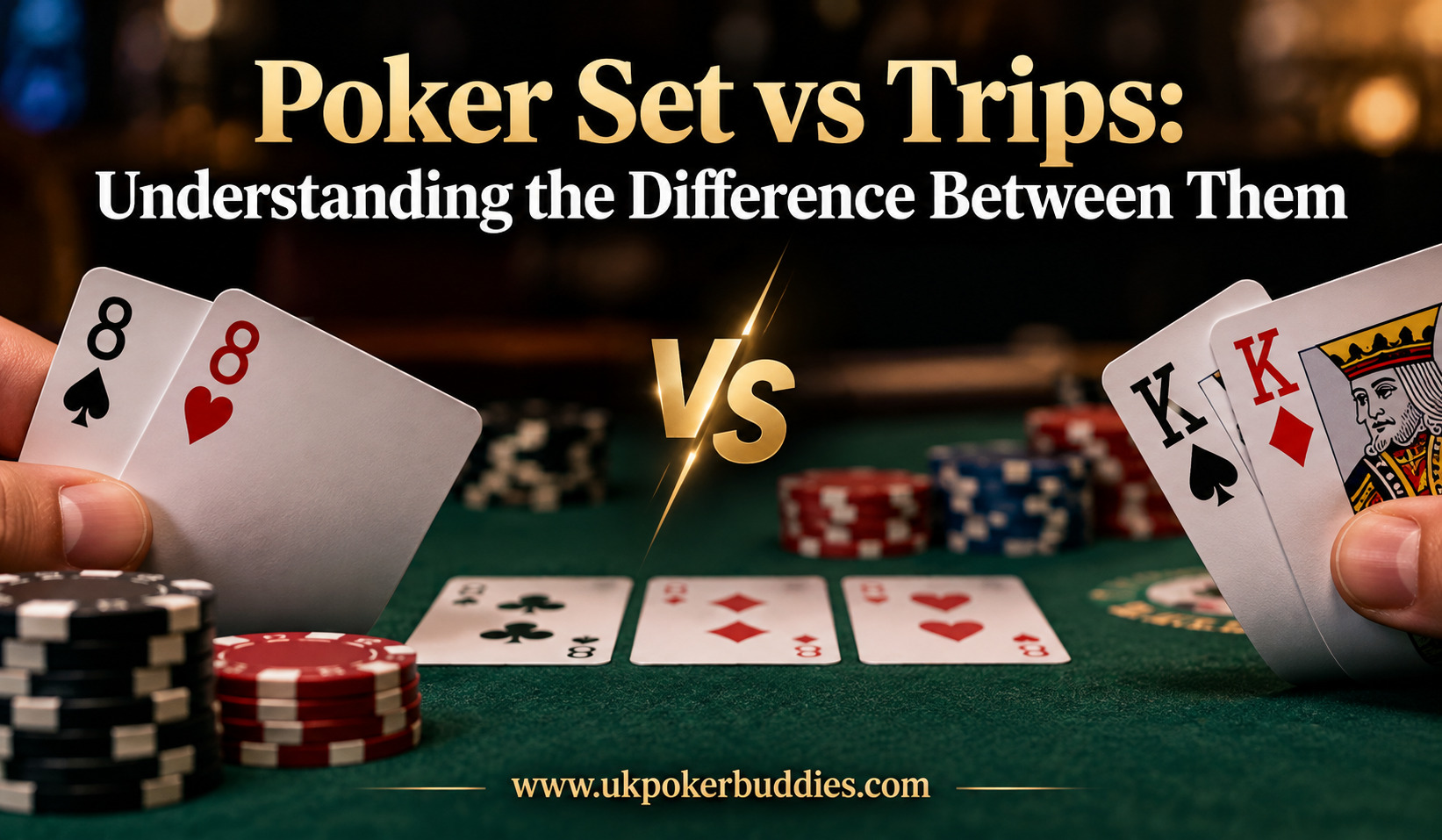
Poker has many terms that describe specific hand situations, and some of them sound similar even though they have important differences. Set and trips are two common examples.
Both describe a hand containing three cards of the same rank, which means both are three-of-a-kind. However, the way you make the hand is different.
A set is made when you start with a pocket pair and one matching card appears on the board. Trips occurs when you have one card of a rank and the board contains two cards of that same rank.
Understanding the difference between a set and trips can help you evaluate hand strength, board texture, possible opponent ranges, and the risks involved in playing three-of-a-kind.
What Is a Set in Poker?
A set is three-of-a-kind made using a pocket pair in your hole cards plus one matching community card.
For example, suppose you are dealt:
8♠ 8♦
The flop comes:
8♣ K♥ 4♠
You have three eights.
Two of them came from your private cards, while the third came from the board.
That is a set of eights.
Another example would be:
Q♠ Q♥
with a board containing another queen.
Because you started with a pocket pair, your three-of-a-kind is called a set.
What Are Trips in Poker?
Trips refers to three-of-a-kind where one card comes from your hole cards and two matching cards appear on the board.
For example, you hold:
A♠ 7♦
The board is:
7♣ 7♥ K♠
You have three sevens.
One seven is your hole card, while two sevens are on the board.
That is trips.
The final hand category is still three-of-a-kind, but the structure of the hand is different from a set.
Set vs Trips: The Main Difference
The easiest way to remember the difference is to look at where the three matching cards come from.
Set:
You have a pocket pair + one matching board card.
Trips:
You have one matching hole card + two matching board cards.
Both are three-of-a-kind, but a set is generally more concealed because only one matching card appears on the board.
Trips can be more obvious because the board itself contains a pair.
Why Sets Are Often More Difficult to See
One major advantage of a set is that it can be difficult for opponents to identify.
Suppose you hold:
9♠ 9♦
and the flop is:
9♣ A♥ 5♦
Your opponent sees only one nine on the board.
They may reasonably believe you could have an ace, a draw, a pair, or another hand.
Because your other two matching cards are hidden, your set can be well disguised.
This is sometimes called a hidden or disguised hand.
Why Trips Can Be More Obvious
Now imagine the board is:
9♣ 9♦ A♥
and you hold:
K♠ 9♥
You have trips nines.
However, your opponent can immediately see that the board contains two nines.
They know that anyone holding another nine has three-of-a-kind.
Because the board itself shows the paired rank, your hand may be easier to identify.
This can affect how much action you receive.
Which Is Stronger: Set or Trips?
Neither set nor trips is automatically a stronger hand category.
Both are three-of-a-kind.
However, the situation surrounding the hand can make one more valuable than another.
A set is often more concealed and can therefore be easier to extract value from.
Trips can sometimes be vulnerable because the paired board creates more opportunities for opponents to have strong full-house combinations or other powerful hands.
The actual strength depends on the board, your opponent’s range, position, stack sizes, and betting action.
Sets and Board Texture
Board texture is especially important when playing a set.
A set on a dry board may be extremely strong.
For example:
K♣ 7♦ 2♠
If you hold pocket sevens, you have a set.
There are relatively few immediate draws on this board.
But imagine a more connected board:
J♠ 10♠ 8♦
If you hold pocket tens, you have a set.
Your hand is still powerful, but the board contains several straight and flush possibilities.
Your opponent may have strong drawing hands that can improve on later streets.
Therefore, having a set does not mean you should ignore the board.
Trips and Board Texture
Trips can also be strong, but the paired board creates different strategic considerations.
Suppose the board is:
K♠ K♦ 6♣
and you hold:
K♥ Q♣
You have trips kings.
However, your opponent can also have a king.
There are now three kings visible between your hand and the board, leaving only one king elsewhere in the deck.
This affects how likely it is that your opponent has the same trips.
The paired board also creates potential full-house situations as additional cards arrive.
Set Over Set
One of the most painful situations in poker is set over set.
This occurs when two players both have sets.
For example:
Player A: 8♠ 8♦
Player B: 5♠ 5♦
Board:
8♣ 5♥ 2♦
Player A has a set of eights.
Player B has a set of fives.
Both players have very strong hands, but Player A is ahead.
This situation can lead to a large pot because neither player necessarily expects the opponent to have another set.
Set-over-set situations are a classic example of why poker can produce difficult decisions even when both players hold excellent hands.
Can Trips Beat a Set?
Yes.
The terms set and trips do not determine which hand wins.
The actual rank of the three-of-a-kind matters.
For example, trips aces beat a set of kings.
The hand category is the same, but aces are higher than kings.
In addition, the board and remaining cards can create full houses or other stronger hands.
So you should never assume that a set automatically beats trips.
Set vs Trips and Full Houses
One of the biggest dangers when holding three-of-a-kind is the possibility of a full house.
Suppose you have a set on the flop.
If the board pairs another card on a later street, an opponent may potentially make a full house.
For example, if you hold:
9♠ 9♦
and the board is:
9♣ K♥ 4♦
you have a set of nines.
If the turn or river pairs the king, a player holding pocket kings could have a full house.
Likewise, if the board pairs the four, certain combinations can become full houses.
This is why board changes should always be considered.
Sets, Trips, and Kickers
Kickers can matter when comparing hands involving trips.
However, if two players have the same three-of-a-kind, the remaining cards in their best five-card hands determine the comparison.
For example:
Player A: Q Q Q A 10
Player B: Q Q Q A 8
Both have three queens and an ace.
The ten beats the eight, so Player A wins.
Remember that poker uses the best five-card hand available.
Common Mistakes With Sets and Trips
One common mistake is thinking that every three-of-a-kind is a set.
That is incorrect.
The term set specifically refers to three-of-a-kind made from a pocket pair plus one matching board card.
Another mistake is assuming that trips are always weaker.
Trips can be extremely strong depending on the board.
Players also sometimes become too confident after making a set and forget that the board can develop into a dangerous texture.
A strong made hand still needs to be evaluated against possible draws and ranges.
How to Play Sets More Effectively
When you make a set, your goal is often to extract value from weaker hands while protecting yourself against dangerous board developments.
On a dry board, you may have more opportunities to build the pot gradually.
On a wet board, stronger betting may be appropriate because opponents can have many drawing hands.
Position also matters.
Being in position gives you more information about your opponent’s actions before you make your own decision.
How to Play Trips More Effectively
Trips require careful attention to the board because two matching cards are already visible.
If the board is paired, opponents can potentially have:
- A stronger three-of-a-kind
- A full house
- A draw toward a full house
- A weaker made hand
- A bluff
Your exact hole card matters greatly.
Having the highest possible remaining card can give you a strong trips hand, while having a lower card can make your hand more vulnerable.
Why the Difference Matters
Knowing whether you have a set or trips is more than learning poker vocabulary.
It helps you understand how visible your hand is and what combinations your opponents may have.
A set can be difficult for opponents to detect because the pair is hidden in your hole cards.
Trips are more connected to the board, making the hand structure more obvious and changing the possible ranges.
This distinction can improve your hand reading and decision-making.
Final Thoughts
Set vs trips in poker is a simple distinction once you understand where the three matching cards come from.
A set is three-of-a-kind made from a pocket pair and one matching community card. Trips is three-of-a-kind made from one hole card and two matching cards on the board.
Both hands belong to the same poker hand category, but they can play very differently.
Sets are often more concealed, while trips are more visible because the board is paired. Both can be extremely strong, but neither is unbeatable. Board texture, opponent ranges, possible full houses, position, and betting action all influence how you should play them.
The most important lesson is to look beyond the name of the hand. Knowing that you have a set or trips is only the starting point. The real skill comes from understanding how that three-of-a-kind interacts with the board and your opponent’s possible holdings.