

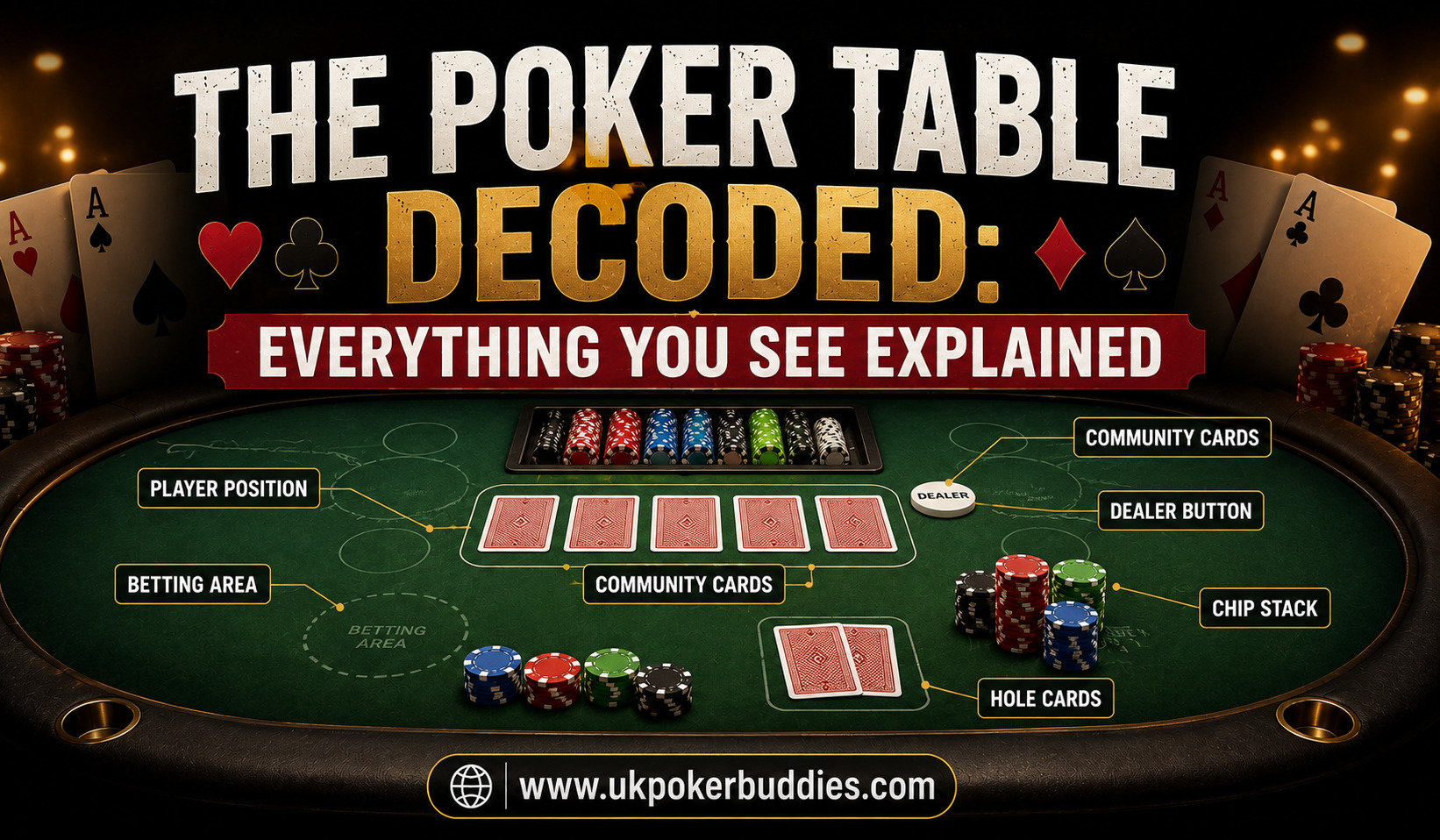
Walk into a poker room and the table can look deceptively simple. There is a dealer, a group of players, cards, chips and a familiar green or blue felt surface. Yet almost every object and marking around the table serves a specific purpose. For newcomers, understanding what they see at the table can make poker feel far less complicated and much more approachable.
A poker table is designed around one central goal: keeping the game organized. From the dealer button that determines betting positions to the community-card area where shared cards are revealed, the layout helps players and dealers follow the action without confusion. While designs vary between casinos, home games and online-inspired tables, the basic principles remain remarkably consistent.
The Shape and Design of a Poker Table
Most traditional poker tables have an oval or kidney-shaped design. This shape allows players to sit around the table while leaving enough room in the center for the dealer to manage the cards and chips. Casino tables are generally covered with felt or another smooth material that allows cards to slide easily across the surface.
The felt itself is more than decoration. It provides a controlled playing surface and often contains printed areas for cards, betting information or logos. Some tables include designated betting lines, while others use a more open layout.
The table’s size also influences the pace of the game. A full-size poker table may accommodate around eight to ten players, while smaller home-game tables are often designed for fewer participants.
The Dealer Position and Dealer Button
One of the most recognizable objects on a poker table is the dealer button. Usually marked with the word “DEALER,” this small round disc identifies the nominal dealer position in games where a professional dealer handles the cards.
The button moves clockwise after each hand. Its position determines the order in which players act and helps establish positions such as the small blind and big blind in games like Texas Hold’em.
This rotating system is important because poker is a positional game. Players closer to the dealer button generally have different strategic advantages and disadvantages compared with players who must act earlier.
In a casino, the dealer may physically deal the cards, but the button still determines the positional structure of the hand.
The Blinds and Betting Positions
Immediately to the left of the dealer button are normally the small blind and big blind positions. These players are required to place predetermined bets before the cards are dealt.
The small blind is usually posted by the player immediately to the left of the button, while the big blind is posted by the next player. These forced bets create money in the pot and encourage action from the beginning of the hand.
After each hand, the button and blind positions move, giving players an equal opportunity to pay the blinds over time.
Key positions commonly seen at a Texas Hold’em table
- Dealer/Button: Determines the positional order.
- Small Blind: Posts the smaller forced bet.
- Big Blind: Posts the larger forced bet.
- Early Position: Players who must act relatively early.
- Middle Position: Players acting between early and late positions.
- Late Position: Players who benefit from seeing more action before making a decision.
Understanding these positions is essential because the same hand can have very different strategic values depending on where a player is sitting.
The Community Card Area
At the center of a Texas Hold’em poker table is the area reserved for community cards. These cards are shared by every active player and are revealed in stages.
The first three community cards are known as the flop. They are followed by the turn, which is the fourth community card, and finally the river, the fifth and final community card.
The central layout gives players a clear visual reference for the cards that everyone can use to form their five-card poker hand.
| Table Element | Purpose |
| Dealer Button | Identifies the dealer position and determines action order |
| Small Blind Area | Indicates the small blind position |
| Big Blind Area | Indicates the big blind position |
| Community Card Area | Holds shared cards in games such as Texas Hold’em |
| Betting Area | Space where chips are placed during betting |
| Player Rail | Area where players keep chips and personal items |
| Pot Area | Location where chips committed to the pot may be collected |
The exact markings differ from one table to another, but the underlying functions are generally similar.
The Pot: Where the Action Comes Together
The pot is one of the most important areas of any poker hand. It contains the chips that players have committed through betting.
In a live game, chips may be pushed toward the center or placed in a designated betting area. The dealer is responsible for keeping the betting process organized and determining the correct pot amount.
In some games, especially when several players remain involved, side pots can also be created. A side pot occurs when one player has committed fewer chips than others because they have gone all-in. The remaining players may continue competing for additional chips in a separate pot.
This is one reason the dealer’s role is so important. Pot management can become complicated when multiple betting rounds and all-in situations occur.
Poker Chips and Their Meaning
Poker chips represent monetary value in cash games or tournament value in tournaments. Different colors typically represent different denominations, although there is no universal color system that applies to every poker room.
Players normally arrange their chips in stacks so that their available betting amount is easy to identify. Dealers and casino staff also monitor chip denominations to reduce confusion during large bets.
In tournaments, chips usually do not have a direct cash value during play. Instead, they represent tournament units and are used to determine a player’s position in the event.
Players should pay attention to chip stacks around them because the amount a player can wager influences strategic decisions.
The Dealer’s Working Area
The dealer occupies the central position at many live poker tables. The dealer’s workspace normally includes the deck, discard area and space for managing chips and cards.
A dealer may use a cut card to protect the bottom of the deck during dealing and may place discarded cards into a muck area. The muck is where folded or otherwise discarded cards are placed so they are not accidentally returned to play.
The dealer also manages the betting sequence, reveals community cards, awards pots and helps enforce the rules of the game.
The Burn Cards and Muck
Two areas that beginners may not immediately recognize are the burn-card area and the muck.
Before dealing certain community cards in games such as Texas Hold’em, the dealer removes a card from the top of the deck and places it face down in the burn pile. This is done before the flop, turn and river.
The discarded cards from players are placed into the muck. Keeping these cards separate from live cards is an important part of maintaining the integrity of the game.
Although these areas may seem insignificant, they help prevent accidental exposure or reuse of cards.
Betting Lines and Player Areas
Many casino poker tables include printed betting lines. These markings help establish where players should place chips when making bets.
A player’s personal area generally includes their hole cards and chip stack. In Texas Hold’em, each player receives two private cards, which must remain visible only to that player.
Players are expected to protect their cards and keep them on the table. A card that is accidentally released into the muck can potentially be considered folded depending on the house rules.
The physical boundaries on the table therefore help establish what belongs to each player and what belongs to the game.
What the Table Tells You About the Game
A poker table is effectively a visual map of the game. The button tells players where the dealer position is located. The blinds identify the forced bets. The community-card area shows where shared cards will appear, while the pot and betting areas organize the money being contested.
For beginners, learning these features can be more useful than memorizing complicated strategies immediately. Once the physical layout becomes familiar, it becomes easier to understand concepts such as position, betting rounds and pot odds.
A simple way to read a poker table
- Find the dealer button.
- Identify the small blind and big blind.
- Locate the community-card area.
- Observe where the pot and active bets are placed.
- Check each player’s chip stack and position before the action begins.
This quick visual check can help a new player understand what is happening before making a decision.
How the Table Changes During a Hand
The appearance of the table changes as a hand develops. At the beginning, players have their private cards and the blinds have been posted. The first betting round then takes place.
After that, the flop appears in the community-card area. Another betting round follows. The turn introduces another shared card, followed by additional betting, and the river completes the board.
At showdown, remaining players reveal their cards and the best eligible five-card combination wins the appropriate pot.
The table therefore acts almost like a timeline. Each area becomes important at a different stage of the hand.
Conclusion
The poker table may appear straightforward, but every section has a purpose. The dealer button establishes position, the blinds create the initial action, the community-card area organizes shared cards, and the betting and pot areas keep the financial side of the hand structured.
Once players understand these elements, the table stops looking like a collection of unfamiliar markings and becomes a clear representation of how a poker hand works. Whether someone is watching a tournament, joining a casual home game or learning Texas Hold’em for the first time, knowing what each part of the table means provides a stronger foundation for understanding the game itself.
FAQ:
What is the dealer button used for?
The dealer button identifies the dealer position and determines the positional order of the players. It moves clockwise after each hand.
Where are the community cards placed?
In games such as Texas Hold’em, community cards are placed in the designated central area of the table. Five cards are eventually revealed through the flop, turn and river.
What is the muck in poker?
The muck is the area where folded or discarded cards are placed. These cards are generally no longer part of the hand.
What are burn cards?
Burn cards are cards removed from the top of the deck before certain community cards are dealt. They are normally placed face down and are not available to players.