

Poker is often described as a single game, but the experience can change dramatically depending on the format. Two of the most popular ways to play are poker tournaments and cash games. Both involve familiar poker rules, betting rounds and strategic decision-making, yet the way chips, money, blinds and eliminations work creates two very different playing environments.
For new players, the distinction can sometimes be confusing. A player may know the rules of Texas Hold’em, for example, but still find tournament poker surprisingly different from a cash table. Understanding these differences is important because a strategy that works well in a cash game may not produce the same results in a tournament.
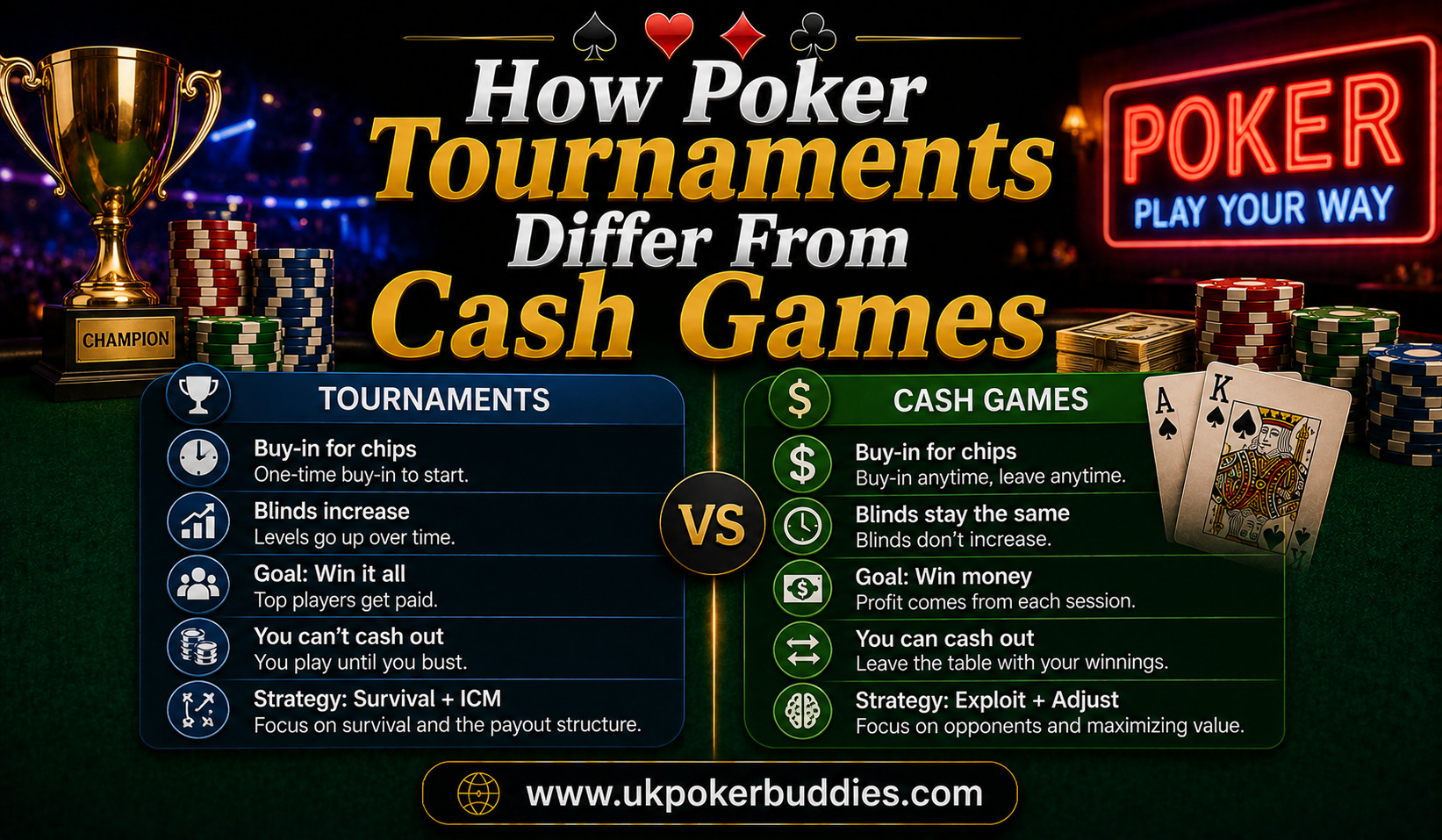
The biggest difference is simple: cash-game chips represent real monetary value during the game, while tournament chips generally represent a player’s position in the competition rather than a direct cash value. From that point, several other strategic differences emerge.
What Is a Poker Cash Game?
A cash game is a poker format in which players buy chips using money and can generally leave the table whenever they choose, subject to the table’s rules. The chips have a fixed monetary value. If a player buys $100 worth of chips, those chips remain worth $100 unless the player wins or loses some of them through play.
Cash games usually have fixed blind levels. For example, a table could operate with 1/2 blinds throughout the session. The blinds do not automatically increase simply because players have been sitting at the table for a certain amount of time.
Another important feature is the ability to reload. If a player loses a portion of their stack, they may be able to purchase additional chips, provided they remain within the table’s minimum and maximum buy-in limits. A player can also generally leave the game and cash out whatever chips remain in their possession.
This creates a poker environment where every hand can be considered primarily in terms of its immediate monetary value. Players are not normally trying to survive until a particular stage of the game. Instead, they are making decisions based on expected value, table conditions, opponent tendencies and the amount of money involved.
What Is a Poker Tournament?
A poker tournament follows a different structure. Players usually pay a predetermined entry fee and receive a starting stack of tournament chips. Those chips are used to compete against other players, but they cannot normally be exchanged directly for cash during the event.
The objective is to accumulate chips and remain in the tournament long enough to reach the paid positions. As players are eliminated, the remaining field becomes smaller. Eventually, the tournament reaches a final table and continues until one player has all the chips.
Tournament blinds typically increase at predetermined intervals. This means a stack that looks comfortable early in the event may become relatively short later as the blind levels rise.
Prize money is distributed according to the tournament’s payout structure. The player who finishes first generally receives the largest prize, while lower finishing positions receive smaller payouts. This creates an additional strategic element because players must consider not only the strength of their hand but also their position in relation to the remaining field and the prize structure.
The Main Difference Between the Two Formats
Although both formats use poker skills, their objectives and strategic pressures are different.
| Feature | Cash Games | Poker Tournaments |
| Chips | Have direct monetary value | Represent tournament position |
| Blinds | Usually remain fixed | Increase during the event |
| Buying more chips | Usually possible | Generally not allowed after entry period |
| Leaving the game | Usually possible | Leaving means forfeiting tournament participation |
| Elimination | Usually not permanent | Losing all chips eliminates the player |
| Main objective | Maximize long-term profit | Finish as high as possible |
| Prize structure | Money won or lost hand by hand | Predetermined tournament payouts |
| Stack importance | Important for betting decisions | Changes significantly as blinds rise |
These differences mean players need to adjust their approach depending on the format they choose.
Tournament Strategy Is More Dynamic
Tournament poker tends to become more demanding as the event progresses. At the beginning, players may have relatively deep stacks compared with the blinds. This can allow them to play more hands and make decisions without immediately risking tournament elimination.
As the blinds and antes increase, however, stacks become shorter relative to the cost of entering each pot. Players can no longer wait indefinitely for premium cards. Stealing blinds, applying pressure and selecting appropriate moments to become aggressive can become increasingly important.
The shrinking field also changes the atmosphere. A player who reaches the final stages is not simply playing for individual hand profits. They are competing for a share of a prize pool, and the difference between finishing one position higher or lower can sometimes be financially significant.
This is why tournament poker often involves decisions that would look unusual in a standard cash game. A player may fold a hand that could be profitable in a cash game because tournament survival or payout considerations make the risk less attractive.
Cash Games Put More Focus on Immediate Value
Cash-game poker generally offers greater freedom because players are not locked into a tournament structure. If a player doubles their stack, they can continue playing with those chips. If they lose most of their stack, they may have the opportunity to buy more.
Because blinds usually remain stable, players can also take a more patient approach. There is less pressure to accumulate chips simply because time is passing.
For example, imagine a 1/2 cash games where a player has $200. If the player loses $50, they still have $150 and can continue playing. The blinds do not suddenly increase because the player has been at the table for several hours.
That stability makes cash games particularly suited to players who prefer analyzing individual hands, opponent tendencies and long-term profitability rather than managing a tournament life.
Tournament Chips Do Not Have a Simple Cash Value
One of the most important concepts for tournament players is that tournament chips are not equivalent to cash.
Suppose a player pays $100 to enter a tournament and receives 10,000 tournament chips. It would be incorrect to assume that each chip always represents one cent of cash. The value of those chips changes according to the tournament’s structure, remaining players and payout distribution.
This concept becomes especially important near the final table. A player may have a large chip stack but still need to make carefully calculated decisions because the monetary value of gaining chips is not exactly equal to the monetary value of losing them.
Tournament strategy therefore involves balancing chip accumulation with the potential consequences of elimination.
Risk and Reward Work Differently
Risk management is another major difference between cash games and tournaments.
In a cash game, losing your entire stack does not necessarily mean you are finished playing. You can often buy another stack if you have sufficient funds and the table allows it. The financial consequence is immediate, but your ability to continue is not automatically removed.
In a tournament, losing your entire stack usually ends your participation. This creates a form of tournament-specific pressure. Players have to decide when a potentially profitable gamble is worth the possibility of elimination.
At the same time, being too cautious can also be dangerous. Because blinds increase, a player who continually waits for premium hands may eventually find their stack too small to make meaningful moves.
The challenge is therefore finding the right balance between survival and accumulation.
The Importance of Position Changes
Position matters in every form of poker, but tournament conditions can make it even more significant. As players are eliminated, tables are reshuffled and the number of opponents at each table changes.
A player may suddenly find themselves at a short-handed table, where wider ranges and more aggressive play can become necessary. Later, at a final table, the pressure of increasing payouts can further change how players approach each hand.
Cash games can also become short-handed, but the player usually has greater control over whether to remain in that situation. They can leave the table or potentially select another table, depending on the poker room.
Which Format Is Better for Beginners?
There is no universal answer because the better format depends on the player’s goals and personality.
Cash games may appeal to players who want greater flexibility and prefer making decisions based on individual hand profitability. The ability to leave the table or rebuy can also make the format easier to understand from a money-management perspective.
Tournaments may be more attractive to players who enjoy competition, structured progression and the excitement of trying to outlast a large field. However, tournaments require an understanding of changing blind levels, stack sizes and payout pressure.
Beginners should focus on learning the fundamental rules and developing disciplined bankroll habits before becoming overly concerned with advanced strategies.
Key Things Players Should Understand
Before choosing between a tournament and a cash table, players should understand these core differences:
- Cash-game chips have a direct monetary value, while tournament chips primarily determine a player’s competitive position.
- Tournament blinds normally increase, creating additional pressure as the event progresses.
- Cash games usually provide greater flexibility because players can often buy in, leave or reload according to table rules.
- Tournament players must balance chip accumulation with the risk of elimination and the structure of the prize pool.
Why Players Often Switch Between Formats
Many experienced poker players participate in both tournaments and cash games because each format develops different skills.
Cash games can sharpen decision-making around individual hand value, bet sizing and opponent tendencies. Tournaments can improve skills related to stack management, changing blind levels, table dynamics and pressure situations.
Moving between the two formats can initially be challenging. A strategy designed for deep-stack cash poker may not work effectively when tournament stacks become short. Similarly, overly cautious tournament habits may prevent a player from taking profitable opportunities in a cash game.
The ability to recognize these differences is therefore an important part of becoming a more adaptable poker player.
Final Thoughts
Poker tournaments and cash games may share the same basic rules, but they create fundamentally different strategic environments. Cash games focus heavily on the value of individual hands and long-term monetary decisions, while tournaments add changing blinds, player elimination, prize structures and increasing competitive pressure.
Neither format is automatically better than the other. The right choice depends on what a player enjoys and how comfortable they are with risk, changing conditions and different styles of decision-making.
For anyone learning poker, understanding the structure before sitting down is just as important as understanding the cards. Once players recognize how chips, blinds, payouts and elimination work differently, they can approach tournaments and cash games with much clearer expectations.
Frequently Asked Questions
1. What is the biggest difference between a tournament and a cash game?
The biggest difference is how chips and the objective of play work. Cash-game chips have direct monetary value, while tournament chips are used to determine a player’s position and eventual share of the prize pool.
2. Can players leave a poker tournament whenever they want?
A player can leave physically, but doing so normally means giving up their remaining tournament participation. Cashing out tournament chips like cash-game chips is generally not an option.
3. Do blinds increase in cash games?
Usually, cash-game blinds remain fixed at the levels established for the table. Tournament blinds generally increase according to a predetermined schedule.
4. Can you rebuy in a cash game?
Most cash games allow players to purchase additional chips within the table’s established buy-in limits. Tournament re-entry or rebuy opportunities depend on the specific event and are normally available only during designated periods.
5. Is tournament poker harder than cash-game poker?
Neither format is simply harder. They require different skills. Cash games emphasize long-term hand profitability, while tournaments require players to adapt to changing blinds, stack sizes, field sizes and payout pressure.