

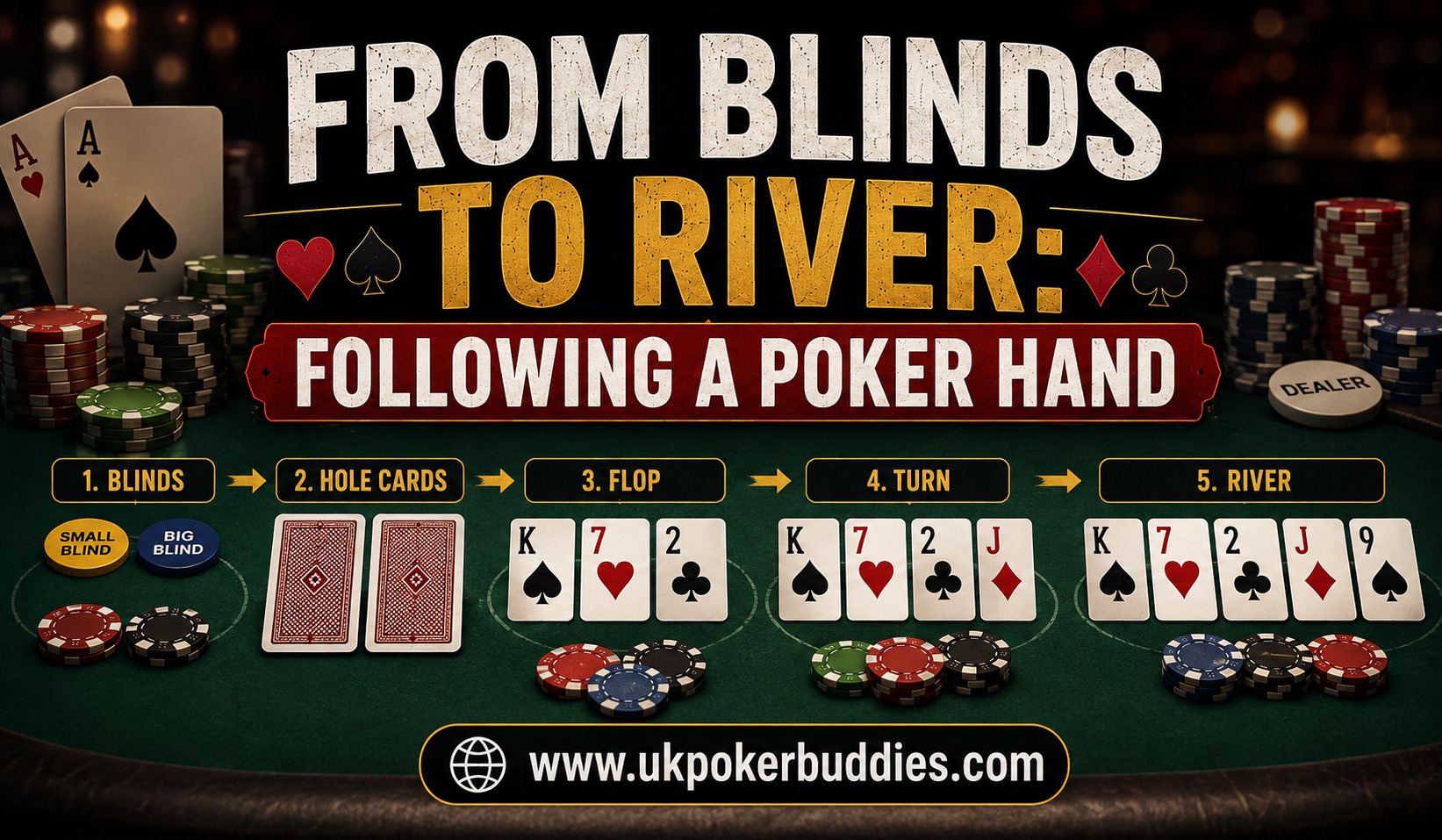
Following a Poker Hand Step by Step
A poker hand can look complicated when viewed for the first time. Players post chips, receive private cards, place bets, and watch community cards appear one by one. Around the table, the action may seem fast, but there is a clear structure behind every decision. Understanding that structure is one of the first steps toward becoming comfortable with poker.
From the opening blinds to the final river card, a hand follows a predictable sequence. While specific rules can vary between poker variants, Texas Hold’em provides one of the clearest examples of how a modern poker hand develops. Each stage introduces new information, changes the possible combinations players can make, and creates another opportunity to bet, fold, call or raise.
How a Poker Hand Begins
Before any cards are dealt, the table needs to establish the dealer position. In live poker, a small disc known as the dealer button identifies that position. The button moves around the table after every completed hand, ensuring that players rotate through different positions.
The two players immediately to the left of the button normally post the small blind and big blind. These are forced bets designed to create an initial pot and encourage players to compete for it.
Once the blinds have been posted, the dealer distributes the private cards. In Texas Hold’em, every player receives two hole cards. These cards remain private and become the starting point for each player’s decision-making process.
The opening stage may seem simple, but position is already influencing the hand. Players acting earlier have less information about what opponents intend to do, while players acting later can observe more of the action before making their own decisions.
The Pre-Flop: The First Major Decision
The first betting round is known as the pre-flop. At this point, no community cards have been revealed, so players must evaluate their two private cards without knowing what will appear on the board.
The action begins with the player to the left of the big blind in a standard Texas Hold’em game. Depending on the decisions made around the table, a player may fold, call the big blind or raise.
A fold removes the player from the current hand. Calling means matching the existing bet, while raising increases the amount that other players must pay to continue.
The pre-flop stage can quickly reduce the number of players involved. Strong bets may encourage opponents with weaker starting hands to fold, while several calls can create a multi-player pot.
Common pre-flop actions include:
- Fold: Give up the hand and surrender any chips already committed.
- Call: Match the current required bet.
- Raise: Increase the amount being wagered.
- Check: Pass the action without betting when the rules allow it.
The betting continues around the table until the required bets are matched or players have folded. Once the betting round is complete, the game moves to the first community-card stage.
The Flop Reveals Three Community Cards
The flop is where the character of a poker hand can change dramatically. Three community cards are placed face up in the center of the table.
These cards are available to every remaining player. Combined with their two hole cards, players now have five visible cards from which they can begin constructing their best possible five-card poker hand.
The flop often provides much more information than the pre-flop stage. A player holding two cards of the same suit may suddenly have a potential flush draw. Someone holding a pair may improve to three of a kind, while connected cards can create straight possibilities.
However, the flop does not guarantee that a promising hand will become a winning hand. Players must consider what their opponents could hold and what future cards might change the situation.
Another betting round begins after the flop. The first remaining player to the left of the button generally acts first, and the action continues clockwise.
Reading the Action After the Flop
The betting after the flop is often more informative because players now have access to three shared cards. The size and timing of bets can influence how opponents perceive the strength of a hand.
For example, a player who makes a large bet on a coordinated board may be representing a strong hand or a powerful draw. Another player might respond by calling rather than raising, potentially indicating a different type of holding.
However, betting patterns should not be interpreted as absolute evidence. Poker involves incomplete information, and players can use different strategies depending on the situation.
The key is to understand that every betting decision adds another piece of information to the hand.
The Turn Brings a Fourth Community Card
After the flop betting round ends, the dealer reveals the turn. This is the fourth community card in Texas Hold’em.
The turn is often considered one of the most important moments in a hand because it gives players another card that can significantly change their possible combinations.
A player who was drawing toward a straight or flush may complete that draw. A seemingly harmless card can also create new possibilities for opponents. At the same time, a card that improves one player’s hand may make another player’s previous advantage much weaker.
The second major post-flop betting round follows the turn. By this point, the pot can become substantially larger, particularly when players have continued betting aggressively.
| Stage | Cards Available | Main Development |
| Pre-Flop | 2 private cards | Players evaluate starting hands |
| Flop | 3 community cards | First shared information appears |
| Turn | 4 community cards | New draws and combinations develop |
| River | 5 community cards | Final board is completed |
| Showdown | All available cards | Remaining players compare hands |
Why the Turn Can Change Everything
The turn creates a different strategic environment from the flop. With only one community card remaining, players have less opportunity to improve their hands.
A drawing hand that misses on the turn has one final chance to improve on the river. Meanwhile, a player holding a strong hand may begin protecting it through larger bets.
This is also the stage where pot size becomes particularly important. Players may have already invested considerable chips, but previous investments do not automatically justify continuing. Each decision still needs to be considered based on the current situation.
Good poker decisions are therefore not simply about whether a player has a strong hand. They involve evaluating the board, possible opponent holdings, position, betting patterns and the potential cost of continuing.
The River Completes the Board
The final community card is called the river. Once it is dealt, the board is complete.
No additional community cards will appear, so players now know every shared card that can be used to construct their final hand. If a player was waiting for a particular card to complete a straight or flush, the river determines whether that draw succeeded.
The river also creates one final betting opportunity. Depending on the action, a player may check, bet, call, raise or fold.
This stage can produce some of the most dramatic moments in poker. A player who appeared to be comfortably ahead may discover that the river completed an opponent’s draw. Conversely, a player who was behind may improve to the winning hand with the final card.
The Final Betting Round
The river betting round is different from earlier stages because there are no future cards to consider. Players are making decisions based on the completed board.
A player with a strong hand may bet for value, hoping an opponent with a weaker hand will call. Another player may attempt a bluff, representing a stronger holding than they actually possess.
The amount wagered can also influence the opponent’s decision. A small bet may encourage a call, while a large wager can put significant pressure on a player with a marginal hand.
At the end of the betting round, there are two possible outcomes. Everyone except one player may fold, in which case the remaining player wins the pot without showing their cards. If two or more players remain, the hand reaches showdown.
The final stages of a hand usually look like this:
- The river card is dealt.
- Remaining players complete the final betting round.
- Players who fold leave the hand.
- Remaining players reach showdown or one player wins through a final uncalled bet.
Showdown: Determining the Winner
If more than one player remains after the final betting round, the players reveal their hole cards. This is called the showdown.
Each player combines their two private cards with the five community cards to make the strongest possible five-card poker hand. Importantly, players do not necessarily have to use both hole cards. Depending on the board, their best hand may use both, one or neither of their private cards.
The player with the highest-ranking eligible hand wins the pot. If players have identical five-card hands, the pot can be split.
The showdown is the conclusion of the hand, but it also provides valuable information for spectators and players. Seeing how the cards actually fit together helps explain why particular betting decisions were made.
What Happens After the Pot Is Awarded?
Once the winner is determined, the dealer pushes or distributes the pot to the appropriate player. The cards are collected, the dealer button moves to the next position, and new blinds are posted.
The next hand then begins.
This continuous rotation is one of the defining features of poker. A player who was on the button in one hand may be in a blind position shortly afterward. Over a long session, everyone experiences different positions and different situations.
Following a Hand Without Getting Lost
For beginners, the easiest way to follow live poker is to focus on three things: the betting action, the community cards and the player’s position.
Instead of trying to understand every strategic decision immediately, first identify who has posted the blinds and where the action begins. Then watch how many players continue to flop. Once the flop appears, compare the board with the possible hands players might have.
As the turn and river arrive, pay attention to how the betting changes. A player who was passive earlier may suddenly make a large bet, while another may slow down after a dangerous card appears.
A simple viewing framework
- Before the flop: Watch the starting hands and opening decisions.
- On the flop: Look at how the three community cards change the possibilities.
- On the turn: Notice which draws and combinations become stronger.
- On the river: Focus on the completed board and final betting decisions.
With practice, following the action becomes much easier.
Conclusion
Following a poker hand from blinds to river becomes much easier once its structure is understood. The blinds begin the action, the pre-flop introduces the first decisions, and the flop brings the first three shared cards. The turn adds another layer of possibilities, while the river completes the board and leads to the final decision.
For anyone learning poker, understanding this sequence provides a foundation for everything that follows. Strategy, probability and psychology become easier to appreciate when the basic rhythm of the hand is already familiar. Every hand may develop differently, but the journey from blinds to river gives poker its recognizable structure—and much of its enduring appeal.
Frequently Asked Questions
How many betting rounds are there in Texas Hold’em?
There are normally four betting rounds: pre-flop, flop, turn and river.
What happens first, the blinds or the cards?
The blinds are posted before the private cards are dealt. Once the blinds are in place, players receive their hole cards and the pre-flop betting begins.
How many community cards are dealt?
Texas Hold’em uses five community cards: three on the flop, one on the turn and one on the river.
Can a player win without reaching the river?
Yes. If every opponent folds during an earlier betting round, the remaining player wins the pot without needing to see the remaining community cards.
What is the showdown?
The showdown occurs when two or more players remain after the final betting round. Players reveal their hole cards and the best eligible five-card hand wins.