

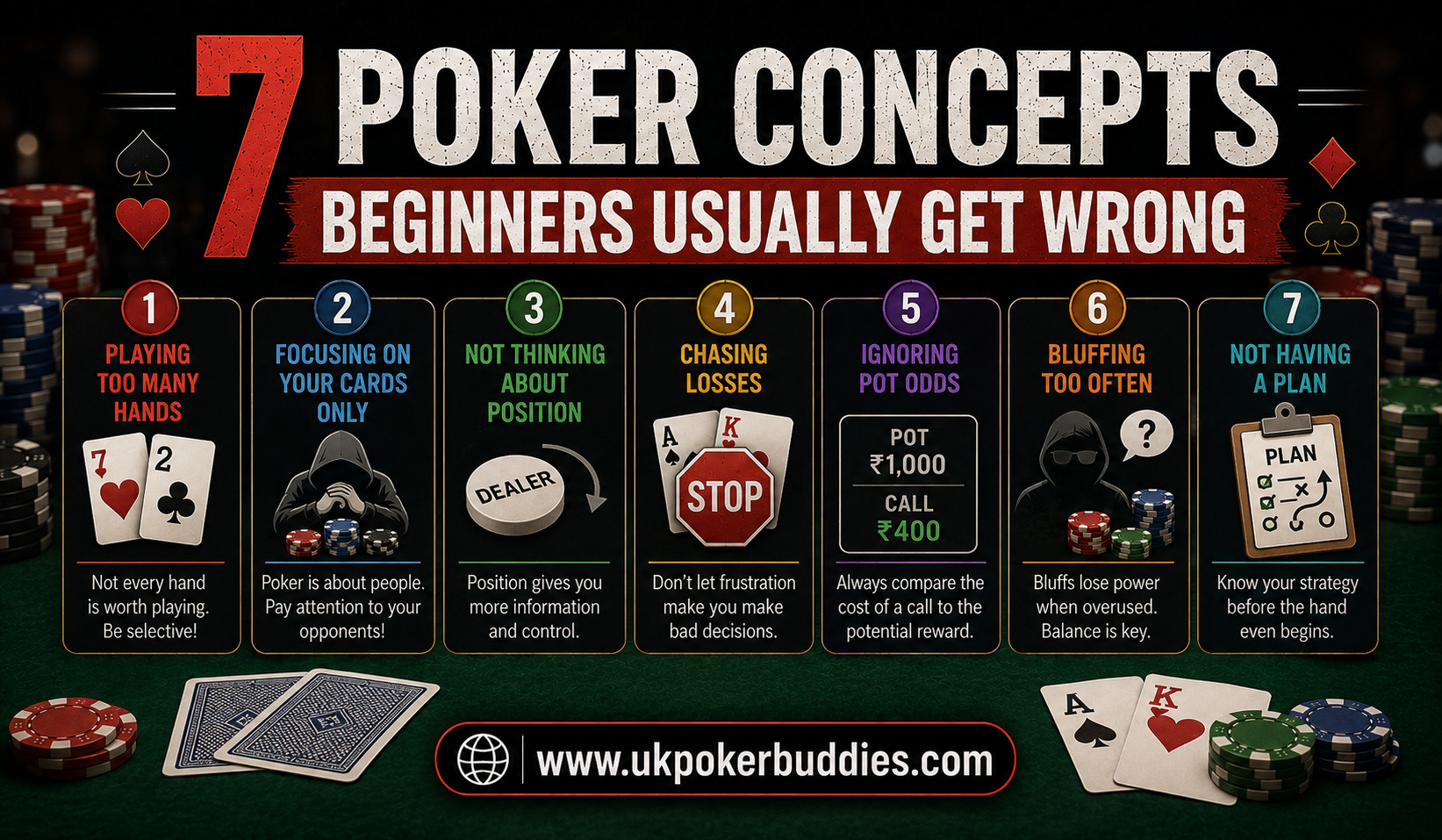
Poker is often introduced as a simple card game: receive cards, make a hand and try to win the pot. But once a beginner starts playing, the game quickly becomes more complicated. Position, probability, betting patterns, hand ranges and psychology all influence decisions, and several common assumptions can lead new players in the wrong direction.
Many poker mistakes are not caused by a lack of intelligence or effort. They come from misunderstandings about how the game actually works. A player may believe that a strong starting hand should always be played aggressively, that winning individual hands proves good strategy, or that a draw is automatically worth chasing.
Correcting these ideas can make poker easier to understand and can help beginners develop a more disciplined approach. Here are seven poker concepts that new players frequently misunderstand.
1. A Strong Starting Hand Does Not Guarantee Victory
One of the most common beginner mistakes is treating a strong starting hand as if it were already a winning hand.
In Texas Hold’em, receiving pocket aces, kings or another premium combination is certainly a favorable situation. However, the hand still has to survive several betting rounds and community cards.
The flop, turn and river can completely change the situation. An opponent may connect with a straight, flush, set or other stronger combination. Even if your starting hand remains relatively strong, the board may create a difficult decision.
This is why experienced players do not simply ask, “How strong are my cards?” They also consider the board, position, number of opponents and betting action.
| Beginner Assumption | More Accurate View |
| Pocket aces always win | Pocket aces are very strong but can still lose |
| A premium hand should never be folded | Strong hands can become vulnerable |
| Starting cards determine the result | Community cards and decisions also matter |
| Strong cards justify any bet | Bet size should reflect the situation |
The lesson is simple: starting-hand strength is a starting point, not a guarantee.
2. Winning a Hand Does Not Always Mean You Played It Well
Another important misconception is judging a poker decision entirely by its result.
Suppose a player calls a large bet with very poor odds and happens to hit the perfect card on the river. They may win the pot, but that does not necessarily mean the call was mathematically correct.
The opposite can also happen. A player may make a strong decision with favorable odds and still lose because the expected result did not occur this time.
Poker involves variance, meaning short-term results can differ significantly from long-term expectations.
Beginners should separate these two ideas:
- Decision quality: Whether the action made sense based on the information available.
- Result: Whether the player actually won or lost the hand.
- Variance: The natural short-term fluctuation caused by probability.
This distinction is one of the most valuable lessons a beginner can learn. Good poker is about making profitable decisions repeatedly, not winning every individual hand.
3. You Do Not Need to Play Every Hand
New players sometimes believe that sitting at a poker table means they should participate in almost every hand.
That approach can quickly become expensive.
Poker rewards selectivity. A player can fold many hands and still remain an active competitor. In fact, folding is one of the most important decisions in poker because it prevents players from investing chips in situations where their prospects are poor.
Playing too many hands can create difficult post-flop situations. A player may enter a pot with weak or dominated cards and then feel committed after connecting with a small pair or draw.
The better approach is to understand that folding is not a sign of weakness. It is part of controlling risk.
At the same time, beginners should avoid swinging to the opposite extreme and folding everything except premium cards. Poker requires balance, and position can make some weaker hands playable.
4. Position Is More Important Than Many Beginners Realize
Position is frequently misunderstood because it does not appear on the cards.
A player’s position determines when they act relative to the other players. Someone acting later in a betting round has more information because they have already seen what opponents have done.
This information advantage can be significant.
A player in late position may be able to enter a pot with a wider range because fewer opponents remain behind them. Meanwhile, an early-position player must act without knowing how several opponents will respond.
Position generally affects:
- How wide a player’s starting range can be.
- How much information is available before making a decision.
- The ability to control pot size.
- The profitability of certain bluffs and value bets.
Beginners often focus heavily on their cards and overlook where they are sitting. Experienced players consider both.
5. A Draw Is Not the Same as a Made Hand
Seeing four cards that could become a straight or flush can be exciting. But a draw is still an unfinished hand.
For example, a player with four cards toward a flush has a strong possibility of improving, but the flush does not yet exist. The player must still receive a suitable future card.
This distinction matters because chasing draws can become expensive.
Players should consider their outs, pot odds and the possibility that some apparent outs may not be clean. A card that completes your draw might also give an opponent a stronger hand.
The correct question is therefore not simply, “Can I hit my draw?” It is, “Is continuing to invest chips worthwhile given my chances and the price I am being offered?”
That small change in thinking can dramatically improve decision-making.
6. Bluffing Is Not About Betting Randomly
Movies and television often make poker bluffing look like a dramatic act of courage. A player pushes chips forward, stares down an opponent and somehow convinces them to fold.
Real poker is usually more structured.
A good bluff generally has a reason behind it. The player considers the board, their perceived range, the opponent’s likely range and how the betting sequence tells a believable story.
For example, a river bluff may be more effective when the final community card creates a strong combination that the bluffer could realistically represent.
Randomly betting large amounts with weak cards is not the same as strategic bluffing.
Effective bluffing usually considers:
- The board texture.
- The opponent’s likely holdings.
- The size of the bet.
- The probability that the opponent will fold.
- Whether the betting story makes sense.
Beginners should therefore avoid thinking of bluffing as a requirement. A player does not need to bluff constantly to play good poker.
7. Poker Is Not About Guessing an Exact Opponent’s Cards
Perhaps one of the biggest misunderstandings is the idea that skilled poker players can always identify exactly what an opponent holds.
In reality, strong players usually think in terms of ranges.
A range is a collection of possible hands that an opponent could reasonably have based on their position and actions.
Suppose an opponent raises before the flop. Instead of deciding they definitely have pocket aces, a player might consider several possible hands, including premium pairs, medium pairs and strong high-card combinations.
As additional cards appear and the opponent continues betting, the possible range can become narrower.
This approach is more realistic because poker is a game of incomplete information.
Why These Misconceptions Matter
These seven concepts are connected. A beginner who believes that strong starting cards guarantee victory may also overvalue those cards after the flop. Someone who thinks every draw should be chased may ignore pot odds. A player who focuses only on winning individual hands may struggle to understand variance.
Correcting one misconception often improves several parts of a player’s game at once.
The goal is not to memorize complicated strategy charts. It is to develop a way of thinking that asks better questions.
Instead of asking, “Will I win this hand?” a player can ask, “Is this decision profitable?” Instead of asking, “What exact card does my opponent have?” they can ask, “What range of hands makes sense?”
That shift from certainty to probability is central to understanding poker.
A Better Way for Beginners to Study Poker
Learning poker works best when concepts are introduced gradually. Trying to master advanced mathematics, psychology and game theory at the same time can make the game unnecessarily confusing.
Start with the basic hand rankings and betting structure. Then learn position, starting-hand selection and the fundamentals of pot odds. Once those ideas become familiar, concepts such as ranges, equity and expected value become easier to understand.
It can also be useful to review completed hands. Instead of focusing only on whether you won, examine the decisions made at each stage.
A useful hand-review process is:
- Identify the starting position and hole cards.
- Review the action before the flop.
- Examine how the flop changed the possible hands.
- Consider whether the turn and river changed the original plan.
This process encourages players to think about decisions rather than outcomes.
Conclusion
Poker becomes much easier to understand when common misconceptions are replaced with more realistic ideas. Strong starting cards are valuable but not unbeatable. Winning does not automatically prove that a decision was correct, and losing does not necessarily mean a player made a mistake.
Position, ranges, pot odds and disciplined folding are just as important as the cards themselves. Draws need to be evaluated rather than chased automatically, while bluffing works best when it fits the story of the hand.
Ultimately, good poker is less about predicting the future with certainty and more about making the best decision with incomplete information. Once beginners understand that principle, many of the game’s seemingly complicated concepts start to make much more sense.
Frequently Asked Questions
What is the biggest mistake poker beginners make?
One of the most common mistakes is playing too many hands. Beginners often feel they need to participate frequently, but folding is an important part of good poker strategy.
Does having pocket aces mean you should always win?
No. Pocket aces are an excellent starting hand, but they can lose when community cards improve an opponent’s hand or when the overall situation becomes unfavorable.
Should beginners bluff often?
No. Bluffing should have a strategic purpose. Beginners can focus first on understanding hand strength, position, betting and opponent ranges.
What is a poker draw?
A draw is an incomplete hand that could become stronger if a suitable future community card appears. Flush and straight draws are common examples.
Why is position so important?
Position determines when a player acts. Acting later provides more information about opponents’ decisions and can make certain hands and strategies more profitable.