

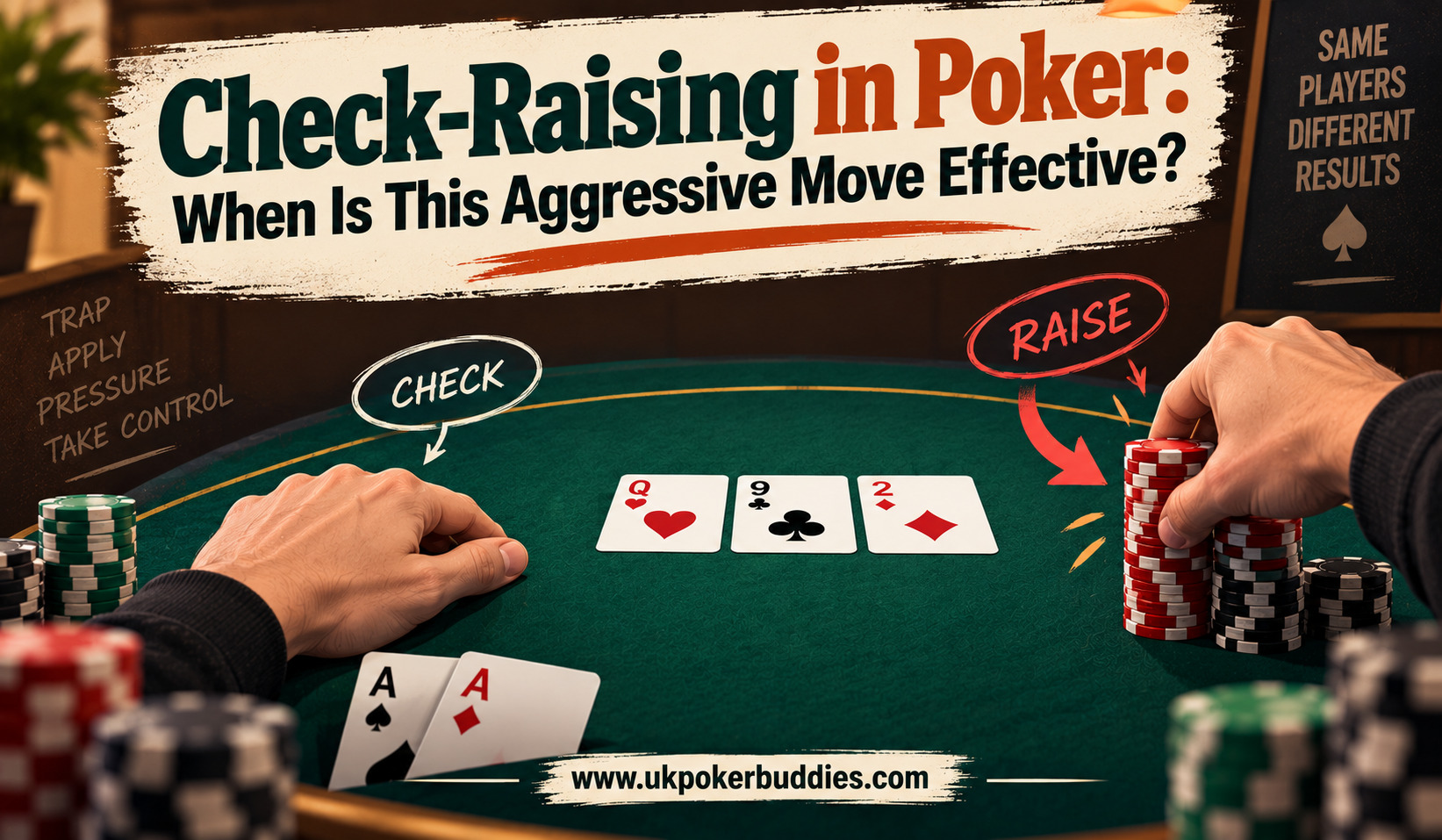
Poker is a game where the order of your actions can be just as important as the cards you hold. One strategy that demonstrates this perfectly is the check-raise in poker. Instead of betting immediately, a player checks, waits for an opponent to bet, and then raises that bet.
At first, check-raising may seem unusual. Why give an opponent the opportunity to bet instead of simply betting yourself? The answer is that checking can encourage opponents to put chips into the pot with hands they might otherwise fold against a direct bet.
When used in the right situations, a check-raise can build a larger pot with a strong hand, apply pressure with a bluff, or punish opponents who bet too frequently.
What Is a Check-Raise in Poker?
A check-raise is a two-step betting action.
First, a player checks when it is their turn to act. If an opponent behind them makes a bet, the original player then raises.
For example, imagine you are playing Texas Hold’em and the flop is dealt. You decide to check. Your opponent bets, and you respond by raising.
That is a check-raise.
The move can be used with strong hands, drawing hands, and selected bluffs. Its effectiveness comes from allowing your opponent to take the first aggressive action before responding with greater pressure.
Why Do Players Check-Raise?
There are several reasons to use a check-raise.
The first is value. If you have a very strong hand, allowing an opponent to bet before raising can help you build a larger pot.
The second is bluffing. A check-raise can represent significant strength and force an opponent to fold hands that might otherwise continue against a smaller bet.
The third is protection. A player with a vulnerable but strong hand may check-raise to make drawing hands pay more to continue.
The important point is that a check-raise should have a purpose. Randomly checking and raising without considering the board or opponent can quickly become expensive.
Check-Raising With Strong Hands
One of the most straightforward uses of a check-raise is with a strong made hand.
Suppose you flop a set or another powerful combination. If you immediately bet, your opponent might fold weaker hands.
By checking first, you may give your opponent an opportunity to bet. When they do, you can raise and potentially extract more value.
This strategy can work particularly well against aggressive opponents who frequently bet when checked to.
However, slow-playing a strong hand has a downside. If everyone checks behind, you may miss an opportunity to build the pot.
Therefore, the decision should depend on how likely your opponent is to bet and how the board is developing.
Check-Raising as a Bluff
A check-raise does not always mean that you have a monster hand.
Players can also use check-raises as bluffs.
Imagine your opponent makes a continuation bet on the flop. You believe their range contains many hands that missed the board. Instead of folding or calling, you check-raise and apply pressure.
Your opponent may decide that continuing is too expensive and fold.
This can allow you to win the pot even though your hand is not currently strong.
Bluff check-raises should be selected carefully. You need to consider whether your opponent’s range contains enough hands that can realistically fold.
Semi-Bluff Check-Raises
Some of the most useful check-raises involve drawing hands.
Suppose you have a strong flush draw or straight draw. You may not currently have a made hand, but you have several ways to improve.
By check-raising, you create fold equity while retaining the chance to win if your draw completes.
This is called a semi-bluff.
The advantage is that you can win in two ways. Your opponent can fold immediately, or you can improve on a later street and potentially win at showdown.
A semi-bluff check-raise can therefore be more attractive than a pure bluff because your hand still has meaningful equity when called.
The Importance of Position
Position plays an important role in understanding check-raises.
A check-raise generally occurs when you act before your opponent, because you need an opponent to bet after your check.
This means check-raising is closely connected to out-of-position play.
Being out of position is normally a disadvantage, but checking can sometimes allow you to turn that situation into an opportunity. Instead of always betting first, you can give an opponent the chance to take the aggressive action and then respond.
However, you should not assume that being out of position automatically makes check-raising profitable. The opponent’s tendencies and the board remain important.
Board Texture Matters
The flop or turn can have a major impact on whether a check-raise makes sense.
A board with many connected cards can create numerous possible draws. If you check-raise on such a board, your opponent may have several strong hands and drawing combinations that can continue.
On a dry board, your check-raise may represent a narrower group of strong hands, depending on the situation.
You should also consider how the board interacts with each player’s likely range.
If the community cards strongly favor your opponent’s range, bluffing with a check-raise may be difficult. If the board contains cards that fit your perceived range, your aggression may be more credible.
Check-Raising Against Continuation Bets
Check-raising is often used as a response to continuation betting.
A player raises before the flop and then bets after the flop. This continuation bet may contain strong hands, drawing hands, and bluffs.
If you believe the opponent is c-betting too frequently, a check-raise can put pressure on the weaker portion of their range.
However, you should not automatically assume that every continuation bet is weak.
Before check-raising, consider the flop, the opponent’s pre-flop range, and their likely response to aggression.
A player who rarely folds to check-raises may be a poor target for a bluff.
Check-Raising and Bet Sizing
The size of both the opponent’s bet and your raise matters.
If your check-raise is too small, you may fail to create enough pressure or give drawing hands attractive odds to continue.
If it is excessively large, you may risk too many chips and make your strategy easier to interpret.
Your sizing should generally reflect the pot, board texture, effective stack size, and your intended outcome.
A value check-raise and a bluff check-raise should also fit within a balanced overall strategy. If you use huge raises only when bluffing, observant opponents may eventually identify the pattern.
When Should You Avoid a Check-Raise?
A check-raise is not automatically better than calling or folding.
You may want to avoid the move when your opponent has a range that is particularly strong or when they are unlikely to fold.
It can also be problematic when your hand has little equity and you have no convincing way to represent strength.
Another consideration is the number of players in the pot.
Check-raising becomes more complicated in multiway situations because more than one opponent may have a hand strong enough to continue.
Common Check-Raising Mistakes
Beginners often check-raise simply because they want to appear aggressive.
Aggression without a clear reason can be costly.
Another common mistake is using the strategy too frequently. If you check-raise almost every time you have a playable hand, opponents can adjust by checking behind more often or calling with stronger ranges.
Some players also forget to think about what happens after their check-raise is called.
A check-raise is not the end of the hand. You need a plan for the turn and river, particularly when bluffing.
How to Use Check-Raises More Effectively
Before making a check-raise, ask yourself several questions.
Why am I checking?
If your opponent bets, which hands do I expect them to have?
Which parts of their range can fold to my raise?
Does my hand have enough value or drawing equity to continue if called?
Does the board support the story I am representing?
What will I do on the next street if my opponent calls?
These questions can prevent emotional or automatic decisions.
The best check-raises are usually based on a combination of range analysis, board texture, opponent tendencies, and your own hand’s potential.
Check-Raising vs. Calling
Sometimes calling is better than check-raising.
Calling can keep weaker hands and bluffs in your opponent’s range. It can also allow you to control the size of the pot when your hand does not need immediate protection.
Check-raising, on the other hand, creates greater pressure and can build a larger pot.
The correct choice depends on the situation.
A strong hand may benefit from either approach depending on how aggressive your opponent is. A drawing hand may prefer a check-raise when fold equity is valuable.
There is no universal rule that says one action is always superior.
Final Thoughts
Check-raising in poker is a powerful strategy because it combines deception, aggression, and information. By checking first, you can encourage an opponent to bet and then respond with a raise that puts pressure back on them.
The move can be used for value with strong hands, as a bluff with weaker holdings, or as a semi-bluff when you have a strong drawing hand.
However, successful check-raising requires more than simply being aggressive. You need to understand your opponent’s range, evaluate the board, consider position, choose an appropriate bet size, and have a plan for future streets.
The most important lesson is that a check-raise should always have a purpose. When used selectively and in the right situations, it can become an effective tool for winning larger pots and putting difficult decisions in front of your opponents.