

Poker is a game of decisions made with incomplete information. You rarely know exactly which cards your opponents are holding, so judging whether a decision is profitable requires more than simply looking at your own hand. One of the most useful concepts for making better decisions is poker equity.
Poker equity represents your estimated share of the pot based on the likelihood that your hand will win by the end of the hand. It helps players compare their chances against an opponent’s possible holdings and decide whether continuing in a hand makes sense.
Understanding equity does not guarantee that you will win individual hands. Instead, it gives you a mathematical way to evaluate decisions over the long run.
What Is Poker Equity?
Poker equity is the percentage chance that your hand will win the pot at a particular point in the hand.
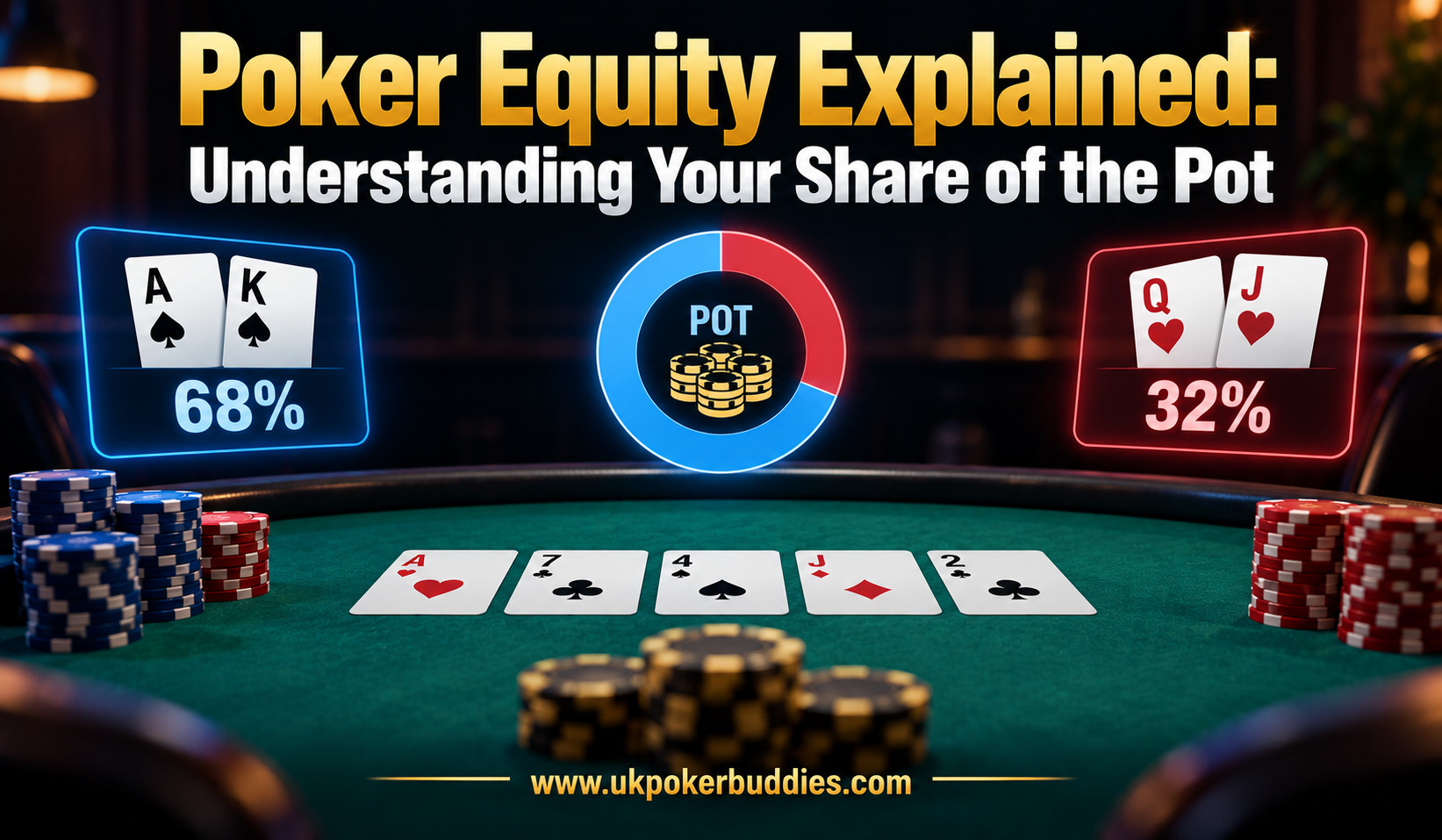
For example, if your hand has approximately 60% equity against your opponent’s hand, you can think of yourself as having roughly a 60% chance of winning the pot, assuming the hand reaches showdown and no additional factors change the calculation.
Your opponent would have approximately 40% equity in that specific matchup.
Equity can also be calculated against a range of possible hands rather than one known hand. Since you usually cannot see your opponent’s cards, range-based equity is often more useful in real poker situations.
Why Poker Equity Matters
Equity helps answer an important question: How strong is my hand relative to what my opponent could have?
Imagine you have a strong pair, but the board contains several connected cards that create potential straight and flush draws. Your hand may look strong on its own, but its equity could be much lower against an opponent’s likely range.
Without considering equity, it is easy to overestimate the strength of a hand.
Equity also helps players understand why a hand can be worth continuing with even when it is currently behind. Drawing hands can have significant equity because they have opportunities to improve on later streets.
This makes equity particularly useful when deciding whether to call a bet, raise, or continue with a draw.
How Poker Equity Is Calculated
Poker equity is based on the possible outcomes of the remaining cards.
Suppose two players are all-in before the river. There are a limited number of possible combinations for the remaining community cards. By evaluating those outcomes, you can determine how often each hand wins, loses, or ties.
For example, if your hand wins in roughly 70% of possible runouts and your opponent wins in the remaining 30%, your equity would be approximately 70%.
In real games, however, the calculation is more complicated because you do not know your opponent’s exact hand. Instead, you estimate their range and calculate how your hand performs against that collection of possibilities.
Equity Against a Hand vs. Equity Against a Range
There is an important difference between these two concepts.
Equity against a specific hand assumes you know exactly what your opponent holds.
For example, if you somehow know your opponent has a particular pocket pair, you can calculate your hand’s chances against that exact holding.
Equity against a range considers multiple hands your opponent might have.
This second approach is much closer to real poker. If an opponent raises before the flop, you may believe they could have premium pairs, strong aces, medium pairs, suited combinations, and other playable hands.
Your equity is then measured against the entire range rather than one specific combination.
Poker Equity and Pot Odds
Equity becomes especially useful when comparing your chances of winning with the price you are being offered to continue.
This is where pot odds come into the picture.
Pot odds describe the relationship between the amount you need to call and the total pot you could potentially win. Equity describes your estimated chance of winning.
If your estimated equity is greater than the percentage required by the pot odds, a call may be mathematically favorable, assuming your assumptions are accurate and other factors are accounted for.
For example, imagine there is ₹1,000 in the pot and your opponent bets ₹500. You would need to call ₹500 to compete for a total pot of ₹2,000.
Your required winning percentage would be 25%.
If your hand has significantly more than 25% equity against your opponent’s likely range, calling may be worth considering.
This simplified example shows why equity and pot odds are often discussed together.
Equity Changes Throughout the Hand
Poker equity is not fixed.
Your equity can change dramatically from the pre-flop stage to the flop, turn, and river.
A hand that has reasonable equity before the flop may become much stronger after the flop improves it. Conversely, a strong starting hand can lose equity when the community cards create favorable possibilities for an opponent.
For example, a pocket pair might have a strong position before the flop. If the flop contains several cards that connect with an opponent’s likely range, the relative strength of the pocket pair may decrease.
This is why players need to reassess equity as new cards appear.
Drawing Hands and Equity
Draws are a major reason poker equity can be misunderstood.
A player holding a drawing hand may currently be behind but still have meaningful equity because future cards can improve the hand.
For instance, a flush draw may not be a made hand yet, but it can have a substantial chance of becoming a flush by the river.
The same principle applies to straight draws, combination draws, and other hands with multiple ways to improve.
Instead of asking only, “Am I ahead right now?” players should also ask, “How often can I improve, and how does my hand perform against the opponent’s range?”
Equity Realization
Having a certain amount of theoretical equity does not always mean you will actually receive that full value.
This idea is known as equity realization.
Suppose your hand has 40% equity against an opponent’s range. You might not realize the full 40% if you are forced to fold on later streets, make difficult decisions, or play the rest of the hand out of position.
Players in position may often have an easier time realizing their equity because they can make decisions after observing their opponent’s actions.
This is one reason equity should not be treated as the only factor when making a poker decision.
Fold Equity Is Different
Another term players often encounter is fold equity.
Fold equity refers to the potential value gained when your opponent folds in response to your bet or raise.
It is different from traditional showdown equity.
For example, you may have a drawing hand that is not currently favored against your opponent’s holding. By making an aggressive bet, you may convince your opponent to fold immediately.
In that situation, you can win the pot without needing your draw to complete.
This is why aggressive poker decisions sometimes involve both hand equity and fold equity.
Common Poker Equity Mistakes
One common mistake is assuming that equity tells you exactly how much money you will win. It does not.
If you have 60% equity, you will not necessarily win 60% of the current pot. Equity represents a probability over possible outcomes, not a guaranteed result in an individual hand.
Another mistake is calculating equity against an unrealistically narrow range. If you assume an opponent only has very strong hands, your calculation may give you a misleading result.
Players can also overlook position, future betting, and stack sizes. These factors can affect whether theoretical equity can actually be converted into profit.
How to Improve Your Understanding of Equity
You do not need to become a mathematics expert to use poker equity effectively.
Start by learning the approximate strength of common draws and hands in different situations. Then practice estimating your opponent’s range instead of trying to identify one exact holding.
After playing, review important hands and ask:
What range did I assign to my opponent?
How much equity did my hand have against that range?
What pot odds was I receiving?
Could my position or future betting decisions affect how much equity I could realize?
Over time, these questions can become part of your normal decision-making process.
Final Thoughts
Poker equity is one of the fundamental concepts for understanding the mathematical side of poker. It estimates your share of the pot based on the probability of winning against a particular hand or range.
Equity can help players evaluate calls, raises, drawing hands, and other decisions. However, it should not be viewed in isolation. Pot odds, position, stack sizes, opponent tendencies, and fold equity can all influence whether a decision is profitable.
The most important lesson is that poker is not about winning every hand. It is about making decisions that have positive expected value over time. By learning how to estimate and use equity, players can replace some of their guesswork with a more structured approach to decision-making.
Once you understand how your hand performs against an opponent’s possible range, you can begin to see poker from a much more strategic perspective.