

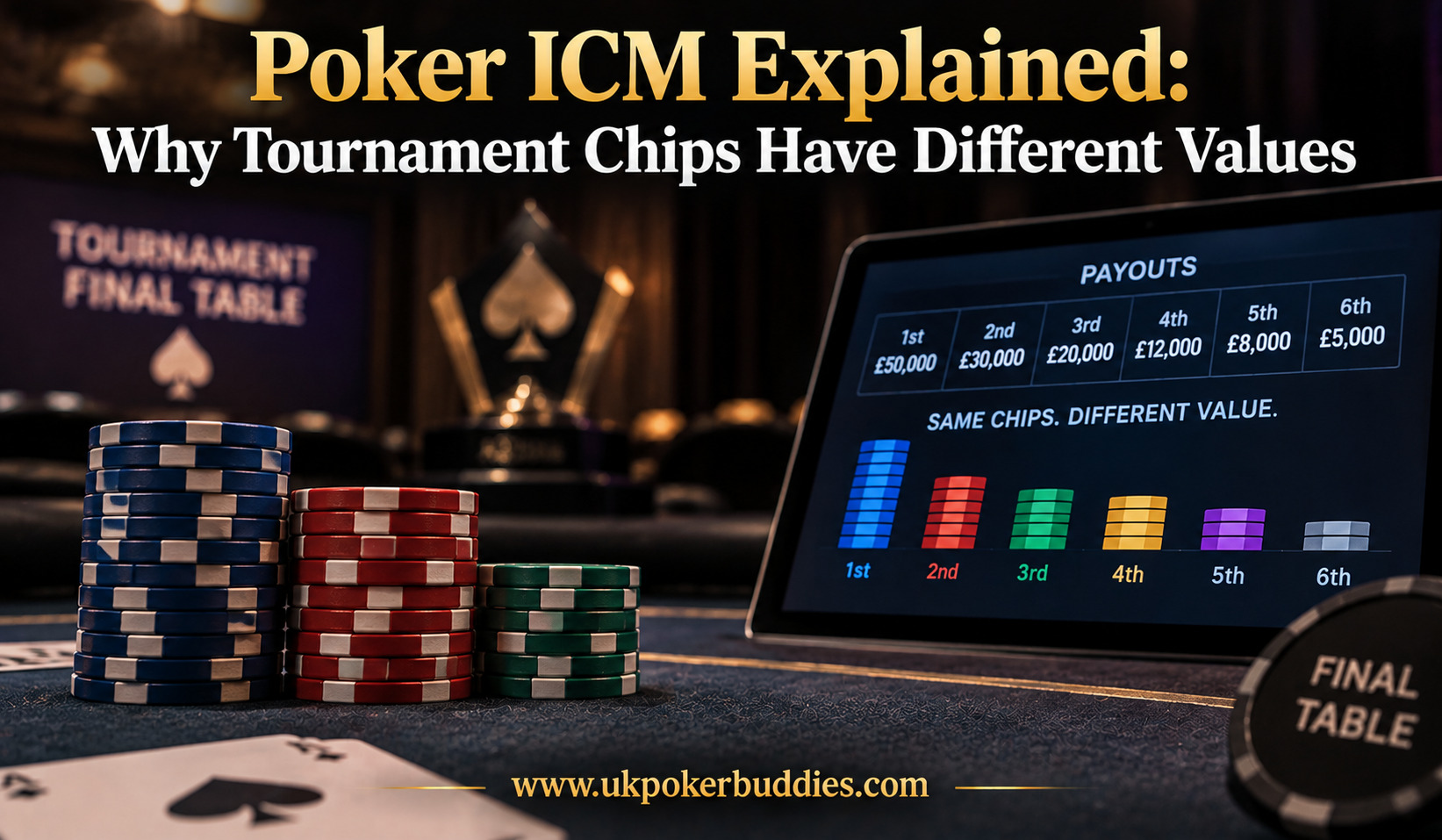
Tournament poker is different from cash games in one major way: chips do not always have a fixed monetary value.
In a cash game, a $100 chip is simply worth $100. If you win $100 worth of chips, you have gained $100, and if you lose them, you have lost $100.
Tournament poker works differently. You buy tournament chips, but those chips cannot normally be exchanged for cash at the same value during the event. Their monetary value depends on factors such as the remaining players, stack sizes, and payout structure.
This is where ICM, or the Independent Chip Model, becomes important.
ICM is a mathematical concept used to estimate how much a tournament player’s stack is worth in terms of their expected share of the remaining prize pool. Understanding ICM can explain why a tournament decision that looks profitable in chips may not be equally profitable in money.
What Is ICM in Poker?
ICM stands for Independent Chip Model.
It is a method for estimating the monetary value of tournament chips based on the tournament’s current situation.
ICM considers factors such as:
- The size of each player’s stack
- The number of players remaining
- The tournament payout structure
The basic idea is that your percentage of the chips does not directly equal your percentage of the prize money.
For example, having 20% of the chips does not necessarily mean you have 20% of the remaining prize pool in expected monetary value.
This is one of the most important differences between tournament poker and cash games.
Why Tournament Chips Have Different Values
Imagine a tournament with four players remaining and a payout structure where the top four positions receive prizes.
Suppose one player has a very large stack while another has a very small stack.
The large stack has a strong chance of finishing near the top, but gaining additional chips does not increase their potential payout proportionally.
Meanwhile, the short stack’s chips can be extremely valuable because losing them could mean elimination.
As a result, the value of winning chips and losing chips is not symmetrical.
Winning chips can increase your chance of earning a larger prize, but losing chips can increase your risk of finishing in a lower-paying position.
ICM attempts to account for this difference.
ICM vs Chip EV
One of the most important distinctions in tournament poker is between chip EV and ICM-based decisions.
Chip EV focuses on whether a play is expected to win chips over the long term.
ICM focuses on how that change in chips affects your expected monetary payout.
Consider an all-in decision.
Suppose calling could increase your stack significantly if you win but eliminate you if you lose.
From a chip perspective, the call might appear attractive.
However, if you are already in a strong position to reach a valuable payout, elimination could be extremely costly.
Under ICM, the call may therefore be worse than it first appears.
This is why tournament players sometimes fold hands that they would happily play in a cash game.
The ICM Effect Near the Bubble
ICM becomes especially important near the tournament bubble.
The bubble is the point where one more elimination puts the remaining players into the money.
Suppose a tournament pays the top 10 players and 11 players remain.
The player who finishes 11th receives nothing, while the other 10 players are guaranteed a payout.
This creates significant pressure.
A player with a medium or large stack may have an incentive to avoid risking their entire tournament life against another big stack.
Meanwhile, a large stack may be able to put pressure on shorter stacks that are trying to survive.
This is commonly referred to as ICM pressure.
Big Stacks and ICM
Big stacks often have more freedom to apply pressure near important payout points.
Imagine three players are significantly shorter than you.
If you raise frequently, those players may be reluctant to call or move all-in with marginal hands because losing could eliminate them.
This gives the big stack an opportunity to collect blinds and antes.
However, being the big stack does not mean you should risk your entire stack unnecessarily.
A large stack still needs to understand which confrontations are worthwhile.
ICM can sometimes encourage big stacks to pressure opponents while avoiding situations where they could lose a significant portion of their advantage.
Medium Stacks and ICM Pressure
Medium stacks often face some of the most difficult ICM decisions.
They may have enough chips to survive several rounds but not enough to absorb a major loss comfortably.
For example, imagine you are sitting in third place with several shorter stacks behind you.
Calling an all-in from the chip leader with a marginal hand could put your tournament at serious risk.
Even if the call has positive chip EV, it may have poor ICM consequences.
This is why medium stacks sometimes need to be more selective than their chip count might suggest.
Short Stacks and ICM
Short stacks also need to understand ICM, but their situation can be different.
If a player is extremely short, simply folding may not solve the problem because blinds and antes continue to reduce their stack.
They may eventually need to take a calculated risk.
However, the presence of other short stacks can influence their decisions.
If another player has only a few big blinds remaining, waiting may sometimes be reasonable because that player could be eliminated first.
The correct decision depends on stack distribution and payout structure rather than your stack alone.
ICM and All-In Decisions
All-in situations are where ICM considerations become particularly noticeable.
Suppose you have a strong but not premium hand and another player moves all-in.
In a cash game, you might compare your hand’s equity with the pot odds and make a straightforward decision.
In a tournament, there is another question:
What happens to my tournament equity if I lose?
If losing would eliminate you just before a major payout jump, the cost of the risk can be much greater.
This does not mean you should always fold.
Instead, ICM encourages you to consider the financial consequences of elimination.
ICM and Payout Structures
The payout structure has a major effect on ICM decisions.
If the difference between consecutive payouts is relatively small, risking your entire stack may sometimes be more acceptable.
But when there is a large jump between positions, preserving your stack can become more important.
For example, the strategic considerations can be very different when moving from 20th to 19th place compared with moving from 2nd to 1st place.
ICM is therefore closely connected to the distribution of prize money.
ICM Is Not the Same as Playing Scared
A common misunderstanding is that ICM simply tells players to fold more.
That is not correct.
ICM is about making decisions based on the relationship between chips and prize money.
Sometimes ICM recommends folding.
In other situations, it can support aggressive play.
For example, if opponents are folding too often because they are afraid of elimination, applying pressure can be profitable.
The goal is not to avoid risk completely. It is to take risks that make sense given the tournament’s financial structure.
Common ICM Mistakes
One common mistake is treating tournament chips exactly like cash-game chips.
Another is looking only at your own stack.
ICM decisions require you to consider the stacks of other remaining players because their positions can influence your own payout prospects.
Players also sometimes ignore the payout structure.
A tournament with a flat payout structure can create different ICM situations from a tournament with large jumps between positions.
Finally, some players become excessively cautious and miss profitable opportunities to accumulate chips.
ICM should guide your decisions, not replace normal poker strategy.
How to Learn ICM
The best way to understand ICM is to study actual tournament situations.
Start by looking at scenarios involving:
- The bubble
- Final-table play
- Pay jumps
- Short stacks
- Medium stacks
- Big-stack pressure
- All-in decisions
Compare what happens under chip EV with what happens under ICM.
Over time, you will begin to recognize why certain tournament decisions feel different from normal cash-game decisions.
ICM calculators and poker training tools can also help players study these situations, although the most important skill is learning how to think about tournament equity rather than memorizing individual answers.
ICM and Tournament Strategy
ICM should be considered alongside other important poker concepts such as position, stack depth, opponent ranges, pot odds, and hand equity.
It does not replace fundamental poker strategy.
Instead, it adds another layer.
A hand can be strong enough to call from a chip-EV perspective but still be a poor tournament decision because of the risk involved.
Likewise, a weaker hand can sometimes become profitable when opponents are under extreme ICM pressure.
Understanding this interaction is what makes advanced tournament poker so different from simply playing for chips.
Final Thoughts
Poker ICM explains why tournament chips do not have a fixed monetary value.
The same number of chips can be worth different amounts depending on the remaining players, stack distribution, and payout structure. This becomes especially important near the bubble, final tables, and major payout jumps.
ICM helps tournament players understand the cost of elimination and why some high-risk decisions should be avoided even when they appear profitable in terms of chips.
The key lesson is simple: in tournament poker, maximizing chips and maximizing expected money are not always the same thing.
Once you understand that difference, concepts such as bubble pressure, stack preservation, pay jumps, and big-stack aggression become much easier to understand.