

Tournament poker changes dramatically as players get closer to the money. A decision that might be reasonable early in a tournament can become much more important when only a few eliminations separate the remaining players from a payout.
This stage is known as the poker bubble.
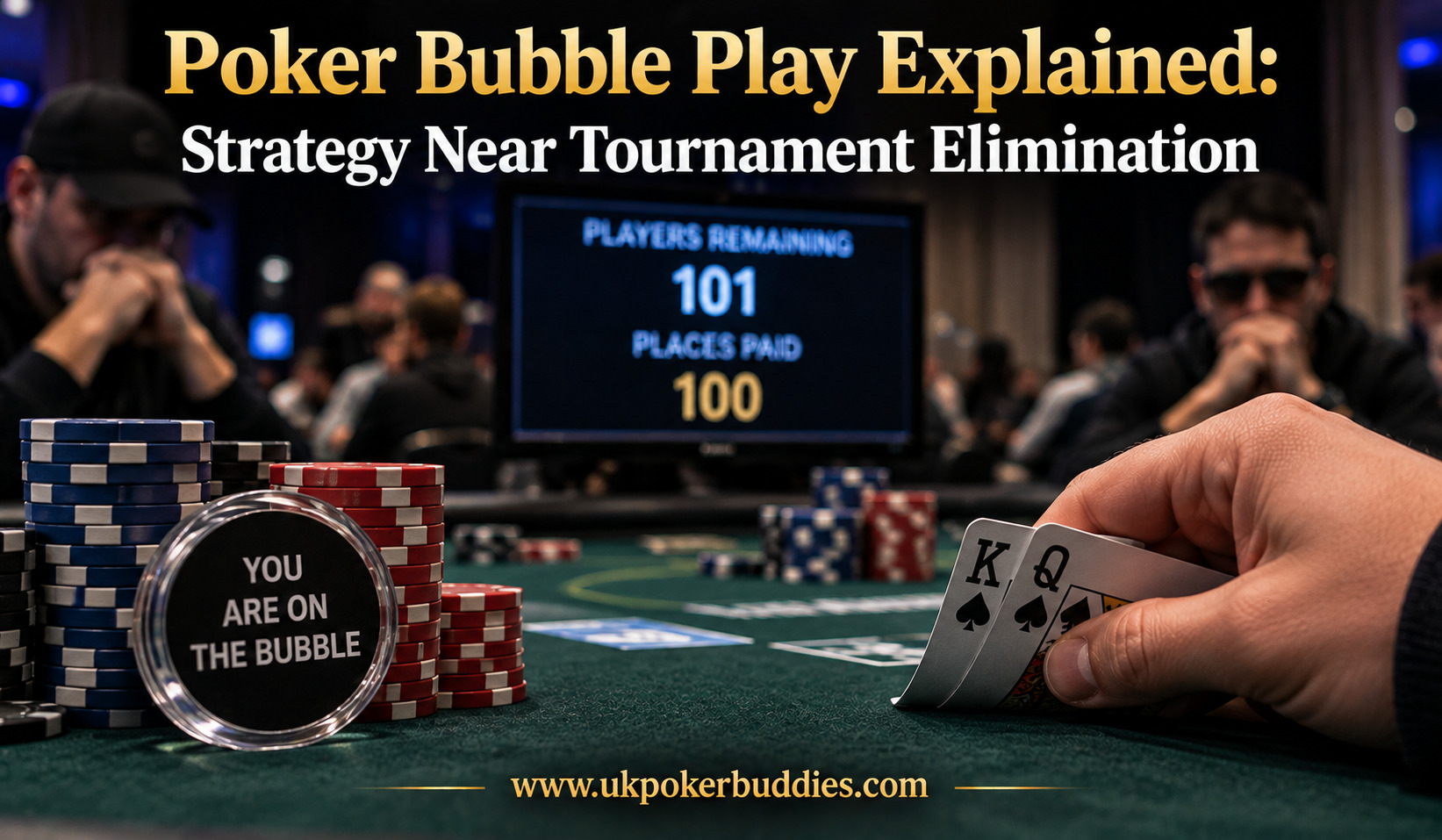
Bubble play is the period immediately before players reach the paid positions. For example, if a tournament pays the top 100 players and 101 players remain, the tournament is on the bubble. The player who finishes outside the money receives nothing, while the remaining players are guaranteed a payout.
Because of this difference, players often adjust their strategies near the bubble. Understanding how bubble play works can help you make better decisions when tournament survival and payout pressure become important.
What Is the Poker Bubble?
The poker bubble is the stage of a tournament immediately before the remaining players reach the money.
Imagine a tournament has 500 entries and pays the top 50 positions. When 51 players remain, the tournament is on the bubble.
One more elimination means everyone else is guaranteed a prize.
The player in 51st place is therefore under significant pressure. They can play aggressively and risk elimination, or they can take a more cautious approach and try to survive into the money.
This tension creates some of the most interesting strategic situations in tournament poker.
Why Bubble Play Is Different
Early in a tournament, losing your entire stack means elimination, but there may still be plenty of opportunities to enter other pots and rebuild.
Near the bubble, elimination has an additional consequence: missing the money.
A player’s chips therefore do not have a simple one-to-one relationship with their potential cash value.
For example, doubling your stack does not necessarily double your expected payout. Similarly, losing half your stack can have a larger impact on your tournament situation than the number of chips alone suggests.
This is why bubble decisions require consideration of both chip value and tournament payout structure.
The Importance of Stack Sizes
Stack sizes become especially important during bubble play.
A player with a large stack can often put pressure on shorter stacks because those players have more to lose by being eliminated.
A short stack, on the other hand, may have to balance survival against the danger of becoming too short to continue playing effectively.
Medium stacks can face particularly difficult decisions. They may have enough chips to survive for a while but not enough to comfortably absorb a major loss.
Understanding the relative size of every stack at the table is therefore essential.
Big Stacks Can Apply Pressure
One of the biggest advantages of having a large stack near the bubble is the ability to pressure opponents.
Shorter stacks may be reluctant to call large bets or commit all their chips with marginal hands because elimination would mean missing the money.
This can create opportunities for a big stack to steal blinds and antes.
However, aggression should not mean betting recklessly. A big stack can lose its advantage quickly if it becomes involved in unnecessary high-variance situations.
The goal is to apply pressure intelligently.
Short Stacks Face Difficult Decisions
Short stacks have a different problem.
They cannot always wait for premium hands because the blinds and antes continue to reduce their stack.
If a short stack waits too long, it may eventually have to make an all-in decision with an even weaker hand.
This means bubble play is not simply about folding everything until the money.
Sometimes a short stack needs to take a calculated risk before its stack becomes too small.
The important question is whether the potential reward justifies the risk of elimination.
Medium Stacks and Survival
Medium stacks often experience significant bubble pressure.
They are not short enough to be desperate, but they are also not deep enough to freely attack everyone.
A medium stack may have a strong incentive to avoid confrontation with another large stack, particularly when several shorter stacks are close to elimination.
For example, risking most of your chips against another big stack with a marginal hand can be dangerous when several players have significantly fewer chips than you.
In some situations, preserving your stack can be more valuable than winning a medium-sized pot.
The Bubble Factor
The concept of bubble factor helps explain why tournament chips can have different values during bubble play.
In a cash game, losing $100 and winning $100 have direct monetary consequences.
In a tournament, the relationship between chips and money is more complicated.
Losing a large portion of your stack near the bubble can significantly increase your risk of finishing outside the money. Winning the same number of chips may not provide an equivalent increase in your expected payout.
This creates an uneven relationship between risk and reward.
Position Matters Near the Bubble
Position becomes particularly useful during bubble play.
Players in late position can see how opponents act before deciding whether to enter a pot.
If players ahead of you appear unwilling to risk their stacks, you may have an opportunity to steal the blinds.
Early-position decisions require more caution because several opponents remain behind you.
Your position should therefore be considered alongside stack sizes and tournament circumstances.
The Bubble and Blind Stealing
Stealing blinds can become an important part of bubble strategy.
Suppose you are in late position and everyone folds to you. The players in the blinds may have strong reasons to avoid a confrontation if they are close to qualifying for the money.
A raise can therefore put pressure on them.
However, blind stealing should still be selective.
If opponents are short-stacked and likely to move all-in, repeatedly raising weak hands can become expensive.
The best opportunities usually come when your position, stack, and opponent tendencies work together.
Calling All-Ins Near the Bubble
Calling an all-in near the bubble can be much more complicated than making an all-in decision yourself.
If losing the hand would eliminate you or leave you severely short, you may need a very strong reason to call.
This does not mean you should fold every hand.
If you have a premium holding and the situation supports a call, avoiding the decision simply because you are on the bubble can also be a mistake.
The key is understanding the consequences of both winning and losing.
Bubble Play and ICM
Bubble strategy is closely connected to the Independent Chip Model, commonly called ICM.
ICM attempts to estimate the monetary value of tournament chips based on the remaining stacks and payout structure.
Under ICM, chips are not worth a fixed amount throughout the tournament.
This explains why a player might fold a hand that would clearly be profitable in a cash game or early tournament situation.
The decision may be correct because tournament survival has significant financial value.
ICM becomes especially important in tournaments with meaningful jumps between payout positions.
Common Bubble Play Mistakes
One common mistake is becoming too passive.
Some players become so focused on reaching the money that they fold almost every hand. This can allow aggressive opponents to steal their blinds repeatedly.
Another mistake is ignoring stack sizes.
A player’s decision should not be based only on their own cards. The stacks of other players can dramatically change the correct strategy.
Players also sometimes attack the wrong opponents. Putting pressure on another large stack may create unnecessary risk when shorter stacks are available to target.
Finally, some players forget that the bubble eventually ends. Once a player is eliminated, tournament dynamics can change immediately.
How to Improve Your Bubble Strategy
Improving bubble play starts with paying attention to more than your hole cards.
Before making an important decision, consider your own stack, the stacks around you, the number of players remaining, the number of paid positions, and the size of the payout jumps.
Also pay attention to player tendencies.
Some opponents may fold too often because they are desperate to reach the money. Others may ignore bubble pressure and continue playing aggressively.
Adjusting to these differences can give you an advantage.
Studying ICM concepts and reviewing important bubble hands can also help you understand why certain decisions are profitable even when they feel uncomfortable.
Bubble Play Is About Risk Management
The central idea behind bubble strategy is risk management.
You are not simply trying to win every pot. You are trying to make decisions that maximize your tournament equity while considering the consequences of elimination.
Sometimes that means applying pressure.
Sometimes it means folding a strong but vulnerable hand.
Sometimes it means taking a calculated risk before your stack becomes too short.
The correct decision depends on the entire tournament situation.
Final Thoughts
Poker bubble play is one of the most important strategic stages of a tournament because the value of survival increases as players approach the money.
Big stacks can often use the fear of elimination to pressure opponents, while short and medium stacks must carefully balance survival with the need to accumulate chips.
Position, stack sizes, blind levels, payout structure, opponent tendencies, and ICM all play important roles.
The biggest lesson is that bubble poker is not simply about playing tighter or more aggressively. It is about understanding who has the most to lose and who has the most freedom to apply pressure.
Once you learn to evaluate tournament decisions through that lens, bubble situations become much easier to understand and manage.