

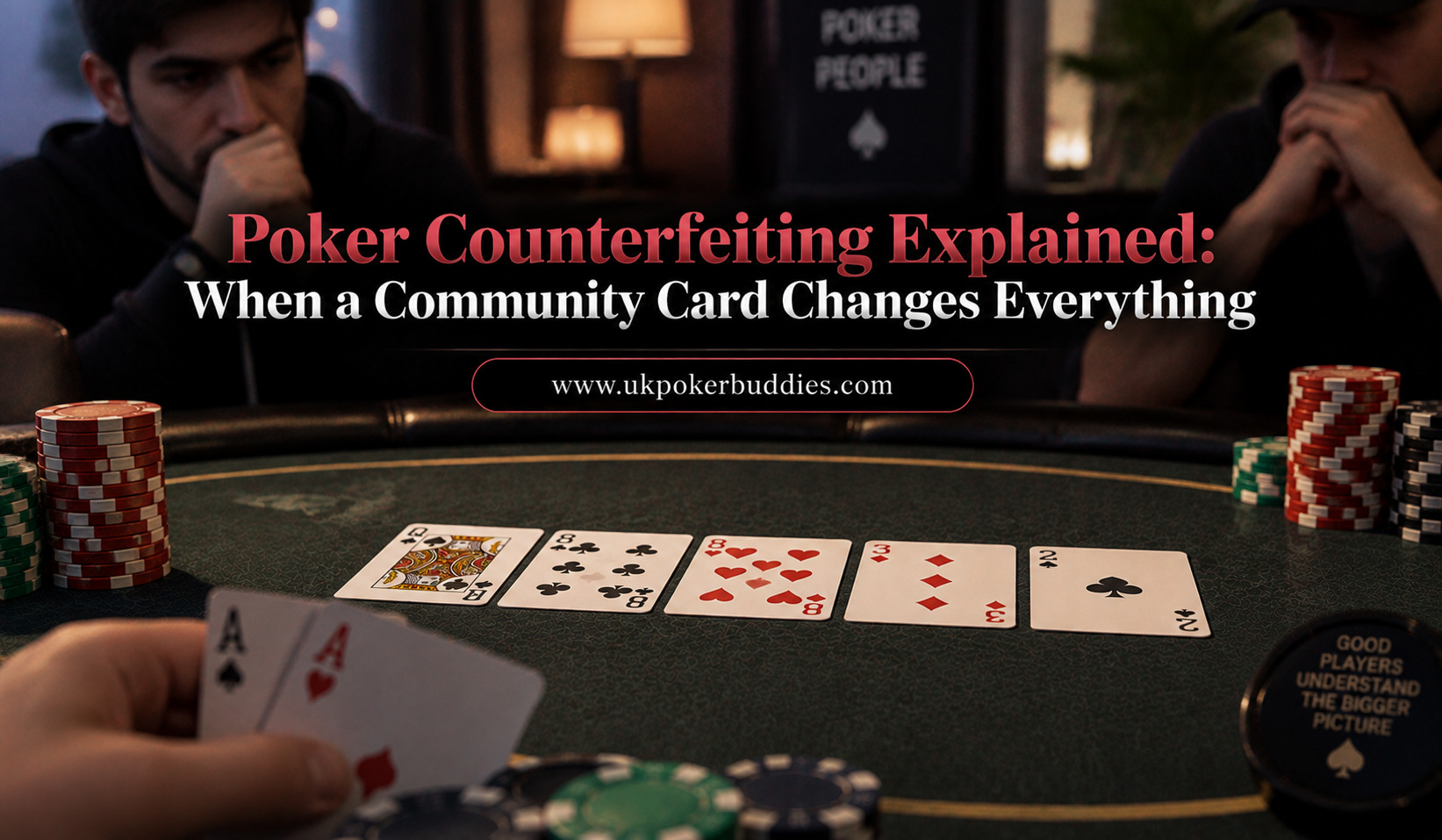
Poker is full of situations where a single community card can completely change the strength of a hand. A player who looks comfortably ahead on the flop can suddenly find that their advantage has disappeared on the turn or river.
One particularly interesting situation is called counterfeiting in poker.
Counterfeiting happens when a community card makes part of your hand less valuable because it creates a stronger shared combination on the board. Your original cards may still be technically part of your hand, but their advantage can be reduced or completely removed.
Understanding poker counterfeiting is important because it explains why some apparently strong hands can suddenly become much weaker.
What Is Counterfeiting in Poker?
Poker counterfeiting occurs when a community card effectively replaces or reduces the value of one of your cards by creating a stronger combination that is shared by multiple players.
The concept is most commonly discussed in Texas Hold’em when players have two pair or similar hands.
For example, imagine the board gives you a pair of aces and a pair of smaller cards using one of your hole cards. If another community card pairs a rank that both players can use, the board may create a better shared five-card combination.
Your private card that previously gave you an advantage may no longer matter.
That card has effectively been counterfeited.
A Simple Example of Counterfeiting
Suppose you hold:
A♠ 8♣
And the board is:
A♦ 8♦ 4♣
You currently have two pair: aces and eights.
Now imagine the turn is:
4♦
The board becomes:
A♦ 8♦ 4♣ 4♦
You still have two pair, but the situation has changed.
The board itself now contains a pair of fours. The best five-card hand may use the board pair along with the ace and eight.
The value of your eight as a private-card advantage can be reduced because the paired board creates a shared component of the hand.
This illustrates the basic idea behind counterfeiting: a community card can make a card that previously mattered much less important.
Why Counterfeiting Matters
Counterfeiting matters because poker hands are evaluated using the best five-card combination.
A player’s private cards do not automatically remain valuable just because they helped create a strong hand earlier.
When the board changes, the best five-card combination can change too.
A turn or river card can:
- Create a higher pair on the board
- Pair a card that was part of your two pair
- Make your kicker irrelevant
- Give both players a stronger shared combination
- Change which hole cards actually play
This can dramatically change the relative strength of hands.
Counterfeiting and Two Pair
Two-pair situations are where counterfeiting is particularly important.
Imagine you have:
A♠ 7♣
The board is:
A♦ 7♦ 2♠
You have aces and sevens.
Now suppose another seven appears on the turn.
The board becomes:
A♦ 7♦ 2♠ 7♥
Your hand is no longer evaluated in exactly the same way as it was before.
The board now contains three sevens, and the best five-card hand must be constructed from the available cards.
Your original seven may no longer provide the same advantage it did when you first made two pair.
This is why players need to reevaluate their hand whenever the board pairs.
Counterfeiting and Kickers
Counterfeiting can also affect kickers.
Suppose you have a pair of aces with a strong kicker.
Your ace kicker may give you an advantage against another player holding the same pair.
But if the board develops a higher shared combination, that kicker may no longer be part of the best five-card hand.
When this happens, your previous kicker advantage disappears.
This is particularly important when playing hands where the kicker is responsible for much of your advantage.
A community card can essentially remove that advantage by making another card more important.
Counterfeiting vs Board Pairing
Not every paired board is necessarily a counterfeit situation.
A board pairing can change hand strength without actually making your hole card irrelevant.
Counterfeiting specifically involves a card or combination that reduces the value of an existing part of your hand because the board now provides a better alternative.
Therefore, it is useful to distinguish between:
Board pairing: A community card matches another board card.
Counterfeiting: That change causes part of your previous hand advantage to lose value or become irrelevant.
The two ideas are related, but they are not identical.
Counterfeiting in Community Card Games
The concept is particularly easy to see in Texas Hold’em because players share five community cards.
Every new community card can change the best five-card hand available to everyone.
A card that helps you can also help your opponent.
Likewise, a card that does not seem dangerous may reduce the value of your hole cards.
This is one reason experienced players constantly reevaluate the board rather than assuming their flop hand remains equally strong.
How Counterfeiting Affects Your Strategy
When a potentially counterfeiting card appears, you should reassess your hand.
Do not automatically continue betting simply because you had a strong hand on the previous street.
Ask:
What is my best five-card hand now?
Which of my hole cards are still contributing?
What stronger combinations can my opponent now have?
Did the new card create a shared hand?
Has my kicker or two-pair advantage disappeared?
These questions help you identify whether the new card has significantly changed your position.
Counterfeiting and Relative Hand Strength
Poker is about relative hand strength, not just the absolute strength of your cards.
A hand that was strong on the flop can become mediocre on the turn.
For example, two pair may look excellent on a relatively dry flop.
But if the turn pairs the board and creates additional combinations, the same two pair may become much less valuable.
This does not automatically mean you should fold.
It means you need to reconsider the strength of your hand compared with your opponent’s likely range.
Counterfeiting and Betting Decisions
Counterfeiting can influence whether you should value bet, check, call, or fold.
Suppose you were planning to make a large value bet because you believed your two pair was significantly ahead.
Then the turn creates a board combination that reduces the importance of your second pair.
Your original betting plan may no longer make sense.
Continuing with the same strategy simply because you already planned the bet can be a mistake.
Strong poker decisions are based on the current situation, not on what you intended to do before the new card appeared.
Counterfeiting and Opponent Ranges
A new community card can also change the range of hands you expect your opponent to have.
If the board pairs, certain full houses, trips, two-pair combinations, or other strong hands may become possible.
At the same time, some combinations may become less likely because you hold a card that blocks them.
This is why counterfeiting should be considered alongside range analysis and card removal.
The board tells you what is possible, while your hole cards help determine which combinations your opponent can realistically hold.
Common Counterfeiting Mistakes
One common mistake is assuming that a strong flop hand remains strong after every turn and river card.
Another is forgetting to rebuild the best five-card hand after the board changes.
Players can also become attached to their original two pair and fail to recognize that a community card has reduced its value.
Another mistake is thinking that every board pair automatically means your hand has been counterfeited.
The important question is not simply whether the board paired. It is whether the new card changed which cards matter in your best five-card hand.
How to Recognize a Counterfeit Card
A simple method is to compare your hand before and after the new community card arrives.
Ask:
What was my best five-card hand before the card?
What is my best five-card hand now?
Which hole card contributed to my previous advantage?
Does that card still contribute the same value?
If the new community card creates a stronger shared combination and reduces the importance of your private card, you may be dealing with a counterfeit situation.
Counterfeiting and Poker Equity
Counterfeiting can also change your poker equity.
Equity represents your expected share of the pot based on the possible outcomes.
If a new community card improves your opponent’s range or reduces the value of your hand, your equity can fall.
This is why poker equity is dynamic.
Your equity on the flop is not guaranteed to remain the same on the turn.
Every new card changes the possible combinations and therefore can change the balance of the hand.
Why Beginners Should Learn Counterfeiting
Beginners often evaluate their hand based on the combination they originally made.
They may think:
“I have two pair, so I have a strong hand.”
But poker requires you to evaluate the current board.
Two pair can be strong on one board and vulnerable on another.
A counterfeit card teaches an important lesson: the value of your hole cards depends heavily on how they interact with the community cards.
Learning this concept can make board reading much more accurate.
Final Thoughts
Poker counterfeiting describes situations where a community card reduces the value of part of your existing hand by creating a stronger shared combination.
It is particularly important with two pair and kicker-dependent hands, where a new board card can make one of your private cards less valuable or completely irrelevant.
The most important habit is to reevaluate your best five-card hand after every community card.
Do not focus only on what your hand was on the flop. Focus on what it is now.
When a new card arrives, ask whether it improved you, improved your opponent, created a shared combination, or changed which of your hole cards actually matter.
Understanding counterfeiting can help you recognize when a seemingly harmless community card has actually changed everything—and make more accurate decisions as the hand develops.