

A Complete Beginner’s Guide
Poker is often described as a game of strategy, probability and decision-making, but before players can understand advanced tactics, they need to know the foundation of the game: poker hand rankings. Whether someone is learning Texas Hold’em, Omaha, Caribbean Stud or another poker variation, knowing which hands are stronger than others is essential.
A poker hand is normally evaluated using five cards. The exact way those five cards are selected can differ between poker variants. In Texas Hold’em, for example, players can make their best five-card hand from their private cards and the community cards. In Omaha, players must follow the specific rule requiring exactly two hole cards and three community cards.
Although different poker formats can have variations, the traditional ranking system is widely recognized. From a royal flush at the top to a high-card hand at the bottom, each category has its own probability and strategic importance.
What Is a Poker Hand?
A poker hand is a combination of cards evaluated according to established rankings. In most traditional poker games, the goal is to create the strongest five-card combination possible.
The strength of a hand depends on factors such as matching ranks, consecutive values and suits. For example, two cards of the same rank create a pair, while five cards of the same suit can create a flush.
Understanding these categories helps players determine whether they are likely to have the winning hand at showdown. It also provides the foundation for making betting decisions during a game.
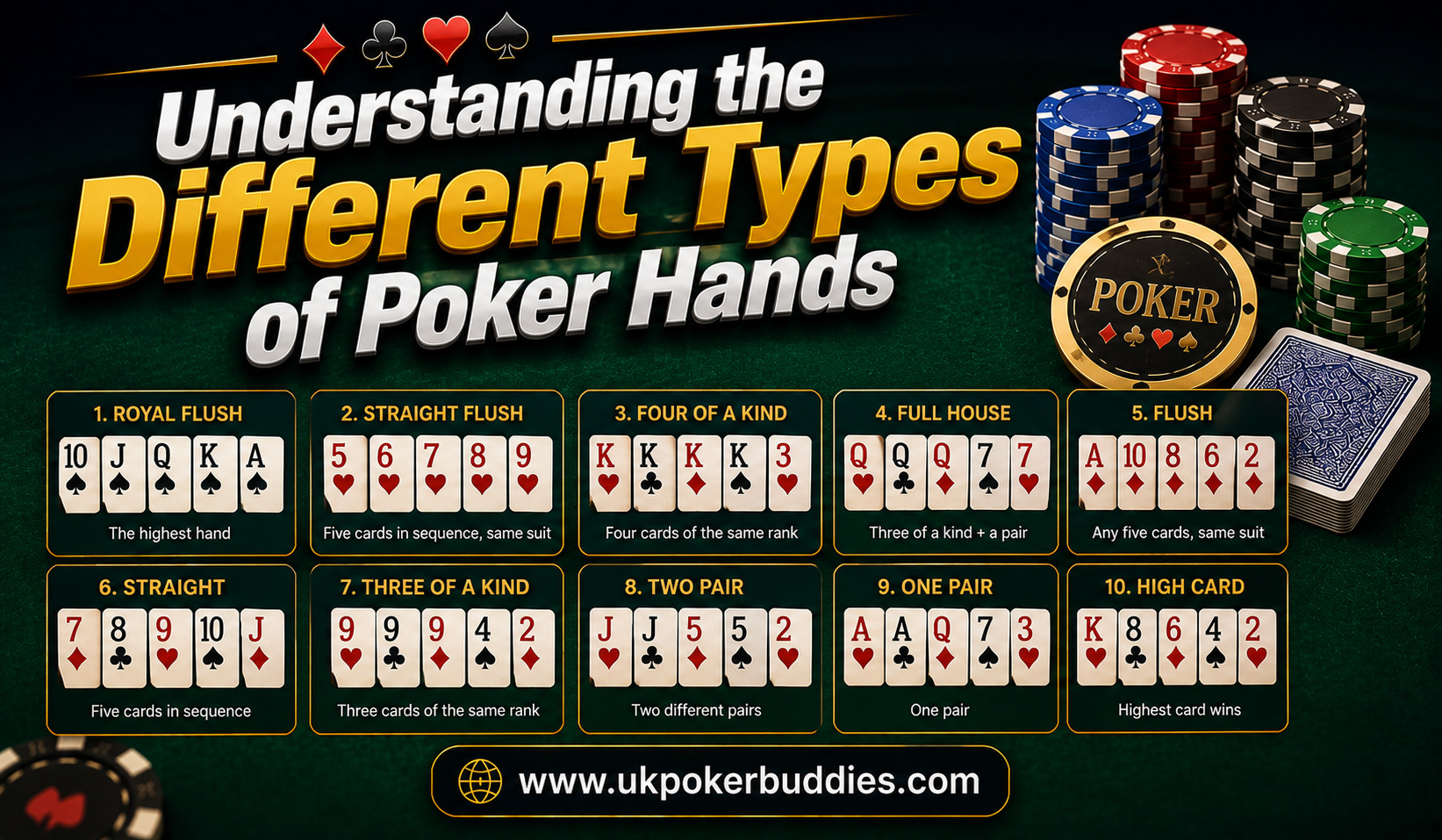
Poker Hand Rankings From Strongest to Weakest
The standard poker ranking system contains several categories. While some poker variants modify the rankings, the traditional hierarchy remains the most commonly used.
| Rank | Poker Hand | Example | Description |
| 1 | Royal Flush | A-K-Q-J-10 same suit | Highest possible straight flush |
| 2 | Straight Flush | 9-8-7-6-5 same suit | Five consecutive cards of one suit |
| 3 | Four of a Kind | Four kings | Four cards of the same rank |
| 4 | Full House | K-K-K-8-8 | Three of one rank plus a pair |
| 5 | Flush | A-J-8-5-3 same suit | Five cards of one suit |
| 6 | Straight | 9-8-7-6-5 | Five consecutive cards |
| 7 | Three of a Kind | Three queens | Three cards of the same rank |
| 8 | Two Pair | A-A-7-7-K | Two different pairs |
| 9 | One Pair | J-J-8-5-3 | Two cards of the same rank |
| 10 | High Card | A-J-8-5-2 | No qualifying combination |
The ranking order is important because a stronger category beats every category below it. However, ties can occur, in which case the values of the individual cards are compared.
Royal Flush: The Highest Standard Hand
A royal flush is generally considered the strongest possible hand in traditional poker. It consists of an ace, king, queen, jack and ten, all belonging to the same suit.
For example, the ace, king, queen, jack and ten of hearts form a royal flush.
Because this combination is extremely rare, it is one of the most recognizable hands in poker. When it appears in games with bonus or jackpot features, it may also qualify for special payouts depending on the rules.
The royal flush cannot be beaten by another standard poker hand.
Straight Flush: Five Consecutive Cards of One Suit
A straight flush consists of five cards in numerical sequence, all from the same suit.
A hand such as 9-8-7-6-5 of clubs is a straight flush. The sequence can be lower or higher, provided the cards are consecutive.
A straight flush ranks below a royal flush but above four of a kind. When two players have straight flushes, the higher sequence generally wins.
Because both rank and suit must align, this is a rare combination.
Four of a Kind: Four Matching Ranks
Four of a kind, sometimes called quads, contains four cards of the same rank.
For example, four kings plus any fifth card make four of a kind. The fifth card is commonly known as the kicker.
If two players somehow have four of a kind in the same hand, the rank of the four matching cards determines the winner. The kicker can matter in certain situations where the main four-card combination is tied.
Four of a kind is a powerful hand and ranks below a straight flush.
Full House: Three Matching Cards Plus a Pair
A full house contains three cards of one rank and two cards of another rank.
An example would be three queens and two 7s. The three-card portion is called the trips or three-of-a-kind component, while the two-card portion forms the pair.
When comparing two full houses, the rank of the three matching cards is considered first. A full house containing three kings beats one containing three queens, regardless of the pair.
Full houses are relatively strong because they combine two different matching patterns.
Flush: Five Cards of the Same Suit
A flush consists of five cards belonging to the same suit, without necessarily being consecutive.
For example, ace, jack, 8, 5 and 3 of diamonds form a flush.
When comparing two flushes, the highest card is considered first, followed by the next highest card if necessary.
The ranking of a flush can vary in some poker formats. For example, certain Short Deck Poker variations place a flush above a full house because the reduced deck changes the probability of making the hand.
Straight: Five Consecutive Cards
A straight contains five cards in numerical sequence, regardless of their suits.
For example, 10-9-8-7-6 forms a straight line.
The suits do not need to match. The highest card in the sequence determines the strength of the straight.
An ace can sometimes serve as either a high or low card depending on the sequence and rules. In standard poker, A-2-3-4-5 is commonly recognized as the lowest straight.
Players should remember that a straight and flush are different hands. A straight depends on consecutive ranks, while a flush depends on matching suits.
Three of a Kind: Three Matching Cards
For example, three jacks with a 9 and 4 create three of a kind.
When comparing two three-of-a-kind hands, the rank of the three matching cards determines which hand is stronger. If necessary, the remaining cards can act as kickers.
Is this hand strong enough to beat a straight? No. In the standard ranking, a straight beats three of a kind, while a full house and four of a kind are stronger.
Two Pair: Two Separate Pairs
Two pairs contain two cards of one rank, two cards of another rank and a fifth card.
For example, two aces, two 7s and a king form two pairs.
When comparing two two-pair hands, the higher pair is considered first. If the higher pairs are identical, the lower pair is compared. If both pairs match, the fifth card becomes important.
Two pairs is a common hand in community-card poker and can sometimes be difficult for beginners to evaluate correctly when the board itself contains pairs.
One Pair: Two Matching Cards
One pair is made when two cards have the same rank, while the other three cards are different ranks.
An example is two queens accompanied by a 9, 7 and 3.
One pair is below two pairs and all stronger combinations, but it can still win a pot if opponents have weaker hands or choose to fold.
The value of one pair depends heavily on the rank of the pair and the other cards available.
High Card: When No Combination Is Made
A high-card hand occurs when none of the stronger poker combinations can be formed.
For example, ace, jack, 8, 5 and 2 of different suits would normally be evaluated as an ace-high hand if no other combination exists.
When comparing high-card hands, the highest card is considered first. If the highest cards are equal, the next highest cards are compared.
Although a high card is the weakest category, it can still win when opponents have similarly weak holdings.
How Ties Are Resolved
Poker does not always produce a single winner based solely on the hand category. Two players can have the same type of hand.
For example, two players may both have one pair. In this situation, the rank of the pair is compared first. If the pair is identical, the remaining cards are considered in descending order.
The same principle applies to many other hand categories. Players should therefore learn not only the rankings but also how tied hands are compared.
Important tie-breaking principles include:
- Compare the primary matching or sequence cards first.
- Use kickers when the main combination is identical.
- Compare the highest relevant card before moving to lower cards.
- If all five cards are identical in value, the pot may be split.
Poker Hands in Different Variants
Although the traditional hand rankings are widely used, players should never assume that every poker game follows identical rules.
Texas Hold’em generally uses the standard rankings. Omaha also uses familiar rankings but has a special rule requiring players to use exactly two hole cards and three community cards.
Short Deck Poker can change the ranking of a flush and may use an ace as a low card in a particular straight. Casino poker variants may also have their own qualification and payout rules.
This is why checking the rules of the specific game is important before playing.
Why Understanding Hand Strength Matters
Knowing hand rankings is more than memorizing a list. Players need to understand how hand strength changes as community cards appear.
A player holding a pair before the flop may improve to three of a kind on the turn. At the same time, an opponent could complete a straight or flush.
This means the current hand should always be evaluated in relation to the board. A strong hand at one stage may become vulnerable after another community card is revealed.
Understanding possible draws and completed combinations allows players to make more informed decisions.
Conclusion
Understanding poker hands is the foundation for learning almost any poker variation. From the rare royal flush to a simple high-card hand, each category has a specific position in the ranking system and a different level of strength.
For beginners, memorizing the basic order is only the first step. It is equally important to understand how ties are resolved, how kickers work and how community cards can change the strength of a hand during a game.
Players should also remember that poker variants can use different rules. Texas Hold’em and Omaha generally follow traditional rankings, while games such as Short Deck may modify them because of their reduced deck size.
Once the hand rankings become familiar, players can move on to more advanced concepts such as position, probability, pot odds, betting patterns and opponent ranges. A strong understanding of poker hands provides the foundation for making better-informed decisions at the table.
Frequently Asked Questions
What is the strongest poker hand?
A royal flush is generally the strongest standard poker hand. It consists of A-K-Q-J-10 of the same suit.
What beats four of a kind?
A straight flush or royal flush beats four of a kind in standard poker.
Does a flush beat a straight?
Yes. In standard poker rankings, a flush beats a straight.
Does a full house beat a flush?
Yes. In traditional poker, a full house ranks above a flush. Some Short Deck variations use a different ranking.
What is a kicker in poker?
A kicker is a card that does not form part of the main combination but can be used to break a tie between otherwise similar hands.