

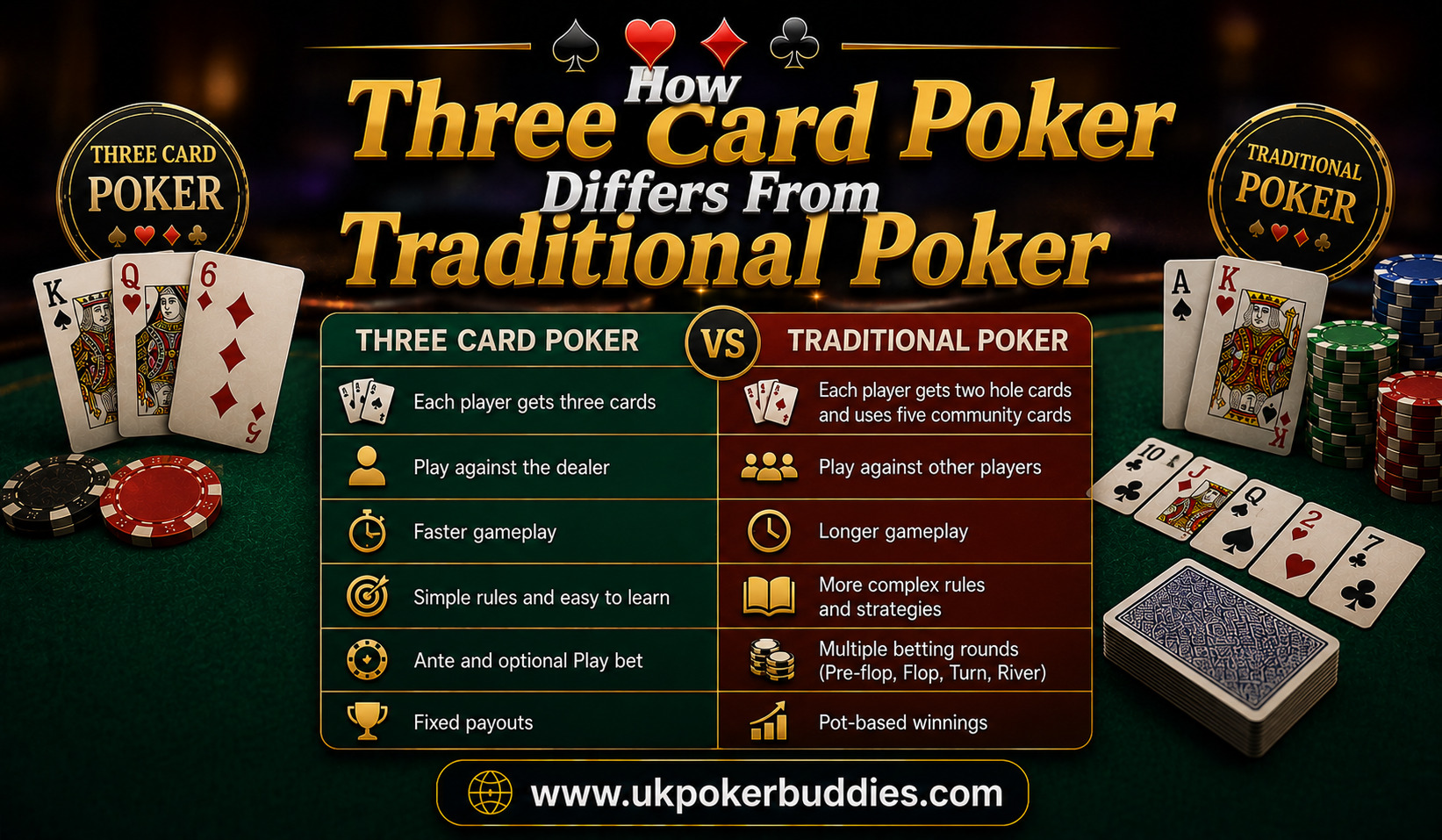
Poker has developed into a broad family of card games, with each variation introducing its own rules, pace, and strategy. While Texas Hold’em and other traditional poker formats remain widely recognized, Three Card Poker offers a very different experience. As its name suggests, the game uses only three cards for each player, creating shorter hands and a simpler decision-making process.
The game was developed as a casino poker variation designed to combine familiar poker hand rankings with a faster format. Unlike many traditional poker games, Three Card Poker is generally played against the dealer rather than primarily against other players. This changes the objective, betting decisions, and overall experience.
For players familiar with traditional poker, the differences can be significant. Three Card Poker may look like a simplified version of poker, but its rules create a distinct casino game with its own strategic considerations.
What Is Three Card Poker?
Three Card Poker is a casino table game in which players receive three cards each. The game commonly includes two main wagers: the Ante and Pair Plus. Some versions or casino tables may also offer additional optional bets.
The Ante wager involves playing against the dealer. Players make an initial wager and receive three cards, while the dealer also receives three cards. After looking at their cards, players can either fold or continue by making a Play wager.
The Pair Plus wager works differently. Instead of competing against the dealer’s final hand, the player wins based on whether their three-card hand meets the required poker combination.
This structure makes Three Card Poker different from traditional poker games, where players usually compete against one another for a shared pot.
Traditional Poker Is Usually Player vs. Player
One of the clearest differences is the opponent.
In Texas Hold’em, Omaha, Stud, and many other traditional poker games, players compete against each other. The dealer or casino generally facilitates the game rather than acting as an opponent.
Three Card Poker changes that relationship. In the Ante game, the player is effectively competing against the dealer’s qualifying hand.
This difference influences how players think about betting. In a traditional poker game, a player may try to understand an opponent’s range, betting habits, position, and potential bluff. In Three Card Poker, the central question is whether the player’s hand is strong enough to continue against the dealer.
That makes the game easier to understand for some newcomers while removing much of the player-versus-player psychological element associated with poker.
The Game Uses Only Three Cards
Traditional poker hands generally involve five cards, either directly or through combinations of private and community cards.
Three Card Poker simplifies this by giving each player only three cards. The dealer also receives three cards.
Because there are fewer cards, the game moves quickly. Players do not need to wait through multiple streets such as the flop, turn, and river. Instead, the main decision comes after receiving the three-card hand.
This shorter structure is one reason the game can appeal to casual casino players who prefer quick rounds.
The Hand Rankings Are Different
Another major distinction is the ranking of poker hands.
Three Card Poker uses a modified ranking system because players have only three cards. A royal flush and straight flush remain extremely strong, but some familiar rankings are rearranged.
In Three Card Poker, the usual ranking from strongest to weakest is:
- Straight flush
- Three of a kind
- Straight
- Flush
- Pair
- High card
The key difference is that a straight ranks above a flush. This is the opposite of the standard five-card poker ranking used in many traditional games.
The reason is mathematical. With only three cards, making a straight is generally less common than making a flush under the game’s rules. The ranking system therefore reflects the probabilities of the available combinations.
There Is No Community-Card Board
Texas Hold’em players are accustomed to seeing community cards appear throughout the hand. The flop, turn, and river gradually reveal shared information and create opportunities for players to improve their hands.
Three Card Poker does not use this system.
Players receive their three cards at the beginning of the hand, and there are no additional community cards revealed later. This means the player’s decision-making is concentrated around the hand they initially receive.
The absence of a board makes the game considerably faster and eliminates many of the calculations associated with traditional community-card poker.
Betting Is Simpler
Traditional poker can involve several betting rounds, each of which may include checks, calls, raises, or folds. Depending on the format, players may also make very large bets or commit their entire stack.
Three Card Poker has a much simpler betting structure.
For the Ante game, the player generally starts with an Ante wager. After seeing the three cards, the player decides whether to fold or continue with a Play wager, usually matching the Ante.
This creates a straightforward decision point. There is no long sequence of betting streets and no need to monitor how multiple opponents react to each community card.
The Dealer Must Qualify
One of the most important rules in the Ante game is the dealer qualification requirement.
The dealer generally needs at least a queen-high hand to qualify. If the dealer does not qualify, the player typically receives an Ante payout while the Play wager is returned according to the game’s rules.
If the dealer qualifies and the player’s hand is higher, the player wins according to the applicable payout structure. If the dealer has the stronger hand, the player loses the relevant wagers.
This qualification rule has no direct equivalent in most traditional player-versus-player poker games. It is one of the features that makes Three Card Poker feel more like a casino table game than a conventional poker tournament.
Pair Plus Creates a Separate Betting Option
The Pair Plus wager adds another important difference.
With Pair Plus, the player is betting on the strength of their own three-card hand. The hand generally needs to contain at least a pair for the player to receive a payout, although the exact payouts depend on the casino’s paytable.
This wager does not require the player to beat the dealer.
For example, a player with three of a kind may receive a payout under the Pair Plus schedule even if the dealer has a stronger qualifying hand. The wager therefore provides an alternative way to play the game.
Three Card Poker vs. Traditional Poker
| Feature | Three Card Poker | Traditional Poker |
| Cards per player | 3 | Often 5-card combinations |
| Main opponent | Usually the dealer | Usually other players |
| Community cards | None | Common in Hold’em and Omaha |
| Betting rounds | Short and limited | Often multiple rounds |
| Hand ranking | Modified for three cards | Usually standard five-card ranking |
| Bluffing | Limited | Major strategic element |
| Game length | Generally quick | Can vary significantly |
| Main decision | Continue or fold | Multiple decisions throughout a hand |
This comparison highlights why the two formats can feel completely different despite sharing the word “poker.”
Bluffing Is Much Less Important
Bluffing is one of the most recognizable aspects of traditional poker. Players can represent strong hands, pressure opponents, and use betting patterns to influence decisions.
Three Card Poker has far less of this element because players generally do not compete directly against other players. The dealer does not make strategic decisions based on the player’s behavior in the same way a human opponent would.
As a result, traditional psychological tactics have a smaller role. Players instead focus more on the mathematical strength of their hand and the rules governing the available wagers.
This can make Three Card Poker easier for players who enjoy poker’s card combinations but are less interested in reading opponents.
Strategy Is More About Probability
Three Card Poker still involves decisions, but the strategic environment is different.
In traditional poker, players may consider position, stack sizes, opponent ranges, pot odds, implied odds, table dynamics, and bluffing opportunities.
Three Card Poker reduces many of these factors. The player’s primary decision in the Ante game is whether to continue after seeing their three cards.
The strength of the starting hand becomes particularly important. Players need to understand which combinations are strong enough to justify continuing and how the dealer qualification rule affects the decision.
The Game Moves Much Faster
Speed is another major reason Three Card Poker attracts attention.
A Hold’em hand can involve several betting rounds and extended decision-making. A Three Card Poker hand can often be completed much more quickly because there are fewer cards, no community board, and fewer betting decisions.
This faster pace can appeal to casino visitors who want a straightforward game with short rounds.
However, faster gameplay also means players can make wagers more frequently. Maintaining a controlled approach to bankroll management remains important.
Why Players Choose Three Card Poker
Three Card Poker occupies an interesting position between traditional poker and casino table games. It uses recognizable poker hands but removes much of the complexity associated with longer poker formats.
Some players prefer it because:
- The rules can be learned relatively quickly.
- Hands are completed faster.
- There is less emphasis on bluffing.
- The game does not require reading several opponents.
- Players can choose between different wager types.
These characteristics make it particularly accessible to people who may find traditional poker intimidating.
What Traditional Poker Offers That Three Card Poker Does Not
While Three Card Poker is simpler, traditional poker offers a much deeper competitive environment.
A Texas Hold’em player can spend years studying strategy, analyzing opponents, improving position play, and refining betting techniques. Every decision can potentially contain layers of information.
Three Card Poker does not provide the same level of player-versus-player complexity. Its appeal comes from simplicity and speed rather than extensive strategic depth.
Neither format is necessarily better. They simply provide different experiences for different types of players.
Final Thoughts
Three Card Poker demonstrates how dramatically poker can change when its basic structure is modified. By reducing the number of cards, removing community cards, limiting betting rounds, and introducing dealer-based competition, the game creates a faster and more straightforward casino experience.
Traditional poker focuses heavily on competition between players, long-term strategy, bluffing, and reading opponents. Three Card Poker places greater emphasis on the strength of the player’s hand, probability, and decisions around the available wagers.
For newcomers, its shorter format can provide an accessible introduction to poker-style hand rankings. For experienced poker players, it offers a different environment where familiar concepts must be applied in a new way.
As casino games continue to evolve, Three Card Poker remains an example of how a simple change in rules can create an entirely different gaming experience.
Frequently Asked Questions
Is Three Card Poker the same as Texas Hold’em?
No. Three Card Poker uses three cards, does not use community cards, and is generally played against the dealer. Texas Hold’em uses two private cards, five community cards, and player-versus-player competition.
What is the best hand in Three Card Poker?
A straight flush is generally the highest-ranking hand in Three Card Poker, followed by three of a kind, straight, flush, pair, and high card.
Does a flush beat a straight in Three Card Poker?
No. In the standard Three Card Poker ranking, a straight beats a flush.
What is the Pair Plus bet?
Pair Plus is an optional wager based on the player’s three-card hand. A qualifying hand, generally a pair or better, can receive a payout according to the casino’s posted paytable.