

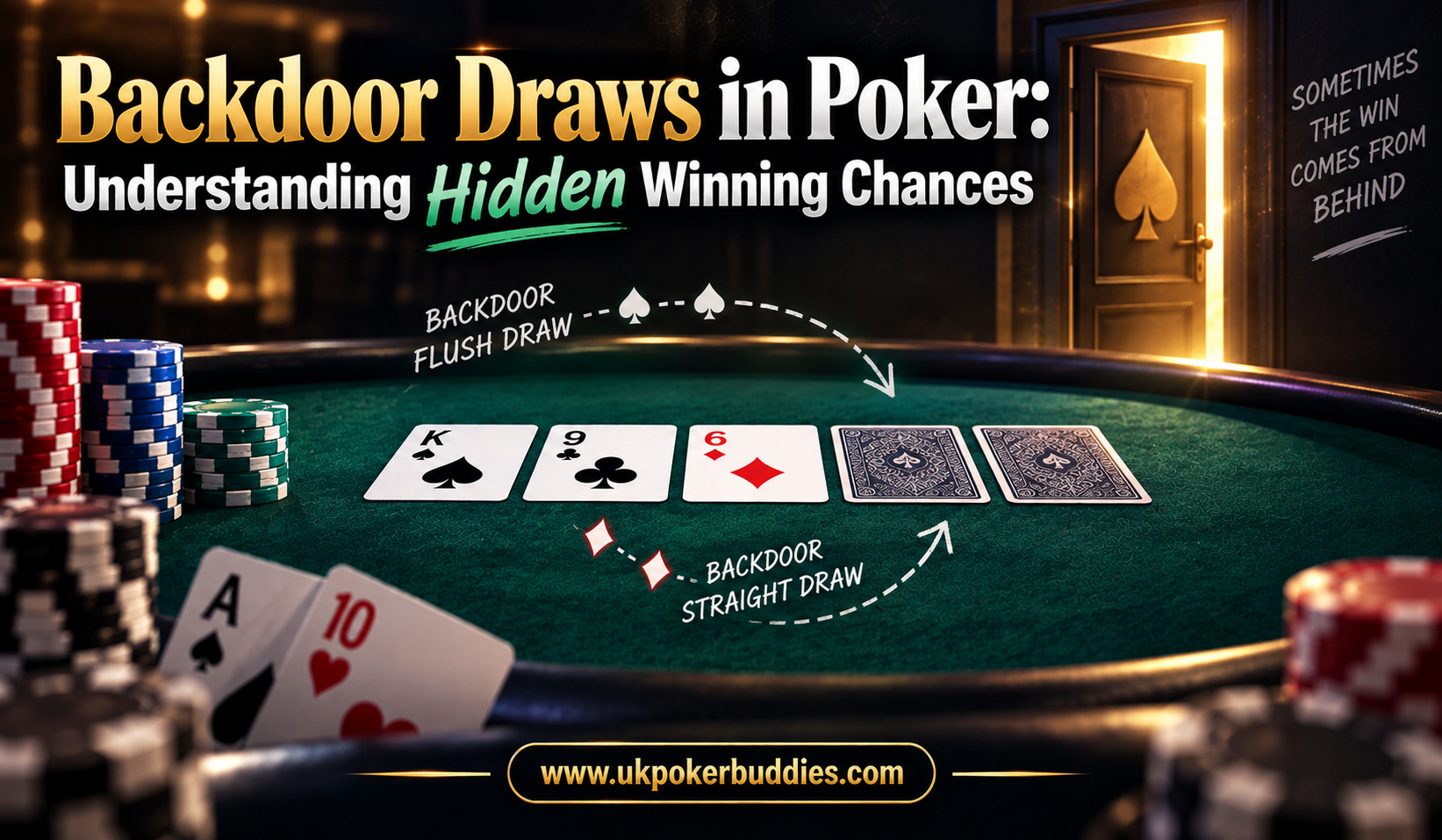
Poker is often a game of incomplete information. You may not have a strong hand on the flop, but certain combinations of cards can give you a chance to improve significantly on the turn and river. One of these less obvious opportunities is a backdoor draw in poker.
Backdoor draws are easy to overlook because they usually require two specific cards to arrive on the remaining streets. Unlike a normal flush draw or straight draw, you do not have an immediate four-card combination after the flop.
Understanding backdoor draws can help you recognize additional possibilities, evaluate your equity more accurately, and make better decisions when choosing whether to bet, call, or continue with a marginal hand.
What Is a Backdoor Draw in Poker?
A backdoor draw is a drawing possibility that requires the right card on both the turn and river to complete.
For example, suppose you hold:
A♠ 7♠
and the flop comes:
K♦ 8♠ 2♣
You do not have a normal flush draw because only two spades are currently available between your hole cards and the board. However, if both the turn and river are spades, you can complete a flush.
That is a backdoor flush draw.
The important point is that you need two consecutive favorable cards rather than one.
Backdoor Flush Draws
Backdoor flush draws are among the easiest examples to understand.
Imagine your hand is:
Q♥ 6♥
and the flop is:
A♣ 9♥ 3♦
You currently have only three hearts available between your hand and the board. If the turn and river both come hearts, you can make a flush.
Because two more hearts are required, this is a backdoor flush possibility rather than a standard flush draw.
The chance of completing it is much lower than having a regular four-card flush draw, but it can still add useful equity to your hand.
Backdoor Straight Draws
Backdoor straight draws work in a similar way, although they can be slightly more complicated.
Suppose you hold:
J♣ 8♦
and the flop comes:
A♠ 5♥ 3♣
You do not currently have a conventional straight draw. However, certain combinations of turn and river cards can create a straight.
Backdoor straight possibilities are especially important when your hole cards and the flop are somewhat connected.
A hand that looks like a complete miss may therefore have more potential than it initially appears to have.
Why Backdoor Draws Matter
A backdoor draw may seem insignificant because the probability of completing it is relatively small.
However, poker decisions are based on more than just immediate hand strength.
A backdoor draw can provide:
- Additional ways to improve
- Extra equity against an opponent’s range
- Better bluffing opportunities
- More favorable turn cards
- Additional semi-bluff possibilities on later streets
These small advantages can become meaningful when combined with position, fold equity, and a strong overall strategy.
Backdoor Draws and Poker Equity
Equity represents your expected share of the pot based on the possible outcomes.
When you have a backdoor draw, your hand may have more equity than it appears to have at first glance.
For example, a weak pair with a backdoor flush possibility may have several ways to improve.
You should not treat a backdoor draw as if it were a regular draw, though. The probability of completing it is much smaller because both remaining community cards need to cooperate.
The important lesson is that backdoor possibilities should be included in your overall assessment without being overvalued.
Backdoor Draws and Position
Position can make backdoor draws more useful.
When you are acting later in the betting round, you have more information about what your opponent has done.
If your opponent checks, you may have an opportunity to bet and take down the pot immediately. If you are called, certain turn cards may improve your hand or create additional opportunities.
Position also gives you more control over how aggressively you pursue marginal possibilities.
Out of position, continuing with a weak backdoor draw can be more difficult because you may face pressure on later streets.
Backdoor Draws and Bluffing
Backdoor draws can be valuable when constructing a balanced bluffing strategy.
Suppose you have a hand that currently has little showdown value but contains a backdoor flush or straight possibility.
You might choose to make a flop bet. If you are called and the turn creates a stronger draw, you can continue applying pressure.
This gives your bluff multiple ways to succeed.
You may win because your opponent folds, or you may improve on the turn and continue with a stronger hand.
This is one reason backdoor draws can make certain weak hands more attractive as bluffing candidates.
Backdoor Draws and Semi-Bluffs
A semi-bluff occurs when you bet with a hand that is not currently strong enough to win consistently but has a reasonable chance of improving.
Backdoor draws can sometimes become part of this strategy.
For example, you might have a hand with a backdoor flush possibility and additional overcard or pair potential.
If you bet the flop and the turn produces a useful card, your hand may develop into a much stronger drawing or made hand.
This makes the original flop decision more flexible.
Choosing Hands With Backdoor Potential
Not every backdoor draw deserves attention.
Good backdoor opportunities often involve cards that provide additional ways to improve.
For example, holding a high card alongside a backdoor flush possibility can be more useful than holding two completely disconnected low cards.
A hand can become particularly interesting when it combines:
- A backdoor flush draw
- A backdoor straight draw
- Overcard potential
- Pair-making possibilities
The more ways your hand can improve, the more attractive it may become in the right situation.
Backdoor Draws and Board Texture
The flop itself has a major impact on backdoor possibilities.
A relatively disconnected flop may still create backdoor flush or straight opportunities.
For example, a flop containing two cards of one suit can provide players with potential backdoor flush combinations depending on their hole cards.
Connected flops can also create unusual straight possibilities.
Understanding the board texture allows you to identify opportunities that are not immediately obvious.
Backdoor Draws and Bet Sizing
Because backdoor draws are relatively weak on the flop, you should be careful about investing too much money simply because you have one.
A backdoor possibility alone is rarely a reason to make a large call.
Your decision should consider the pot odds, position, opponent’s range, implied value, and whether you have other ways to improve.
When betting as a bluff, smaller sizes may sometimes be appropriate depending on the board and strategy.
The important principle is to avoid turning a small additional equity advantage into an unnecessarily expensive decision.
Common Mistakes With Backdoor Draws
One of the biggest mistakes is overvaluing backdoor draws.
Having a possibility of making a flush does not mean you should automatically continue.
Remember that two cards need to arrive in the correct way.
Another mistake is ignoring other parts of your hand.
A backdoor draw can be much more useful when combined with overcards, a pair draw, or other potential improvements.
Players also sometimes forget to reassess the situation after the turn. Once the turn arrives, your backdoor draw may disappear, become a normal draw, or develop into a made hand.
How to Use Backdoor Draws More Effectively
When you identify a possible backdoor draw, ask a few questions before continuing.
How many cards do I need to complete the draw?
Do I have additional ways to improve?
What is my opponent’s likely range?
Am I in position?
What happens if I am called on the flop?
Can favorable turn cards give me additional opportunities?
These questions help put the backdoor draw into the larger context of the hand.
Instead of treating it as a reason to continue automatically, consider it one factor in your overall decision.
Backdoor Draws Can Improve Weak Hands
One of the most interesting aspects of backdoor draws is that they can make seemingly weak hands playable in certain situations.
A hand that has little immediate value may still have multiple paths toward improvement.
For example, a hand could have two overcards, a backdoor flush possibility, and a backdoor straight possibility. Although it may currently be behind, it has more potential than a completely disconnected hand.
This additional potential can influence whether betting or continuing is profitable.
Final Thoughts
Backdoor draws in poker are hidden opportunities that require both the turn and river to cooperate. They are weaker than standard draws, but they can provide valuable additional equity and create useful opportunities for bluffing and improving your hand.
The key is to avoid overestimating them. A backdoor draw should be considered alongside position, pot odds, board texture, opponent range, and other ways your hand can improve.
Once you learn to spot backdoor flush and straight possibilities quickly, you can evaluate marginal hands more accurately. You may begin to recognize that a flop that appears to offer very little can sometimes provide several paths toward a stronger hand.
In poker, small pieces of additional equity can matter. Learning how to identify and use backdoor draws is another step toward making more informed decisions and extracting greater value from every situation.