

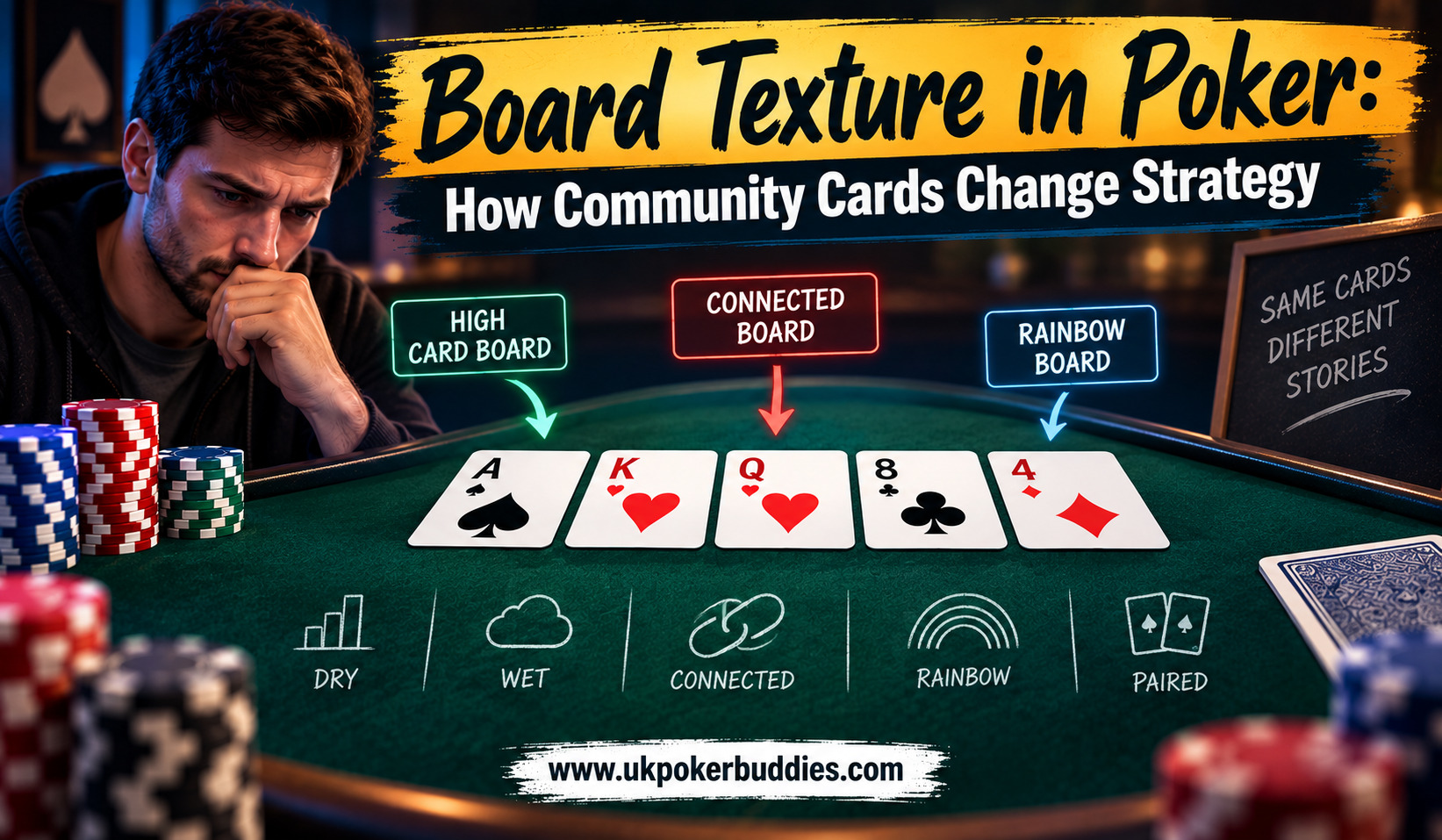
In poker, your hole cards are only one part of the decision-making process. The community cards can completely change how strong your hand is, what your opponent might hold, and how you should approach the pot. This is why understanding board texture in poker is an important skill for both beginners and experienced players.
Board texture refers to the overall characteristics of the community cards, including whether they are connected, suited, paired, or relatively disconnected. Different board textures create different possibilities for made hands and draws, which means your betting strategy should change accordingly.
Learning how to read the board can help you make better decisions, identify potential draws, choose appropriate bet sizes, and understand how a flop, turn, or river affects your opponent’s range.
What Is Board Texture in Poker?
Board texture describes how the community cards interact with possible poker hands.
For example, consider a flop such as:
K♣ 7♦ 2♠
This is a relatively dry board. The cards are not closely connected, and there is no immediate flush draw.
Now consider:
J♥ 10♥ 9♣
This is a much more connected board. Players can have straight draws, pairs, two pairs, and other strong combinations.
These two boards require very different strategies.
The first board usually creates fewer immediate drawing possibilities, while the second can create significant pressure because many hands can improve.
Why Board Texture Matters
Board texture affects almost every decision after the flop.
It can influence:
- Which player is more likely to have connected with the board
- How many drawing hands are possible
- Whether a bet is likely to get called
- How valuable a pair or overpair is
- Which hands should be used for bluffing
- How much protection a strong hand needs
Instead of looking only at your own cards, you need to consider how the community cards interact with your opponent’s possible range.
Dry Boards
A dry board contains cards that are relatively disconnected and offer limited drawing opportunities.
For example:
A♠ 8♦ 3♣
There is no obvious straight draw and no immediate flush draw.
On boards like this, strong made hands can often remain relatively safe. If you hold an ace, you may be ahead of many hands your opponent can have.
Dry boards can also be useful for continuation betting because opponents may have missed the flop with a large portion of their range.
However, this does not mean you should automatically bet every dry flop. Your position, pre-flop action, opponent, and range still matter.
Wet or Connected Boards
A wet board contains cards that create many possible draws and strong combinations.
For example:
Q♠ J♠ 10♦
This board can produce straight draws, flush draws, pairs, two pairs, and made straights.
When the board is highly connected, hand strength becomes more complicated.
A single pair may not be particularly comfortable, while a strong drawing hand may have considerable potential.
Wet boards often require more careful decisions because the turn and river can dramatically change the situation.
Paired Boards
A paired board occurs when two community cards have the same rank.
For example:
K♠ 8♦ 8♣
Paired boards change the combinations available to both players.
A player holding a king has a strong-looking hand, but the paired eight creates additional possibilities. A player holding an eight already has trips.
Paired boards can also influence bluffing because some opponents may have difficulty continuing without a strong hand.
When the board becomes paired, think about which hands benefit from the new card and how it changes your opponent’s range.
Monotone Boards
A monotone board contains three cards of the same suit.
For example:
A♥ 9♥ 4♥
This creates an immediate flush possibility.
On monotone boards, players need to pay close attention to suits. A pair may still have value, but the possibility of a flush changes how comfortable that hand is.
The exact strategy depends on the situation and the cards you hold.
Holding a heart can be particularly important because it may reduce the number of flush combinations your opponent can have.
Two-Tone Boards
A two-tone board contains two cards of one suit and another card of a different suit.
For example:
K♠ 8♠ 3♦
There is a possible flush draw, but a completed flush is not yet available.
This type of board creates more drawing possibilities than a completely dry board.
Players with strong hands may want to bet to get value while also charging drawing hands. Meanwhile, players holding flush draws can have opportunities to continue aggressively.
Straight-Heavy Boards
Connected cards can create significant straight possibilities.
Consider:
10♣ 9♦ 8♠
Many hands can have straight draws or already-made straights.
When the board is straight-heavy, you need to consider how the cards interact with your opponent’s range.
A hand that looks strong on a disconnected flop may become much weaker when several connected cards appear on later streets.
This is why board reading must continue throughout the entire hand.
How the Turn Changes Board Texture
The turn is where board texture can change dramatically.
Imagine the flop is:
K♣ 7♦ 2♠
A turn card such as 3♥ keeps the board relatively dry.
But a turn card such as Q♠ introduces more connections and may create additional draws.
A card such as 8♠ can also change the relationship between the community cards and your opponent’s possible hands.
The turn should therefore be treated as new information rather than simply another card.
Ask yourself how the new card affects:
- Your hand
- Your opponent’s range
- Available draws
- Made hands
- Betting opportunities
- Possible future river cards
River Cards Can Complete or Destroy Draws
The river is the final community card, so it can completely change the value of previous decisions.
Suppose the flop and turn create a possible flush draw. If the river completes that flush, hands that were previously strong may suddenly become much less valuable.
The opposite can also happen.
A river card that misses most draws may strengthen your relative position and make a value bet more attractive.
This is why players should not decide their river strategy based only on what happened on the flop.
The final board needs to be evaluated as a complete picture.
Board Texture and Bet Sizing
Board texture can influence how much you should bet.
On dry boards, smaller bets can often accomplish their purpose because there are fewer drawing hands that need to be discouraged.
On wet boards, larger bets may sometimes be appropriate because there are more possible draws and strong hands that can continue.
However, there is no universal bet size for every board.
Your bet should depend on your range, your opponent’s range, stack sizes, position, and the purpose of your bet.
Board Texture and Bluffing
Board texture is also important when deciding whether to bluff.
Some boards are better for bluffing because they give you credible strong hands and put pressure on your opponent’s weaker holdings.
For example, a card that completes a major draw may allow you to represent a strong hand convincingly.
However, bluffing simply because the board looks dangerous is a common mistake.
You should consider whether the board actually favors your range and whether your opponent has enough hands that can fold.
A good bluff tells a believable story from the beginning of the hand.
Board Texture and Value Betting
Strong hands also need to be evaluated according to the board.
Suppose you have top pair on a dry board. Your hand may be strong enough to make multiple value bets.
On a highly connected board, however, the same top pair may be much more vulnerable.
Before betting for value, consider which weaker hands can realistically call.
If the board contains many possible draws, you may also need to think about whether those draws have completed.
Common Board Texture Mistakes
One common mistake is treating every flop the same.
Players may use the same betting strategy regardless of whether the board is dry, connected, paired, or suited.
Another mistake is focusing too heavily on your own hand.
Having an overpair does not automatically mean you should keep betting. You need to consider how the board interacts with your opponent’s range.
Players also sometimes ignore how the board changes from street to street.
A safe-looking flop can become dangerous on the turn, while a threatening flop can become much safer after a blank turn and river.
How to Improve Your Board Reading
A simple way to improve is to pause after every community card and ask what has changed.
Think about:
What hands improved?
What draws appeared or disappeared?
Which hands became weaker?
Does this card favor my range or my opponent’s range?
How should my betting strategy change?
Practicing these questions away from the table can make board texture easier to recognize during real hands.
You can also review previous poker hands and identify exactly when the board changed the range of possible hands.
Final Thoughts
Understanding board texture in poker is essential because community cards determine how different hands interact with one another. A dry flop, connected flop, paired board, monotone board, and straight-heavy board can all require very different strategies.
The strongest poker decisions come from looking beyond your own hole cards. Consider the entire board, your opponent’s likely range, the draws available, and how each new card changes the situation.
Remember that board texture is not static. The flop creates one situation, the turn can change it, and the river provides the final information.
Once you learn to recognize these changes, you can make better decisions about betting, calling, raising, bluffing, and value betting. Instead of reacting to community cards randomly, you can use them to build a more accurate picture of the hand and make more informed poker decisions.