

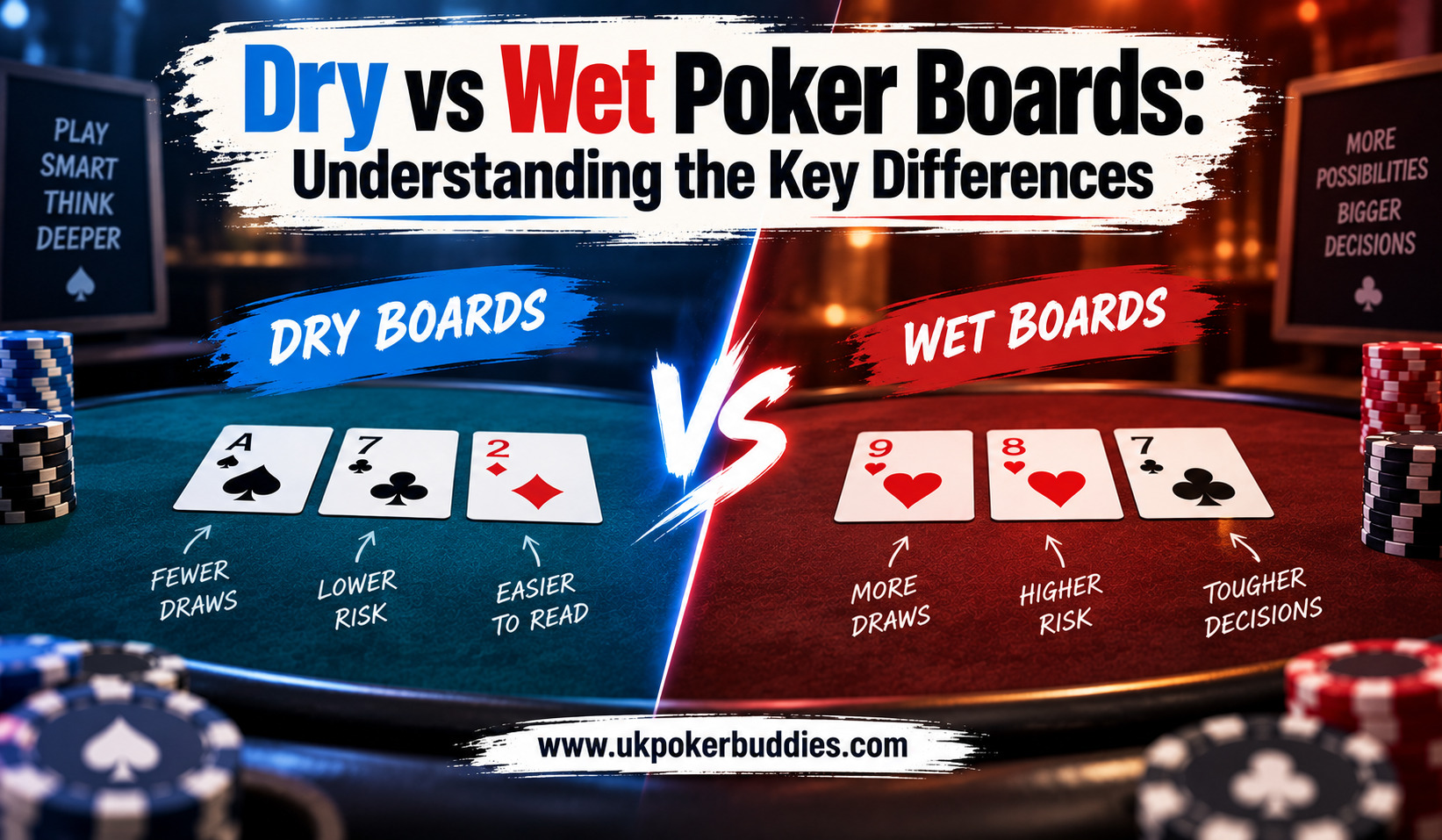
Understanding the community cards is one of the most important parts of making good poker decisions. Your hole cards may look strong, but the flop, turn, and river can dramatically change how valuable your hand is. One of the easiest ways to start reading community cards is by learning the difference between dry and wet poker boards.
A dry board offers relatively few drawing possibilities. A wet board, on the other hand, creates several ways for players to improve their hands. These differences affect everything from continuation betting and bluffing to value betting and bet sizing.
Learning how to recognize board texture can help you understand what your opponent may have and choose a more appropriate strategy throughout the hand.
What Is a Dry Poker Board?
A dry poker board is a community-card combination that offers relatively few possibilities for strong draws.
Consider a flop such as:
A♣ 7♦ 2♠
The cards are disconnected, and all three are different suits. There is no immediate flush draw and very few straight possibilities.
Another example would be:
K♦ 8♣ 3♠
There are limited ways for players to connect strongly with this board.
Dry boards generally produce less immediate uncertainty because fewer drawing combinations are available.
What Is a Wet Poker Board?
A wet poker board is a board with several possible draws and connections.
For example:
J♥ 10♥ 9♣
This board creates numerous possibilities. Players can have straight draws, flush draws, pairs, two pairs, and made straights.
Another example is:
8♠ 7♠ 6♦
This board is highly connected and can interact with many starting hands.
Wet boards can therefore create more complicated decisions because the turn and river may significantly change hand strength.
Dry vs Wet Boards: The Main Difference
The simplest distinction is the number of ways players can improve.
On a dry board, there are usually fewer meaningful draws. On a wet board, there are many possible draws and combinations.
This affects how you should approach betting.
A dry board may allow more controlled betting because there are fewer hands that can improve dramatically.
A wet board often requires greater caution because a seemingly strong hand can quickly become vulnerable.
However, board texture alone should never determine your decision. Your position, starting hand, opponent’s range, stack sizes, and previous betting action also matter.
Examples of Dry Boards
Some common dry board characteristics include:
- Cards that are far apart in rank
- Three different suits
- Few straight possibilities
- No immediate flush draw
- Limited combinations of strong made hands
For example:
Q♣ 5♦ 2♠
This board is relatively dry.
A player holding a queen may have a strong top pair, while many opponents may have completely missed the flop.
Another example is:
A♦ 9♣ 4♠
An ace can connect strongly with this board, but there are still relatively few immediate draws.
Examples of Wet Boards
Wet boards often have cards that are close together or contain multiple cards of the same suit.
Examples include:
10♠ 9♠ 8♦
Q♥ J♥ 7♣
9♣ 8♦ 7♣
These boards create more potential combinations.
Players may have open-ended straight draws, flush draws, pair-plus-draw hands, two pairs, sets, or made straights.
Because so many hands can continue, betting decisions become more complicated.
How Dry Boards Affect Betting
Dry boards can be favorable for continuation betting.
Suppose you raised before the flop and your opponent called. The flop comes:
K♣ 7♦ 2♠
If you have a range advantage, a continuation bet may put pressure on many hands that missed.
Because there are fewer draws, your opponent has fewer strong reasons to continue.
Small or moderate bets can sometimes be effective on these boards because you do not necessarily need to make a large bet to protect your hand.
Still, you should avoid automatically continuation betting every dry flop. Your opponent may connect with certain boards more often than expected, and some hands can still have strong backdoor possibilities.
How Wet Boards Affect Betting
Wet boards generally demand more attention to hand protection and drawing possibilities.
Imagine holding an overpair on:
J♠ 10♠ 8♦
Your hand may currently be ahead, but there are many ways your opponent can have a strong draw or made hand.
A bet can accomplish several things. It may extract value from weaker hands, charge draws, and prevent opponents from seeing future cards cheaply.
However, the same board also means you need to be prepared for stronger responses.
A raise on a wet board can represent a much stronger range than a raise on a completely dry board.
Bet Sizing on Dry Boards
Bet sizing should always depend on the situation, but dry boards often allow smaller bets.
If there are few draws to worry about, you may not need to invest a large amount to protect your hand.
Smaller bets can also keep weaker hands in the pot.
For example, if you have top pair on a dry board, a modest value bet may encourage calls from weaker pairs and other marginal hands.
The exact size should depend on your strategy and the range you believe your opponent has.
Bet Sizing on Wet Boards
Wet boards can justify different sizing because there are more potential draws.
A stronger hand may want to charge drawing hands by making a meaningful bet.
For example, holding a set on a connected, two-tone board can give your opponent many possible draws. Betting too small may allow those draws to continue cheaply.
At the same time, large bets can sometimes force weaker hands out of the pot.
The goal is to find a size that balances value, protection, and range interaction rather than simply betting bigger because the board looks dangerous.
Dry Boards and Bluffing
Dry boards can create useful bluffing opportunities.
If the board does not offer many draws, your opponent may have fewer strong hands with which to continue.
For example:
A♠ 7♦ 2♣
A player who did not connect with the ace may have very little to work with.
However, you should still consider your opponent’s range. A dry board is not automatically a good bluffing board.
Your position and pre-flop action can determine which player has the stronger range.
Wet Boards and Bluffing
Wet boards can also be good for bluffing, but the reasons are different.
A wet board provides many possible strong hands and draws that you can represent.
Suppose the board is:
Q♠ J♠ 10♦
If later cards complete a straight or flush possibility, you may have opportunities to represent those combinations.
But wet boards can also be dangerous for bluffing because your opponent has more hands capable of continuing.
A good bluff should therefore consider how the board changes both ranges rather than simply relying on the board looking scary.
Value Betting on Dry vs Wet Boards
The strength of a made hand can change depending on board texture.
Top pair on a dry board may be a comfortable value-betting hand because fewer draws threaten it.
On a wet board, top pair may still be ahead but can be much more vulnerable.
This affects how aggressively you should build the pot.
Strong hands can often extract value on both board types, but the range of hands that can call and the potential ways your opponent can improve should influence your decisions.
Turn Cards Can Change Everything
A board that starts dry can become wet on the turn.
Imagine the flop is:
K♣ 7♦ 2♠
Then the turn comes:
8♠
Suddenly, additional straight and flush possibilities may appear.
Likewise, a wet flop can become considerably safer if the turn is a disconnected card that does not complete or create important draws.
This is why board texture should be reassessed after every community card.
Do not assume that a board remains dry or wet throughout the entire hand.
Common Mistakes Players Make
One common mistake is treating dry boards as completely safe.
Even a dry board can contain strong combinations, and future cards can create new draws.
Another mistake is automatically betting large on wet boards.
A dangerous-looking board does not always require a huge bet. Your opponent’s range and the purpose of your bet remain important.
Players also sometimes ignore position. The same board can require different strategies depending on whether you act first or last.
Finally, focusing only on your own hand can lead to poor decisions. Board texture should always be analyzed alongside your opponent’s possible holdings.
How to Improve Your Board-Reading Skills
The best way to improve is to practice identifying board texture quickly.
Whenever you see a flop, ask yourself:
Is the board connected?
Are there multiple cards of the same suit?
What straight and flush draws are possible?
Which strong hands can my opponent have?
How could the turn change the situation?
Over time, these questions become automatic.
You can also review hands after playing and categorize each flop as dry, moderately connected, or wet. Then consider whether your betting decisions matched the texture.
Final Thoughts
Understanding dry vs wet poker boards gives you a simple framework for making better post-flop decisions. Dry boards generally create fewer immediate drawing possibilities, while wet boards provide more opportunities for players to make strong hands or improve on later streets.
This difference can influence continuation bets, value bets, bluffs, check-raises, and bet sizing.
The key is not to memorize a fixed strategy for every board. Instead, learn to recognize how community cards affect possible ranges and future outcomes.
A dry board may allow more controlled aggression, while a wet board often demands greater awareness of draws and changing hand strength. Once you become comfortable identifying these differences, you can adjust your strategy more effectively and make more informed poker decisions.