

Rules and Game Format Explained for Beginners
Short Deck Poker has emerged as an increasingly interesting variation of Texas Hold’em, particularly among players looking for faster action and stronger starting hands. The game keeps the familiar community-card structure of Hold’em but changes one fundamental element: cards from the lower end of the deck are removed.
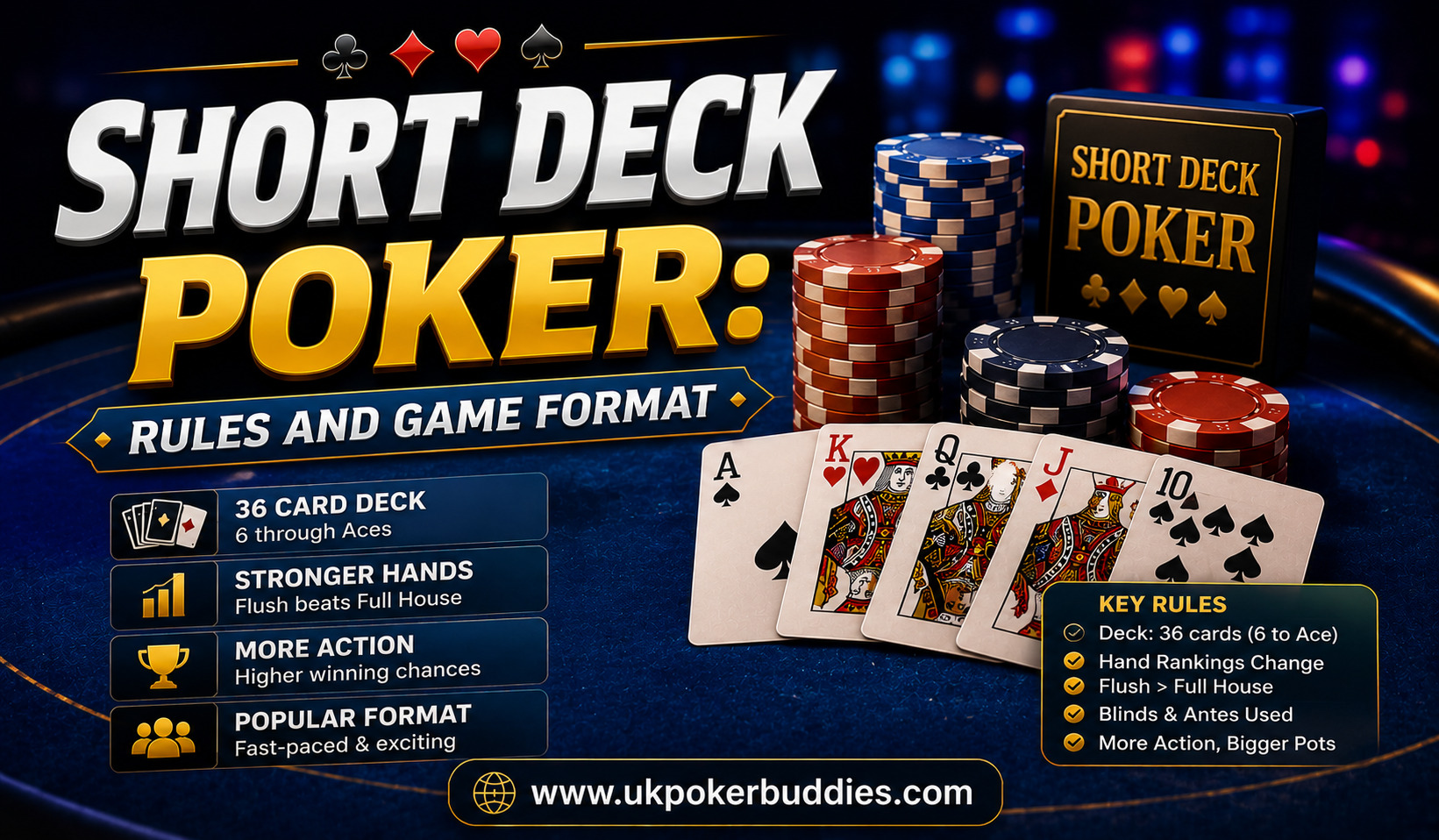
Also known as Six Plus Hold’em, Short Deck Poker is generally played with a 36-card deck instead of the traditional 52-card deck. Cards from 2 through 5 are removed, leaving cards from 6 through ace. This smaller deck significantly changes the probability of different hands and creates more frequent premium combinations.
The format has gained attention because it combines familiar poker rules with a faster, more aggressive style. However, beginners should not assume that standard Hold’em strategy can simply be transferred to Short Deck. Hand rankings, drawing probabilities and starting-hand values can all change.
What Is Short Deck Poker?
Short Deck Poker is a community-card poker game based largely on Texas Hold’em. Each player receives two private hole cards, while five community cards are placed face-up on the table during the flop, turn and river.
The major difference is the deck. Instead of using all 52 cards, Short Deck generally removes all cards from 2 through 5. This leaves a 36-card deck containing 6, 7, 8, 9, 10, jack, queen, king and ace in all four suits.
Because there are fewer cards available, players have a higher chance of connecting with the board. Straights, flushes and other strong combinations become more common, changing the way players evaluate hands.
Although the format is often called Six Plus Hold’em, exact rules can vary between poker rooms and platforms. Players should always check the specific rules before joining a game.
How a Short Deck Poker Hand Works
The basic structure will look familiar to anyone who has played Texas Hold’em.
Players receive two private cards at the beginning of the hand. Betting takes place before the community cards are revealed, creating the pre-flop round.
Three community cards are then dealt for the flop, followed by a fourth card on the turn and a fifth card on the river. Betting rounds occur between these stages.
The objective remains the same: make the strongest possible five-card poker hand or win the pot by causing all opponents to fold.
The smaller deck, however, changes the mathematical environment. A hand that would be considered relatively unusual in traditional Hold’em may occur much more frequently in Short Deck.
Why Are the 2s, 3s, 4s and 5s Removed?
Removing the lower cards is what gives Short Deck its name and distinctive character.
With cards 2 through 5 removed, the lowest available card is the 6. This means the sequence of ranks begins at 6 and continues through ace.
The change reduces the number of cards in the deck from 52 to 36. As a result, there are fewer possible card combinations, and players are more likely to receive connected cards or interact with the community board.
This has a direct effect on strategy. Players must rethink traditional assumptions about the relative strength of different hands because the probability of making certain combinations has changed.
Short Deck Poker Hand Rankings
One of the most important things beginners need to understand is that hand rankings can differ from standard Texas Hold’em.
In many common Short Deck formats, a flush ranks above a full house. This is different from traditional Hold’em, where a full house normally beats a flush.
The reason is mathematical: with fewer cards in the deck, completing a flush becomes less frequent.
A commonly used ranking is:
| Rank | Hand | Example |
| 1 | Royal Flush | A-K-Q-J-10 of the same suit |
| 2 | Straight Flush | 9-8-7-6-5 of the same suit |
| 3 | Four of a Kind | Four queens |
| 4 | Flush | Five cards of the same suit |
| 5 | Full House | Three kings and two 9s |
| 6 | Straight | 10-9-8-7-6 |
| 7 | Three of a Kind | Three jacks |
| 8 | Two Pair | Two aces and two 8s |
| 9 | One Pair | Two tens |
| 10 | High Card | Highest available card |
However, not every Short Deck game uses exactly the same ranking system. Some versions have additional variations, particularly concerning the lowest possible straight.
The Special Ace-to-Six Straight
Another important rule in many Short Deck formats involves the ace.
Because the deck begins with the 6, some versions allow the ace to function as a low card when creating a straight. Under this rule, A-6-7-8-9 can form a straight.
This is sometimes referred to as the “wheel” or a low ace straight in Short Deck.
Players should check the table rules because this feature is not universal across every version of the game.
How Betting Works
Short Deck Poker generally follows the betting structure of Texas Hold’em. Depending on the game, it can be played with different formats, including no-limit and pot-limit variations.
The pre-flop round begins after the blinds or other required opening bets are posted. Players can then fold, call or raise.
After the flop, turn and river, additional betting rounds occur. Because the deck contains fewer cards and players frequently have strong draws, betting can become more aggressive.
The main stages are:
- Pre-flop: Players receive two private cards and the first betting round takes place.
- Flop: Three community cards are revealed, followed by another betting round.
- Turn: A fourth community card is dealt.
- River: The fifth and final community card appears before the last betting round.
The exact betting rules depend on the format being played.
Why Short Deck Creates More Action
The smaller deck increases the likelihood of players connecting with their cards. This creates more strong draws and made hands.
For example, connected cards are more common because the low ranks have been removed. Players can also find themselves holding cards that create multiple straight or flush possibilities.
This can lead to larger pots and more betting pressure. A hand that might be played cautiously in standard Hold’em could become much more active in Short Deck because the underlying probabilities are different.
The game can therefore feel faster even when the betting structure remains similar.
Starting Hands in Short Deck Poker
Starting-hand selection remains important, but traditional Hold’em rankings should not be copied directly.
Pocket pairs remain valuable, particularly high pairs, but the increased frequency of strong drawing combinations means connected cards can also be attractive.
Suited hands and cards that work well together can have significant potential. A hand with strong connectivity may be able to form straights, flushes or other combinations across the later streets.
Beginners should focus on how the two hole cards interact rather than simply looking for the highest individual card.
Important factors to consider include:
- Pair strength and the possibility of making a set.
- Connectivity between the hole cards.
- Suited combinations and flush potential.
- Position and the actions of opponents.
Short Deck vs Texas Hold’em
The two games share the same basic community-card structure, but the deck changes almost everything about the mathematics.
| Feature | Short Deck Poker | Texas Hold’em |
| Deck size | Usually 36 cards | 52 cards |
| Removed cards | 2, 3, 4 and 5 | None |
| Private cards | 2 | 2 |
| Community cards | 5 | 5 |
| Flush ranking | Often above full house | Below full house |
| Common nickname | Six Plus Hold’em | Hold’em |
| Action | Often more aggressive | Varies by table |
This comparison highlights why players moving from Hold’em to Short Deck need to learn the new probabilities rather than simply copying familiar strategies.
Is Short Deck Poker More Difficult?
The basic rules are easy to understand if a player already knows Texas Hold’em. However, strategic adjustment can take time.
Players need to learn the new hand rankings, revised probabilities and different values of starting hands. Drawing situations also require careful consideration because the smaller deck changes the number of available outs.
For experienced Hold’em players, Short Deck can be learned relatively quickly but may require significant adjustment to develop a strong strategy.
Why Players Are Interested in Short Deck Poker
The main attraction is the pace and intensity created by the smaller deck. More connected cards and stronger draws can result in frequent betting action.
The format also offers experienced poker players something different without requiring them to learn an entirely new style of card game. The basic rules remain recognizable, while the changed deck creates a new strategic environment.
This combination has helped Short Deck become an increasingly discussed variation in both live and online poker circles.
Conclusion
Short Deck Poker takes the familiar foundation of Texas Hold’em and changes it by removing the 2s, 3s, 4s and 5s. The resulting 36-card deck creates a different mathematical environment, with more connected cards, stronger drawing possibilities and frequent high-action situations.
The most important adjustments for newcomers are learning the revised hand rankings, understanding the ace-low straight rule where applicable and recognizing that standard Hold’em probabilities do not automatically apply.
While the format can be faster and more exciting, it still involves uncertainty and financial risk when played for money. Understanding the rules, checking the specific table format and playing responsibly are essential for anyone interested in exploring Short Deck Poker.
Frequently Asked Questions
What is Short Deck Poker?
Short Deck Poker is a variation of Texas Hold’em that normally uses a 36-card deck. Cards 2 through 5 are removed, leaving cards from 6 through ace.
Is Short Deck Poker the same as Six Plus Hold’em?
Yes. Six Plus Hold’em is a common name for Short Deck Poker because the lowest card in the deck is normally the 6.
How many cards does each player receive?
Players normally receive two private hole cards, just as in Texas Hold’em.
Is a flush stronger than a full house in Short Deck?
In many common Short Deck rules, yes. The flush is ranked above a full house because flushes are less frequent in the reduced deck. However, players should check the rules of the specific game.
Can an ace be used as a low card?
In many versions, an ace can participate in a 6-7-8-9-A straight. The exact rule depends on the game.